
Sworn testimony and court records describe false credentials, repainted machinery, pressured technicians and diverted public money.
Ecuador’s Progen scandal began with a genuine national emergency. During the electricity crisis of 2024, blackouts stretched as long as 14 hours a day and the government urgently needed additional generating capacity.
What followed, according to criminal investigators in Ecuador and a federal lawsuit in Florida, was not simply a delayed or poorly managed public contract. It was an operation in which technical warnings were allegedly disregarded, documents were falsified, used generators were presented as new and millions of dollars left a company bank account without any clear connection to the projects.
The two contracts awarded to the Florida-based Progen Industries were supposed to provide 150 megawatts of thermal generation at Quevedo and El Salitral. Together, they were worth $149.1 million: $99.4 million for El Salitral and $49.7 million for Quevedo.
Celec, Ecuador’s state-owned electricity corporation, paid Progen $104.37 million as a 70% advance. Prosecutors now consider that amount the presumed loss to the state because the plants never entered operation. In the related U.S. civil case, Celec describes the amount paid as “nearly $110 million,” a rounded figure covering the money it is attempting to trace through Progen’s accounts.
Warnings appeared before the contracts were signed
The warning signs were not discovered only after the equipment reached Ecuador. Members of a four-person Celec technical committee said they found serious deficiencies while reviewing Progen’s preliminary proposal.
The company had not presented a letter from the engine manufacturer or an authorized distributor. Its documents contained inconsistent figures for fuel efficiency, making it impossible to determine whether the equipment met Celec’s minimum requirements. Progen also failed to provide a manufacturer’s certificate showing that the engines were new, built since 2020 and had zero operating hours.
Those doubts intensified after Resource Power Group, the authorized EMD engine distributor in Ecuador, warned officials that the EMD 20-645 model initially offered by Progen had stopped being manufactured for electrical generation in 2015. The distributor said it could not guarantee the condition of the engines or the availability of replacement parts.
Romel Llumiquinga, a former member of the committee and one of the defendants in Ecuador’s criminal case, testified that the technicians were summoned to a meeting at Celec headquarters on June 28, 2024. They were allegedly required to leave their cellphones outside and were pressured to remove their observations from the report.
The committee refused and requested that any such order be issued in writing. Llumiquinga said the acting manager of Celec’s Termopichincha unit later warned the technicians that instructions had come from then-Celec general manager Fabián Calero to dismiss them unless they issued a recommendation allowing the process to continue.
Despite the unresolved questions, the contracts were signed on August 2, 2024.
Experience allegedly manufactured on paper
- Wade Manning, a Progen vice president and the brother of company chief executive John Manning, has now provided sworn testimony in the Florida lawsuit.
Manning said Progen submitted four false experience certificates to create the appearance that it had successfully handled projects comparable to Quevedo and El Salitral. He also described a false certificate stating that the generators had zero hours of use and another claiming Progen was the exclusive manufacturer of their engines.
In reality, Manning said, the company had never carried out a project of similar size. Its previous experience consisted principally of supplying three generators in Texas that led to litigation and four units in Africa that produced customer complaints. Manning also acknowledged that he had no formal education or technical training in mechanics or energy, despite holding a senior engineering-related position.
Manning’s testimony did not come from a neutral outsider. He is a defendant in the Florida case and had fallen out with his brother after Progen stopped paying his $13,000 monthly salary. He resigned in March 2026 and said the company still owed him $65,000.
But significant portions of his account are supported by documents from Apollo Electric, the Houston company that sold equipment to Progen.
Used generators were given a new identity
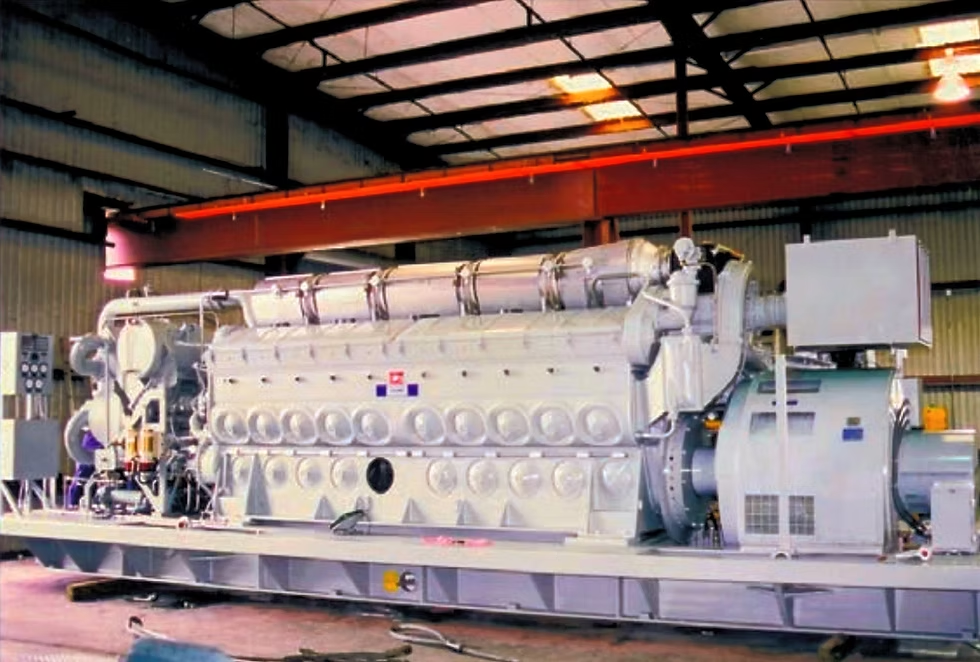
Apollo Electric’s president stated under penalty of perjury that Progen purchased 21 used EMD 20-710 generator sets on an “as-is, where-is” basis. Progen paid $425,000 per unit, or $8.925 million for the group.
The serial numbers showed when the engines had originally been manufactured. The equipment was not sold as new, rebuilt to a new-equipment standard or guaranteed to be suitable for the Ecuadorian contracts. Apollo’s declaration says the units were intended for Ecuador and were painted by an industrial contractor at the request of John and Wade Manning.
According to Wade Manning’s deposition, original manufacturer plates were removed and replaced with Progen labels. The generators were cleaned and painted, and identifying information was changed to create the appearance that Progen had manufactured them.
The Florida filing says Progen also acquired used equipment from an Indian supplier, removed components, scraped away original labels and installed replacement plates before shipping the machinery to Celec as new. Manning testified that the generators were never properly performance-tested and were unsuitable for the heavy fuel oil required under the contracts.
The discrepancy between the engine models in the records is significant but explainable. Progen’s preliminary offer referred to EMD 20-645 engines, while Apollo’s later sales records identify 21 used EMD 20-710 units. That indicates the equipment changed between the preliminary market study and the eventual purchases.
Llumiquinga said any alteration of brands, models, certificates or technical characteristics should have been reviewed by the officials involved in the later contracting stages. The unanswered question is how a proposal already carrying major technical warnings evolved into purchases of different used equipment without stopping the process.
Conflicting accounts of the committees’ role
Ecuadorian prosecutors say technical commissions recommended awarding the contracts even though Progen failed to satisfy technical, economic and legal requirements.
Llumiquinga disputes that description. He says his committee merely recommended inviting Progen to submit a formal offer, subject to full compliance with the specifications, and did not recommend awarding either contract or making Progen the exclusive bidder.
The statements may refer to different stages or different review bodies, but the distinction has not been resolved publicly. Determining which officials evaluated the final offer, approved changes in the equipment and authorized the payments will be central to assigning responsibility.
The money moved while the generators remained silent
Celec’s lawyers say bank records show that the account receiving Ecuador’s payments was systematically emptied through dozens of checks and wire transfers to people and entities in several countries. The account eventually reached a zero balance.
Wade Manning testified that most recipients of Celec’s money had performed no work connected to Quevedo or El Salitral. The federal filing also says several relatives of John Manning and Progen executive Andrew Williamson received salaries or other benefits from companies associated with the operation.
Manning described expensive real estate purchases made after Progen received Ecuador’s money. Andrew Williamson reportedly purchased a Florida residence for $2.85 million in cash, while John Manning and his wife were building another costly home. Celec alleges that public funds were also used for personal expenses and payments unrelated to the power plants.
The deposition created another evidentiary problem for investigators: Wade Manning admitted intentionally deleting private and group text messages exchanged with his brother, Williamson and other senior Progen executives.
Manning said he had no direct knowledge that bribes were paid to Ecuadorian officials. For now, the most concrete evidence concerns false documentation, the origin and alteration of the machinery, pressure inside Celec and the movement of the money. Investigators must still establish who within Ecuador approved each step and whether those decisions involved personal payments or other benefits.
Criminal charges and a U.S. racketeering lawsuit
Ecuador’s Prosecutor’s Office has charged 21 people with alleged embezzlement, including former Energy Minister Antonio Goncalves, former Celec manager Fabián Calero, other public officials and two representatives of companies involved in supplying the equipment. Prosecutors allege that normal contracting requirements were evaded to favor Progen even though its proposal did not meet the specifications.
In Florida, Celec is pursuing claims involving federal and state racketeering laws, fraud, conspiracy, deceptive business practices, conversion and fraudulent transfers. Progen has rejected the fraud allegations and argues that Ecuador is attempting to turn a contractual disagreement into a politically motivated case.
The Florida case remains in discovery, with Celec seeking bank and business records from recipients of Progen transfers. Discovery is scheduled to close in February 2027, followed by a jury trial term beginning August 2, 2027. Until then, subpoenas and testimony will continue tracing how an emergency program intended to end Ecuador’s blackouts produced two silent power plants, a depleted bank account and one of the country’s largest public corruption investigations.
“Ecuadorian prosecutors say technical commissions recommended awarding the contracts even though Progen failed to satisfy technical, economic and legal requirements.” Bribery, corruption and lies seem to be the theme here – from both sides. And what do the Ecuadorian people get in return? More blackouts.
Hello Progen is now entering into the meat of depositions now that will eventually serve to prove our case against CELEC.
The statements made for Wade that are supposed to represent his testimony are not true.
Although we (Progen) cannot afford to tell the truth in public right now due to the massive negative financial impact of the two failed contracts caused by CELEC that ended our contracts, it will be clearly substantiated in court that Progen attempted to deliver two new power plants to CELEC exactly per the terms and conditions of the contract.
Per the terms of the contract the working condition of the generator sets are perfectly described as being newly packaged using either new surplus unused and zero hour equipment. That is NOT new. The actual condition is stated in the contract – if you reference it ALL.
The contracts were only cancelled due to a combination of nefarious and incompetent delaying of the contracts by CELEC and others THST CELEC unsuccessfully tried to blame Progen for, NOT PROGEN. The contracts were NOT cancelled because of the false narrative being promoted that Progen delivers old and used generator sets. Progen delivers nothing but work in progress due to the gross delays of CELEC.
Proven by the facts that two sets of CELEC Directors (CEO’s) and two sets of Contract Administrators and two ministers of energy were fired during the contract period due to thier incompetence that prevented Progen’s ability to deliver the two power plants per the terms of the contract. That is a fact.
And the exact same situiation goes for another project for ERRSA.
These truths will eventually be proven in court and will destroy the Ecuadorian Governments public narrative that Progen delivered “old and used generator sets”. The contracts were cancelled by CELEC for lack of progress. Which they caused. ” old and used generator sets is con on the people to hide the truth about the gross negligence and nefarious actions of some CELEC government employees.
Many were fired for suspected corruption.
Progen believes the contracts were purposely canceled so that some corrupt government officials and some at CELEC could get any new contractors to pay them bribes to complete the projects. Indeed they tried, but failed to find another qualified contractor who could even possibly complete.
During the course of this lawsuit, Progen has uncovered a sizable number of clearly forged and fake documents that were fraudulently inserted throughout the contract that were not provided by Progen, but were provided by others that Progen believes worked with certian Corrupt CELEC government employees to purposely defraud Progen and cause the contracts to fail, that through the course of this lawsuit will be proven in public.
Progen attempted to deliver exactly what was called for in the contract that the government is now aggressively trying to hide from the public. Most likely for political reasons to shield the current administration responsibility to protect the public from and contracting companies from fraud.
Proof that corruption was pervasive thought CELEC and ERRESA exist in the hundreds of firings and current corruption investigations of mid and high level government employees that continued happing in now in real time. NOW that it is too late. Progen is not implying that the current administration knew about it or is responsible, as it talked about it getting rid of the rampant corruption of the last administration, but this has all happened under thier watch.
The current litigation of “old and used generators” is intended to hide the governments own responsibility for the corrupt and rogue personnel in the electrical sectors of CELEC and ERSSA. For which many are now on the run that colluded with others to defraud Progen and the people of Ecuador.
Progen never delivered anything because it was prevented from doing so by CELEC and the delays it caused.
Mark these words. – If Progen can continue to afford to fight legally, what the public will discover eventually will be proven is that is was CELEC that caused the contracts to cancel and that Progen was in the process of delivering exactly what Progen was supposed to as dictated by the contracts.
If the original CELEC director and his attorney of did not have the legal authority to include the equipment IT contracted for Peogen was not aware.
In fact it is Fabián Calero, who was the CEO who signed the contracts who is on the run from justice for corruption.
It will be 100% proven in federal court in US that narrative of “old and used generators” the the Ecuadorian Government is pushing – )conveniently AFTER the contracts had already been cancelled) in the media of the “old and used generator sets” is NOT what Peogen delivered.
The contracts weee delayed for many many months by CELEC from the very beginning after signing and for months thereafter, multiple modified contracts had to be completed as it forced to have to readjust its delivery and completions strategies over and over again forcing Peogen to have complete some the zero hour work on the engines and alternators at site to convert the units to zero hour HFO engines.
This truth is all back up by evidenced of the reasons for the multiple modifications to the original contract to count for all of the delay caused by CELEC.
What the facts will prove is Progen bent over backwards and went way beyond reason to try to continue with the project in spite of the delay delays caused by CELEC.
Summarizing it again, what Progen was forced to ship generator sets as wok in progress to return the internals of the engines to zero hour condition and HFO at the site. All because of CELEC delaying the contracts so long that Progen had to renegotiate the contracts time and time again and it’s the strategy for Deliveries. Progen singed toe high emergency contracts to deliver two power plants. Progen had 130 days to complete Salitral and 90 days on Quevedo. In addition to delaying legalizing the contracts which only required them being notarized, CELEC didn’t even bother itself to legalize the for 30 days after Peogen signed them.
Salitral required completion in a 120 days intellect didn’t even bother to come inspect the units for 65 days after signing the contract and then waited another two weeks to make the contractual payment, which devastated Progen’s ability to deliver on time. Instead of going to work to modify the contracta in good faith CELEC used back took weeks to eventually modify the contract after trying to hold Progen liable for late or lied on delay it caused.
In the 90 day delivery requirement for the QUEVEDO projected CELEC did not even bother itself to even come and inspected generator sets for that project for right at six months. And again tried to hold Pro responsible. Only to have to modify those contracts after six months after devastating Progen’s ability to deliver and again trying to put penalties on Progen for the delay delays until Progen legally forced CELEC to have to modify the contracts. Then CELEC default of those terms to continue with the Quevedo project and again try to blame preaching for those delays.
So Progen shipped work in progress to be completed at the sites because CELEC delayed the contracts so badly.
Finally CELEC hires a third director of CELEC director and and contract admiratora as well as a third minister of energy since the projects began, that promised Progen it would modify the contracts to allow for the delays caused by CELEC once again thar cuawd sister delays to the project completions. But this new set of managers acted as if they had little clue what happened during the last two contract modifications or why and took forever to review as they continued to impose late penalties on Peogen, eventually promised to modify the contracts and incited Progen to Ecuador to help them complete the modifications, but left
Peogen managers and its attorney sitting in Ecuador for nine days with no follow up.
This is the nightmare Peogen endured to try and get these contracts done.
But the administration is trying to cover all this up.
The contracts, were canceled-due to delay of progress at the are NOT for “old and used generators”. This Fact that will be proven and that CELEC was at fault.
The contracts perfectly identify exactly what CELEC agreed to that Progen was to deliver; Progen was to deliver either newly packaged new surplus unused (which is not new! ) and newly packaged ZERO-hour unused equipment – all documented in the contract.
Please do the work to find this in the contract. If you’re unable to someone’s hiding it in Ecuador because it’s part of the court documents here in the US.
This all is what the goverment is trying to hide from the Ecuadorian public.
So again, the contract calls for two new power plants to be built with generator sets to be supplied aaa newly packaged new surplus and zero hour equipment – none of that means brand new or all new equipment.
-AGAIN it is all clearly defined in the contract. Hint for everyone – Read it ALL. Not just a couple of hand picked pages
*If CELEC lacked the authority to approve the equipment they agreed to with Progen to deliver – per the specifications outlined in the contracts, Progen was unaware. *
The lawsuit is an attempt to hide what REALLY happened for political reasons.
This is what will be clearly proven.
Follow closely for the people. They are being lied to.
If we had done anything wrong what-so-ever it will come out.
I am only grateful that this is all being litigated in the United States courts or we would not have a chance. Because we would have no chance in Ecuador. The Government there has way too much political control over the courts and fur narratives there and limitless money and we were just not equipped for all that.
Progen is also suing the person in Ecuador who introduced the emergency contracts to Progen and her company and partner for fraud.
Our only hope is the truth and the courts and that justice prevails.