
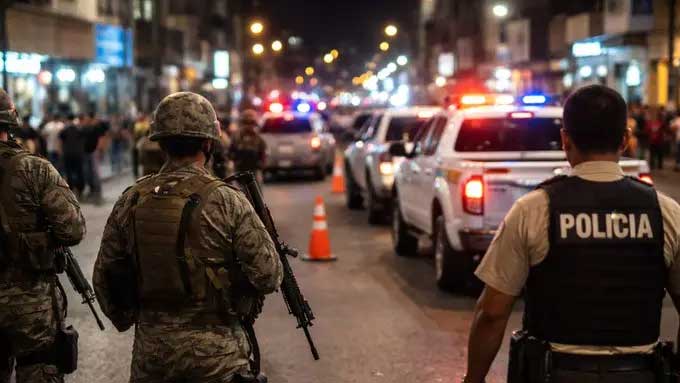
Authorities say most apprehensions involved alleged crimes rather than violations of Ecuador’s nighttime movement restrictions.
Nearly 2,000 apprehensions in 10 days
Ecuador’s police and military reported 1,989 apprehensions during security operations carried out between September 17th and 26th under the country’s targeted state of emergency and nighttime curfew.
The figures, released by the government’s Security Bloc, cover 935 operations. Authorities said 559 people were apprehended for violating curfew restrictions, while 1,430 were detained in connection with alleged crimes including extortion, organized crime, illegal possession of weapons and drug trafficking.
The totals are official operational figures. An apprehension does not establish guilt, and people accused of crimes must still pass through Ecuador’s judicial system.
The government says two people on most-wanted lists were among those captured during the period. Authorities also reported one person killed during the operations.
Eight tons of drugs and hundreds of weapons
The Security Bloc reported seizing 8.02 metric tons of drugs during the 10-day period, along with 326 firearms, 8,632 rounds of ammunition and eight explosive devices.
Authorities also reported seizing $39,199 in cash, 38 communications devices and 1,000 gallons of fuel.
Nine sites described by the government as infrastructure used for criminal logistics were affected during the operations.
Vehicle controls produced another large set of official figures. The Security Bloc reported 803 vehicles and 1,481 motorcycles retained or recovered, along with one boat.
Curfew is concentrated in four coastal provinces
The nighttime curfew applies in Guayas, El Oro, Los Ríos and Manabí, provinces that have been among the areas most affected by organized crime and violent deaths.
The movement restriction began September 17th and is scheduled to remain in effect through September 30th. It forms part of a broader state of emergency declared in eight provinces and three cantons.
The curfew gives police and military forces a quieter operating environment during overnight hours, but the government’s own figures show that enforcement of the movement restriction is only one part of the campaign. Fewer than three in 10 of the reported apprehensions were for curfew violations; the government attributes the remainder to alleged criminal offenses.
Operations continue across Manabí
One of the latest operations occurred September 26th in Paján, Manabí, where the Armed Forces reported apprehending 16 people.
Military officials said the operation resulted in the seizure of weapons, 231 rounds of ammunition and substances suspected of being illegal drugs. The Armed Forces said the detainees and evidence were turned over for the corresponding legal procedures.
In a separate case in Portoviejo, police detained Ruperto M., whom authorities identify as Manabí’s second most-wanted person. He has been called to trial in connection with the 2024 killing of José Miguel Mendoza Rodas, a former candidate for mayor of Portoviejo.
Those cases illustrate the range of activity taking place under the heightened security deployment, from checkpoints and curfew enforcement to targeted investigations and military operations.
International cooperation also increases
The security campaign coincides with growing cooperation between Ecuador and the United States against international drug trafficking.
On September 24th, Ecuadorian police carried out simultaneous raids in Guayaquil, Daule, Samborondón, several cities in Los Ríos and Machala as part of an investigation into an alleged international drug-trafficking structure. More than 320 Ecuadorian police participated, with support from about 50 U.S. Southern Command personnel and the U.S. Drug Enforcement Administration.
Authorities initially reported more than 30 people detained in that operation. Officials said the investigation had lasted about eight months and alleged that the organization was involved in storing, transporting and distributing drugs intended for international markets, including the United States and Europe.
Government officials also alleged links between the investigated organization and Mexico’s Jalisco New Generation Cartel. Those allegations remain subject to the criminal cases against the people accused.
Large numbers do not by themselves measure lasting security
The government is presenting the arrest and seizure totals as evidence of intensified pressure on criminal organizations. The numbers document a substantial level of police and military activity, but they do not by themselves establish whether the operations will produce a sustained reduction in violent crime.
That will depend partly on what happens after arrests are made: whether prosecutors can support criminal charges, courts obtain sufficient evidence to convict defendants, seized networks are prevented from reorganizing and communities experience measurable reductions in homicides, extortion and other crimes.
For now, the September operation provides a snapshot of the scale of Ecuador’s current security deployment. In 10 days, authorities report nearly 2,000 apprehensions and more than eight tons of drugs seized, while the curfew and targeted state of emergency remain in effect.
0 Comments