
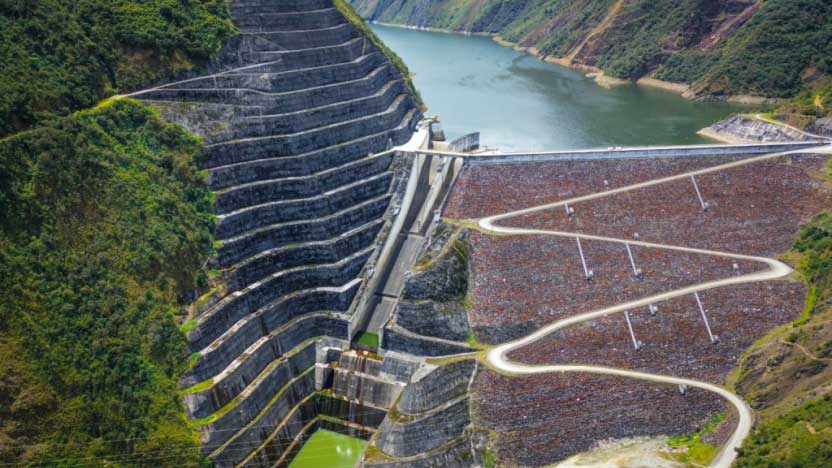
Rising demand from coastal heat is drawing down Mazar while officials insist supply remains under control.
Ecuador’s electricity system is again under pressure as high temperatures on the coast push up demand and one of the country’s key reservoirs continues to lose water.
The Mazar reservoir, part of the Paute hydroelectric complex, stood at 2,132.89 meters above sea level on Sunday, April 26th, 2026, according to data published by Celec. That marks a drop of a little more than six meters since April 1st, when the reservoir was recorded at 2,139 meters above sea level.
The decline has become more pronounced since April 19th, when the coastal heat wave began driving greater electricity consumption. Higher demand has placed additional strain on transformers and distribution infrastructure, producing localized blackouts in some areas and renewing concerns about whether the national grid can withstand prolonged stress.
Mazar remains above critical level
Although the reservoir has fallen steadily during April, it remains above the threshold considered critical for hydroelectric operations. Celec identifies 2,115 meters above sea level as the point at which the Mazar plant begins operating at risk.
As of April 26th, Mazar was still nearly 18 meters above that critical level. But the pace of the decline has drawn attention because the reservoir forms part of one of the country’s most important hydroelectric systems, and because electricity demand is rising at the same time water reserves are being used more heavily.
The Paute Molino complex, which includes Mazar, was generating 19% of the country’s electricity demand as of late Sunday morning, according to information from Cenace. That share makes the condition of the reservoir an important factor in the stability of Ecuador’s power supply.
Heat wave drives demand higher
The immediate pressure comes from the coast, where unusually high temperatures have increased the use of air conditioning, fans, refrigeration and other electrical equipment. That surge in consumption has exposed weaknesses in the transmission and distribution network, especially in areas where transformers and local systems are already operating near capacity.
In recent weeks, outages reported in several areas were attributed by the government to scheduled maintenance that had not been properly communicated to the public. Authorities ordered the suspension of that work and insisted there is no electricity crisis.
Officials have also said reservoirs are being managed to guarantee supply. But the falling level at Mazar shows how quickly the balance can become more fragile when demand rises sharply and hydroelectric resources are called on to carry a large share of the load.
Grid weaknesses remain the larger concern
The reservoir level is only one part of the problem. A report from the National Electricity Operator warned that Ecuador’s power system faces increasing risks because of insufficient investment and delays in upgrading transmission and distribution infrastructure.
The report cautioned that overloads in the grid could trigger chain reactions capable of causing a partial or even total collapse of the national electricity system. That warning points to a broader weakness: even when generation is available, the network must still be able to move electricity safely and reliably to where it is needed.
The risk is especially serious during periods of extreme heat, when demand rises suddenly and local equipment can be pushed beyond its limits. Under those conditions, a problem that begins with transformer overloads or localized failures can spread if the system does not have enough flexibility or backup capacity.
Coca Codo Sinclair flow improves
There was some relief from the Coca Codo Sinclair hydroelectric plant, the country’s largest generator. As of 11:00 a.m. on April 26th, its flow rate had improved to 206 cubic meters per second, 67 cubic meters per second higher than two days earlier.
That level is significant because Coca Codo Sinclair requires flows of around 200 cubic meters per second to generate between 1,000 and 1,200 megawatts. By 11:30 a.m. on Sunday, the plant was providing 52% of Ecuador’s hydroelectric generation.
The improved flow helps ease pressure on the system, but it also highlights Ecuador’s dependence on large hydroelectric plants. When river flows are strong, the system gains breathing room. When they weaken, or when demand climbs sharply, the margin narrows quickly.
For now, Mazar remains safely above its critical level and Coca Codo Sinclair is operating with improved water flow. But the combination of rising demand, falling reservoir levels and an overloaded grid leaves Ecuador’s electricity system vulnerable to the same problem that has defined recent years: a supply network that can function under normal conditions but becomes far less forgiving when heat, maintenance delays and infrastructure weaknesses arrive at the same time.
We need to diversify our generation and the alternative energies of wind and solar are certainly cost-competitive these days. With the El Nino forming up, it will be an interesting year ahead for our rivers.