
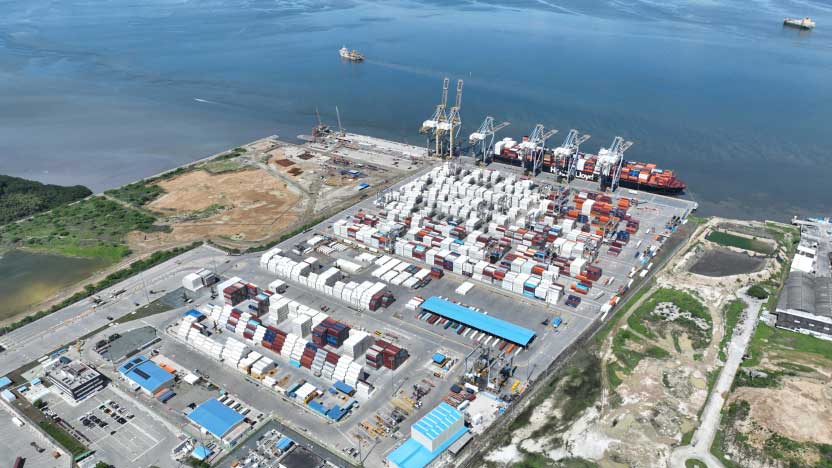
Private investment will fund a strategic Navy base near Posorja to protect Ecuador’s busiest maritime corridor.
The Gulf of Guayaquil, long one of Ecuador’s most important commercial gateways, is now at the center of the country’s fight against drug trafficking. With nearly 90% of Ecuador’s maritime foreign trade moving through its waters, the same channels that carry bananas, shrimp and other exports to international markets have also become a target for criminal groups seeking to move cocaine onto cargo ships bound for the Pacific.
To strengthen control over that corridor, the Ecuadorian Navy has begun construction of a new naval station in Posorja, the rural Guayaquil parish where several of the country’s most important shipping routes converge. The project, backed by private investment from DP World, is designed to give the Armed Forces a permanent operational base at one of the most sensitive maritime points in the country.
The foundation stone for the station was laid on Wednesday, April 22, 2026, during a ceremony that coincided with the inauguration of an expansion of the Posorja Deepwater Port dock. Defense officials described the station as a major step toward closing off the routes used by traffickers to contaminate cargo ships with drugs before they leave Ecuadorian waters.
A strategic point near the ports
The new facility will be built less than one kilometer from the DP World terminal, between the port complex and the center of Posorja. The Ministry of Defense has provided a plot of roughly 24,000 square meters for the project, which is expected to require a $3 million investment.
Once operational, the station will house about 200 Navy personnel, including coast guard units, marine infantry and naval aviation support. The site is expected to include a large coast guard vessel, four small interceptor boats and access to helicopters, giving the Navy a faster response capacity in an area where speedboats and small craft have been used by criminal groups.
Admiral Ricardo Unda, commander of the Navy, said the base will give the Armed Forces an “unprecedented” position in the area. From Posorja, authorities will be able to monitor merchant vessels arriving at or departing from both the local port and the ports of Guayaquil.
The location is important because it sits near two major maritime access channels. One follows the coast near Posorja. The other leads toward the ports south of Guayaquil, about 70 kilometers inland from the Pacific, including terminals such as the Port of Guayaquil, TPG/Inarpi and Bananapuerto/Naportec.
Those routes are vital for legal commerce, but they have also become vulnerable points for organized crime. Traffickers have increasingly sought to place drugs on ships after cargo has already entered the port system, taking advantage of gaps in surveillance along waterways and access channels.
Private sector joins the security effort
The Posorja station is part of a broader push to involve port operators and private companies in maritime security. DP World, which operates the deepwater port in Posorja, is financing the new base, but company officials said the benefits will extend beyond its own terminal.
Carlos Merino, DP World’s CEO for Ecuador, Colombia and Peru, said the Navy’s new position will help protect all foreign trade moving through the Gulf of Guayaquil. The project is intended to reinforce surveillance not only at the port itself but also along the approach channels used by international vessels.
Construction is expected to take at least a year, although Navy officials hope the station can be inaugurated by the end of 2026 or early 2027. The new facility will replace the current Posorja Port Authority presence in the area, but with a much broader operational role.
Unda said the change will mean an expanded Armed Forces capacity in the region, allowing personnel and equipment to be positioned closer to the areas where traffickers are most likely to operate.
Los Lobos presence raises urgency
Defense Minister Gian Carlo Loffredo linked the new base directly to the security crisis in Posorja and surrounding maritime zones. He said the criminal group Los Lobos has been operating in the area, using violence, extortion and piracy to maintain influence.
Loffredo referred to the recent capture of a local leader known as “Pan Quemado,” whom authorities identified as being responsible for extortion, killings and piracy in the sector. His comments underscored the government’s view that maritime security is no longer only a customs or port issue, but part of Ecuador’s wider internal armed conflict against organized criminal groups.
For the Armed Forces, having a permanent base in Posorja will reduce response times and improve logistics. Instead of deploying from farther away, Navy units will be stationed directly in one of the corridors most exposed to illegal activity.
The new infrastructure is expected to support patrols, interdictions, surveillance operations and rapid responses to suspicious movements on the water. Officials say the goal is not only to intercept drugs, but also to make it harder for criminal groups to use the gulf as a predictable route.
Delayed radar system still pending
The naval station is not the only security measure planned for the Gulf of Guayaquil. Authorities also say the Vessel Traffic System, known as VTS, is close to becoming operational after more than two years of delays.
The VTS is a real-time maritime monitoring system that works much like air traffic control. It uses radar, long-range cameras and automatic identification technology to track ships along the 70-kilometer route between southern Guayaquil and the Pacific Ocean.
The system was originally expected to be operating by 2023, but its rollout has been delayed by security and infrastructure problems. Authorities previously reported threats from Los Lobos and Los Choneros against workers involved in the project. The deterioration of the Pilots’ House in Data de Villamil, on the Playas-Posorja road, also complicated the installation of part of the system.
Once active, the VTS is expected to allow authorities to monitor the position, course and speed of vessels in real time. Navy officials say it will also help detect suspicious movements by smaller boats involved in illicit activity, including attempts to contaminate ships with drugs.
Together, the radar system and the new naval station would give Ecuador a stronger security platform in an area where traffickers have exploited limited monitoring and long stretches of navigable water.
Ports expand their own protections
Security efforts are also being reinforced at other ports. DP World and the Navy already have an active security agreement for the Posorja Geomaritime Complex, including land and sea surveillance and patrols in the access channel used by international ships. A second phase of that agreement began in 2024.
At the Port of Guayaquil, operator Contecon ceded 5,732 square meters at the end of 2024 for a Maritime Operational Group center inside the facility. The space is intended to house police and military personnel focused on combating criminal threats within and around the port.
Other private terminals, including TPG and Bananapuerto/Naportec on Trinitaria Island, are also working with the Armed Forces on patrol plans that include internal and external surveillance. Those plans were strengthened in 2025 as authorities tried to respond to increasing pressure from organized crime around port infrastructure.
In Machala, Puerto Bolívar is also under military patrol. Navy officials say the Coast Guard Command has developed a maritime protection model for port areas under its jurisdiction, reflecting the growing need for a coordinated response across Ecuador’s coast.
The government is also trying to revive the Port of Esmeraldas, the only publicly owned port that has not been concessioned. Transport officials say the port is in critical condition and would require more than $100 million in private investment for modernization, dock expansion and dredging.
For now, however, the immediate focus is Posorja and the Gulf of Guayaquil, where the country’s legal trade and illegal trafficking routes continue to collide. The new naval station is meant to put the Navy closer to both realities: protecting the vessels that carry Ecuador’s exports and confronting the criminal groups trying to turn those same routes into corridors for drugs.
0 Comments