
Tourism has revived the capital’s old town, but residents and nightlife continue to disappear.
A showcase with a hollowing center
By morning, Quito’s Historic Center can look like one of the capital’s greatest success stories.
Visitors move through narrow cobblestone streets framed by churches, convents, balconies, plazas and centuries-old façades. Cameras point toward domes and bell towers. Cafes fill with customers. Boutique hotels advertise restored colonial charm. Restaurants, tour guides and small shops work to capture the growing appetite for cultural tourism in one of Latin America’s most important historic districts.
But by evening, much of that energy drains away.
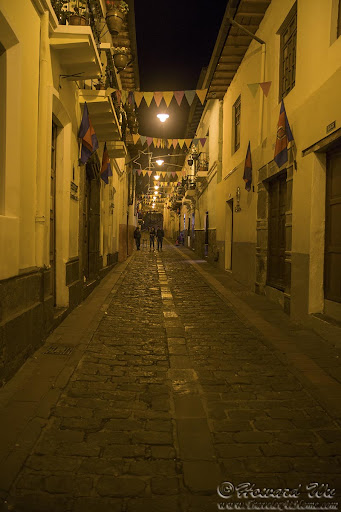
As daylight fades behind the Andes, streets that only hours earlier were filled with tourists and office workers become quiet. Many business owners close earlier than they once did. Residents who remember a livelier neighborhood say the old town has become a place people visit, photograph and leave — not a place where enough people still live.
The contradiction has become one of the central challenges facing Quito’s Historic Center: tourism and commercial investment have expanded, while the permanent population has sharply declined. In less than two decades, the district has lost more than 40% of its residents, falling from about 50,000 inhabitants at the start of the century to far fewer today.
Urban planner Fernando Carrión describes the process as a historic district “dying of success.” The same attention that brings visitors and investment is also pushing the area toward a model that favors short-term consumption over daily neighborhood life.
Residents give way to boutique businesses
The change is visible block by block.
Homes that once housed families have been converted into cafes, small hotels, restaurants and shops aimed at visitors. In other cases, old houses remain closed, deteriorating or listed for sale for years, caught between high renovation costs and uncertain demand from people willing to live in the area.
Carrión says the shift reflects a change in land use. Residential space has gradually given way to more profitable activities, especially businesses tied to tourism and hospitality.
“Everything is becoming boutique,” he says, warning that the transformation is displacing more residents than many officials anticipated.
The pattern is not unique to Quito. Across Latin America, historic centers have often lost middle- and upper-income residents to newer areas with more parking, more services, better security perceptions and greater access to jobs. As that happens, the old centers can become socially stigmatized, associated with poverty, abandonment or crime, even as they remain central to tourism campaigns.
In Quito, the effect has been sharpened by Ecuador’s broader security crisis, including states of exception and curfews in recent years. Even when the level of crime in a specific historic area is disputed, public perception can shape behavior as powerfully as statistics.
Business owners adapt to fear
For longtime merchants, the change has altered daily routines.
Guadalupe, who has operated a traditional coffee shop in the old town for 40 years, remembers when she could keep her doors open until 11 p.m. Today, she closes around 6 p.m.
Part of the reason, she says, is competition. The number of cafes has exploded, including franchises and newer businesses designed for tourists and younger customers. But fear also plays a role. Once the streets begin to empty, she no longer feels comfortable staying open late.
“There used to be 20 cafes, now there are 2,000,” she says, describing the speed of the commercial transformation.
Augusto, who runs a well-known watch shop in the Historic Center, follows a similar pattern. He says shop owners still look after each other and maintain informal networks of protection. But when foot traffic drops and the street begins to feel deserted, he prefers not to take chances.
The result is a cycle that reinforces itself. People leave early because the area feels unsafe. The area feels unsafe because people leave early.
Carrión says fear has become a kind of “urban planning principle,” shaping where people go, when they travel, where they spend money and which neighborhoods they avoid. In that sense, the Historic Center’s problem is not only crime itself, but the way fear reorganizes urban life.
Empty buildings deepen the decline
The loss of residents has had consequences beyond nighttime activity.
As families move out, buildings become harder to maintain. Some properties were inherited by children or grandchildren who no longer want to live in the center. Others moved to parts of the city with better services, schools, jobs or transport connections. Instead of renovating aging structures, many owners simply closed them, sold them or left them unused.
Carrión describes the process as “aporification,” a term he uses to distinguish Quito’s experience from the gentrification seen in many European cities. In those cases, historic districts are often repopulated by wealthier residents. In Quito, he says, the center has lost population without always gaining stable replacement communities.
The deterioration is also visible in institutional buildings, including old schools. One former school building, closed for years, was eventually taken over by the National Police for renovation and use. Officials say bringing activity back to abandoned spaces can help change how people experience the area.
Colonel Gustavo Pérez argues that the police presence has improved the sense of security nearby. He says people often associate darkness and empty streets with crime, but that perception does not always match the actual level of risk.
He acknowledges that no urban area can offer “zero risk” and that thefts may occur but says police operations have made the sector “quite safe.”
A neighborhood needs more than visitors
The debate points to a larger question: What kind of Historic Center does Quito want?
A district built mainly for visitors may succeed during the day but struggle at night. Cafes, hotels and restaurants can bring money and jobs, but they cannot fully replace residents who send children to school, buy groceries, use parks, know their neighbors and keep windows lit after dark.
For business owners, preservation advocates and city officials, the challenge is to protect the Historic Center’s value as a tourist destination without turning it into a stage set. Security patrols may help, but they are only part of the answer. Housing, services, public lighting, transport, cultural activity and incentives for restoration all shape whether people see the old town as a place to live or only as a place to visit.
For now, Quito’s Historic Center remains both a jewel and a warning. Its churches, plazas and restored façades continue to draw visitors each day, but when the sun goes down and the streets grow quiet, the city is left confronting the cost of a success that has not yet brought enough people home.
Very nice piece. And there are lessons here for every city.
My town of Greenville, South Carolina had a dead downtown for many years. Then, some of the wealthy business leaders decided on rejuvenation and implemented a process that generated AMAZING results, making downtown Greenville one of the finest places in the US. The leaders are often hosting managers of other places asking about how it was done.
It CAN be done and a downtown CAN be maintained, but it takes focus. Car traffic is certainly one factor because that opposes pedestrians walking, for one small example. Graffiti and the subconscious messages that transmits to visitors about gangs and safety is another.
Let’s keep Cuenca beautiful.