
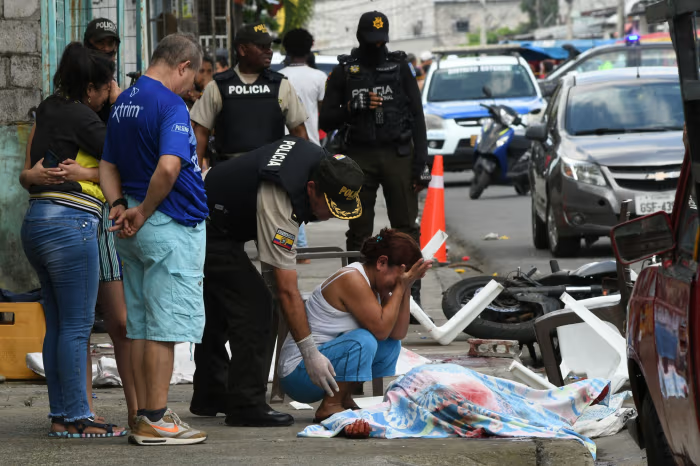
Authorities cite fewer serious crimes, tens of thousands of arrests and expanded security deployments while organized crime remains dominant.
Ecuador’s National Police says violent deaths and other serious crimes are declining in 2026, even as organized criminal groups continue to account for the overwhelming majority of killings and deadly attacks remain a recurring problem in several parts of the country.
National Police Commander Pablo Dávila said the number of violent deaths has fallen by 8% compared with the same period last year, representing 432 fewer killings. The comparison is particularly significant because the previous year was the deadliest in Ecuador’s recent history.
Speaking August 5th, Dávila said police are closely tracking what the institution considers the seven most serious categories of crime and that authorities have recorded an overall reduction in those offenses.
The figures form part of a broader assessment of the government’s national security strategy, which has combined large-scale police operations, military participation, equipment purchases and additional deployments to areas considered particularly vulnerable to crime.
Organized crime remains behind most killings
Despite the improvement in the overall homicide numbers, police data underscores how heavily Ecuador’s violence remains tied to organized crime.
Dávila said approximately 85% of violent deaths recorded nationally have connections to criminal organizations. About 40% of those killed had previous criminal records, according to police.
Authorities say some victims had previously been detained and later released under alternative judicial measures before becoming involved again in criminal activity or becoming targets of rival organizations.
Those figures illustrate one of the central challenges facing Ecuador’s security forces: a reduction in the total number of killings does not necessarily mean the criminal organizations responsible for much of the violence have disappeared or lost their ability to carry out attacks.
That reality was evident even as Dávila presented the improving national statistics. Within roughly 24 hours, five people were killed in La Libertad, in Santa Elena province, while two women were shot and killed in the Cristo del Consuelo sector of southern Guayaquil.
Such incidents continue to create a sharp contrast between improving national indicators and the violence experienced in individual neighborhoods and cities.
Nearly 45,000 arrests during police operations
The scale of police activity so far this year has been extensive.
According to Dávila, nearly 58,000 National Police personnel have participated in more than 374,000 operations throughout the country. Those actions have resulted in 44,934 arrests.
Police have also seized 7,253 firearms, more than 102 tons of illegal drugs and approximately 385,000 rounds of ammunition.
Dávila said 61 suspected criminals have been killed during police operations in circumstances in which officers used what authorities determined was legitimate force.
One such case occurred June 17th in Guayaquil, when police shot a man who authorities said was attempting to kill his partner inside a commercial establishment.
The government has increasingly emphasized both operational capacity and equipment as it attempts to confront criminal organizations that have expanded their influence through drug trafficking, extortion, kidnapping and other crimes.
A national security program now includes approximately $180 million for new police equipment, technology and other resources intended to improve the ability of officers to investigate crimes and respond to emergencies.
Thousands reported missing during 2026
Dávila also provided new details about another major issue facing police: missing persons.
Authorities have received 4,816 missing person reports nationwide so far this year. Of those reports, 2,173 involve men, while the remainder involve women.
Children and teenagers account for the largest group. Police recorded 2,562 reports involving people younger than 18, representing 53.2% of all cases. Adults between the ages of 18 and 65 make up the next-largest category.
Police say approximately 81% of the cases have been resolved.
About 75.9% of those reported missing were eventually located alive. Another 242 people were found dead, while 917 cases remained under investigation at the time of the report.
Authorities say disappearances have numerous causes and frequently are not connected to violent crime. Police investigations have identified family disputes, financial problems, academic difficulties, psychological or social crises, personal conflicts and cases in which individuals voluntarily leave their homes.
Other reports involve people with disabilities or individuals in vulnerable circumstances who disappear unintentionally.
The figures demonstrate that missing-person investigations cover a much broader range of situations than criminal abductions and require police to determine the circumstances surrounding each report individually.
Quito accounts for more than 1,000 reports
Quito alone has recorded 1,010 missing person reports during 2026.
Of those, 486 involved men and the remaining reports involved women. Police said 880 of the people reported missing in the capital were subsequently found alive.
Another 52 were found dead, while 78 cases remained under investigation.
The capital is also becoming a major focus of the government’s broader security deployment.
Authorities are adding 4,000 uniformed personnel to operations in Quito, including 2,000 police officers and 2,000 members of the Armed Forces.
The reinforcement is intended to combat conventional street crime while increasing pressure on criminal activities that have become increasingly disruptive to communities and businesses, particularly extortion and kidnapping for ransom.
Capital receives major security reinforcement
Quito already has approximately 6,640 police officers assigned to the metropolitan area. Dávila said the additional police personnel are being provided through an operational redistribution from other parts of Ecuador rather than through a withdrawal that would leave other regions without adequate protection.
The deployment forms part of the government’s strategy of concentrating personnel and conducting large, coordinated operations in areas where intelligence indicates criminal activity is occurring.
Dávila said those operations increasingly depend on information provided by the public and on technological tools that can help authorities identify areas of concern and develop intelligence about criminal activity.
Among those tools is the QR code incorporated into Ecuadorian identity cards, which authorities say can provide another channel for citizen information used in planning police operations.
The government’s $180 million security investment is expected to support that strategy through the replacement and modernization of police equipment as well as new technological capabilities.
For police officials, the 8% decline in violent deaths provides evidence that the security strategy is beginning to produce measurable results. But with organized crime still linked to an estimated 85% of killings and deadly attacks continuing in cities along the coast and elsewhere, officers remain under pressure to turn the reduction into a sustained national trend rather than a temporary improvement in the statistics.
0 Comments