
New leadership in Bogotá could reshape Ecuador’s electricity security border strategy and commercial relationship with its northern neighbor.
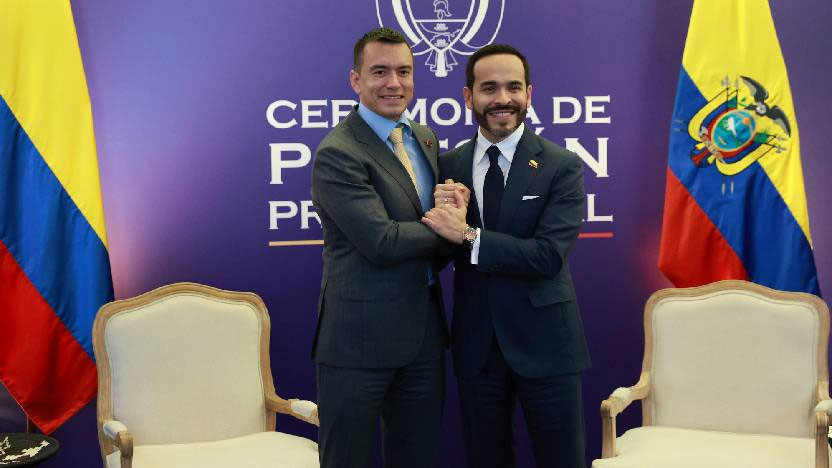
A political relationship Daniel Noboa began cultivating before Colombians had even chosen their next president became official government business Friday, as the Ecuadorian president met Abelardo de la Espriella in Cali on the day Colombia transferred power to its new leader.
The August 7th meeting was more consequential for Ecuador than the customary diplomatic encounter surrounding a presidential inauguration. De la Espriella replaces Gustavo Petro after a period in which relations between Quito and Bogotá deteriorated over border security, narcotics trafficking, tariffs and electricity exports.
Now Ecuador has something it has lacked for several years: a Colombian president whose political and security views are broadly aligned with Noboa’s.
That could have immediate consequences.
Ecuador is preparing for another dry season while still struggling with weaknesses in its electricity system. Criminal organizations operate on both sides of the countries’ 586-kilometer border. Trade is recovering from a tariff confrontation, while longstanding disputes involving transportation and smuggling remain unresolved.
The question is no longer whether Noboa and De la Espriella get along. It is whether their political alliance can produce practical results in areas increasingly important to Ecuador’s economy and national security.
An alliance formed before the election
Noboa took the unusual step of openly cultivating De la Espriella while Colombia’s presidential campaign was still underway.
The two held a video conference to discuss security, commerce and energy, and Noboa publicly congratulated De la Espriella after his strong first-round showing. The Ecuadorian president also spoke openly about Colombia needing political change, drawing criticism from Petro’s government, which viewed his involvement as interference in the Colombian election.
Noboa did not retreat.
After De la Espriella defeated leftist candidate Iván Cepeda in the June 21st runoff, Noboa again congratulated him and made clear that he expected a much closer relationship with the incoming administration.
The election itself was extremely close. De la Espriella received 12,960,166 votes compared with 12,708,312 for Cepeda, a difference of only 251,854 votes and less than one percentage point.
But the narrow victory produced a dramatic political shift.
Before Friday’s inauguration, Noboa and De la Espriella held bilateral talks in Cali centered on cooperation, regional integration and the future of relations between the neighboring countries.
Noboa traveled with First Lady Lavinia Valbonesi and was received by Cali Mayor Alejandro Eder, Valle del Cauca Governor Dilian Francisca Toro and other officials.
Petro years left a damaged relationship
The cordial atmosphere contrasted sharply with the final months of Petro’s presidency.
Noboa repeatedly accused Colombia of failing to do enough about armed groups and drug-trafficking organizations operating from Colombian territory, arguing that Ecuador was being forced to absorb the consequences of insecurity across the border.
The confrontation eventually spread well beyond political rhetoric.
The border was closed several times amid disputes between the governments, affecting travelers, businesses, transporters and families in communities where daily economic activity depends heavily on movement between southern Colombia and northern Ecuador.
Trade relations also deteriorated.
Ecuador imposed an additional security tariff on Colombian imports and Colombia responded with retaliatory measures against Ecuadorian goods. Restrictions were placed on some food products, and electricity — one of Ecuador’s most important points of vulnerability — became part of the confrontation.
Colombia suspended power exports to Ecuador for seven months.
Ecuador removed its special tariff on Colombian imports on June 1st, while De la Espriella was still campaigning. Petro’s government later withdrew Colombia’s retaliatory tariff, saying the decision followed a request from the Andean Community.
By the time Colombia changed presidents, much of the formal trade confrontation had therefore been dismantled.
But the damage demonstrated how quickly disagreements between the governments could affect areas far removed from diplomacy.
Electricity may provide the first test
Perhaps no part of the new relationship will be watched more closely in Ecuador over the next several months than electricity.
The transmission connection between the countries allows Colombia to provide roughly 450 megawatts to Ecuador, equivalent to about 10% of average Ecuadorian demand.
That is particularly significant as Ecuador faces a generation shortage estimated at more than 1,300 MW and approaches the dry season, expected to begin in October. Reduced rainfall can sharply lower production at the hydroelectric plants on which the country depends for much of its electricity.
Colombia resumed electricity exports only two days before De la Espriella took office. During the first day after sales restarted, Ecuador purchased an average of 288 MW.
The longer-term issue, however, is not simply whether Colombian electricity will be available. It is what Ecuador will pay for it.
During the 2024 energy crisis, Colombian electricity was at times sold to Ecuador at prices approaching $1 per kilowatt-hour. The average residential electricity rate paid by Ecuadorian consumers is roughly 10 cents per kilowatt-hour.
Noboa has indicated that the two governments are considering a different system.
On July 23rd, he said he and De la Espriella had reached an initial understanding on creating a binational electricity tariff under which the same pricing formula would apply regardless of whether Colombia was supplying Ecuador or Ecuador was selling electricity northward.
If implemented, such an arrangement could make electricity exchanges more predictable and prevent emergency power purchases from being shaped as heavily by political disputes or temporary market conditions.
For Ecuador, that would turn the Colombian connection from an emergency lifeline into a more reliable part of national energy planning.
Security could define the partnership
Electricity may produce the fastest measurable result, but security is likely to become the defining issue between the two governments.
Both presidents have advocated harder-line approaches to organized crime.
Noboa has classified Ecuador’s struggle against criminal organizations as an internal armed conflict and increasingly relied on military operations alongside traditional police enforcement.
De la Espriella campaigned on abandoning Petro’s broader effort to negotiate with armed organizations under his “total peace” policy. His proposals include expanded military deployments, harsher criminal penalties, larger high-security prisons and intensified operations against narcotics organizations and armed groups.
The overlap with Noboa’s security strategy is obvious.
It also comes as Colombian armed organizations continue to expand.
Figures from the Ideas for Peace Foundation put total membership in Colombian armed groups and their logistical and financial support networks at 27,121 people in 2025, an increase of 23.5% during the year.
The Clan del Golfo alone is estimated to have at least 9,840 members, while the National Liberation Army, or ELN, has about 6,810. The Central General Staff, the largest dissident faction to emerge from the former FARC guerrilla movement, has approximately 4,019 members.
Those groups are not merely a Colombian problem.
Drug trafficking, weapons smuggling, illegal mining and the movement of armed groups through remote areas have increasingly connected Colombia’s longstanding internal-security problems with Ecuador’s more recent explosion of organized crime.
Interior Minister John Reimberg has confirmed that Ecuadorian officials have already begun discussions with representatives of the new Colombian government.
Rather than having security forces on either side of the border conduct largely separate operations, Quito wants greater coordination against criminal and armed groups that move between the countries.
Noboa has said he expects De la Espriella to join what he described as a “real and joint fight against narcoterrorism.”
Trade still has unfinished business
Better political relations could also help repair commercial ties, although eliminating the retaliatory tariffs does not resolve every dispute.
Rice smuggling remains a concern along the border, and Ecuadorian heavy-transport companies continue to face difficulties in Colombia. Some Colombian transport operators have resisted allowing Ecuadorian trucks to move freely through Colombian territory despite an Andean Community ruling.
Those issues have long been difficult to resolve when relations between the national governments are poor.
Former Foreign Trade Minister Francisco Rivadeneira has suggested that the ideological similarities between Noboa and De la Espriella could reduce the possibility of another tariff confrontation and create an opportunity to revive the Binational Cabinet meetings once used by the countries to address security, trade, transportation and border problems at a high level.
No such meeting has been held for years.
Tourism and regional integration are also expected to return to the agenda, particularly along the border, where political disputes have repeatedly disrupted communities whose economies are intertwined regardless of what is happening in Quito or Bogotá.
Cali marks the beginning rather than the result
De la Espriella’s decision to hold his inauguration in Cali rather than Bogotá added symbolism to the transition.
The city is much closer to Ecuador and to areas of southwestern Colombia where armed violence, drug production and organized criminal activity remain deeply rooted.
Noboa was joined at the inauguration by other international leaders, including Spain’s King Felipe VI, Argentine President Javier Milei and Chilean President José Antonio Kast.
But Ecuador’s presence was different.
Noboa was not introducing himself to an unfamiliar president or beginning the customary process of determining where the two governments might find common ground. He was meeting a politician whose candidacy he had publicly encouraged and with whom he had already discussed electricity, trade and security before Colombian voters made their decision.
That gives the new relationship an unusually advanced starting point.
It also raises expectations.
By October, Ecuador could again be worrying about reduced hydroelectric generation. Armed organizations will still be operating along the northern border. Transport and commercial disputes remain to be settled, and both countries will have to decide how much operational information and security planning they are genuinely prepared to share.
For months, Noboa and De la Espriella talked about what Ecuador and Colombia could accomplish if Colombia changed political direction.
With De la Espriella now in office, they no longer have to imagine that relationship. Electricity prices, border security and the movement of goods between the countries will begin showing Ecuadorians fairly quickly whether the political alliance created during Colombia’s election can deliver the cooperation Noboa promised.
0 Comments