
Investigators say the group used spotters, motorcycles and even a child to identify and rob passengers.
A criminal group that police say specialized in stealing luggage from travelers near the airports of Quito and Guayaquil was dismantled after a months-long investigation that connected the suspects to at least nine victims, including former Attorney General Wilson Toainga.
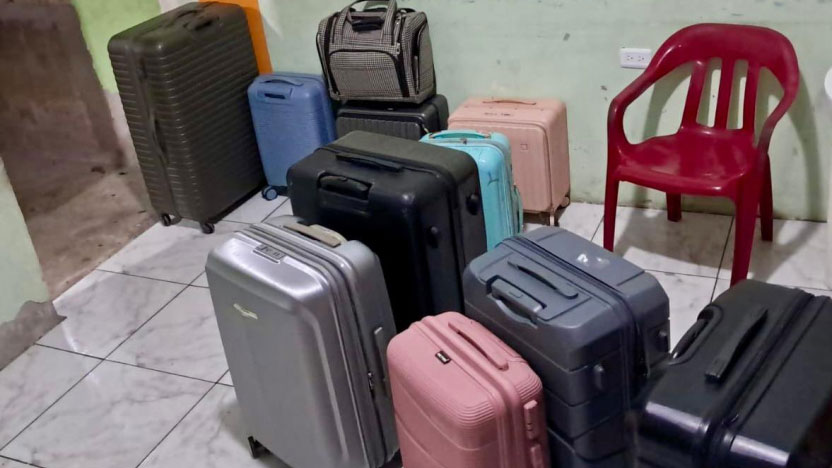
Five people were arrested on May 6th in an operation centered in Santo Domingo de los Tsáchilas, where police raided six homes and recovered suitcases, clothing, shoes, cell phones, perfumes, money and a motorcycle reported stolen. Authorities say the items were linked to robberies committed over the past four months against passengers leaving airport areas in Pichincha, Guayas and Santo Domingo.
The detainees are being investigated for illicit association. Prosecutors said the organization operated with clearly defined roles, combining surveillance inside airport terminals with pursuit vehicles and motorcycles used to intercept travelers after they left.
According to investigators, the group did not choose victims at random. Police say its members watched arriving passengers, identified luggage they believed contained valuable items, followed vehicles leaving the airport and then attacked at points where the travelers were more vulnerable.
A system built around airport surveillance
Police reports describe a structure that relied on coordination before, during and after each robbery. One suspect allegedly acted as a field leader, selecting victims at airport terminals and coordinating movements between provinces. Others were accused of helping execute the robberies, securing escape routes, planning interception points and deploying motorcycles used in the assaults.
Investigators said one member operated inside airport terminals, posing as either a passenger in transit or a relative waiting for someone to arrive. He allegedly used casual clothing and carried a crossbody bag where communication devices could be concealed. His job, police said, was to observe passengers as they left the airport, paying close attention to luggage, behavior and vehicles.
Another suspect was reportedly stationed near passenger exits and used a minor as a cover to remain in the area without drawing attention. Police said the tactic helped him blend into the normal airport crowd while he watched for high-value suitcases and relayed information to others.
Authorities said the gang also studied vehicles, especially pickup trucks carrying luggage in open beds. In some cases, police said, members looked for trucks without locks, reinforced ropes or other protections that would make theft more difficult. Once the group identified a target, motorcycles were allegedly used to move quickly into position and carry out the robbery.
Raids uncover stolen belongings
The May 6th operation followed weeks of surveillance, interviews, monitoring and phone analysis. Police said the investigation led them to a house in Santo Domingo that was frequently visited by one of the suspects and appeared to function as a storage point for stolen property.
During the raids, officers found about a dozen suitcases, along with clothing, shoes, perfumes and cell phones. The discovery gave investigators physical evidence they say helped connect the suspects to complaints filed by victims.
Police estimate that each suitcase represented an average loss of about $3,000, depending on the belongings inside. For travelers, that meant not only the loss of clothing and personal items, but also phones, documents and other belongings often carried after international or domestic flights.
Authorities said the group generally operated at night and targeted people traveling on roads near airports or air terminals. One method described by investigators involved cutting or slashing tarpaulins covering luggage in the backs of pickup trucks, allowing the thieves to remove suitcases quickly before fleeing.
Police said the organization moved between provinces and adjusted its operations depending on where passengers could be intercepted most easily.
Expansion toward Guayaquil
Investigators believe the group was trying to strengthen its operations in Guayaquil after working around the Quito airport.
At a court hearing, prosecutors cited surveillance that began earlier in the year. On February 4th, police followed two suspects to a meeting at a restaurant on the Quito-Papallacta highway. According to the investigation, intercepted communications indicated that Mariscal Sucre airport had been identified as a target during that meeting.
The following day, cameras recorded suspects moving through parking areas near the Quito airport. Police said they were checking vehicles and identifying pickup trucks that would be easier to attack once they left the terminal area.
The investigation later tracked movement toward Guayaquil. Police said that on April 15th, members of the group traveled more than 200 kilometers as part of a plan to prepare for robberies in the port city before the rest of the organization arrived. Authorities described the trip as part of an effort to “position” the group’s robbery tools and logistics in Guayaquil.
That mobility is one reason investigators say the case extended beyond a simple theft operation. Police and prosecutors allege the suspects had a coordinated structure, assigned roles and repeated methods that allowed them to operate across provincial lines.
Former attorney general among the victims
The case gained additional attention because one of the nine complainants was Wilson Toainga, a former attorney general. Prosecutor Erick López mentioned Toainga’s complaint during the arraignment hearing, along with the statements of other victims whose luggage was allegedly stolen by the group.
Toainga filed his complaint with the Prosecutor’s Office in Santo Domingo on the afternoon of April 23rd, according to prosecutors. That same date is also significant because police carried out a previous operation in which four people were arrested for similar crimes.
Investigators are now trying to determine whether the group dismantled in May is connected to the suspects arrested in April. Police have not yet confirmed a link, but intelligence units are reviewing evidence from both cases to determine whether the same network, or related networks, were operating in airport areas.
The evidence presented in court included police reports, victim statements, phone record analysis, surveillance photographs and information gathered from human sources. Prosecutors argued that the material showed a pattern of organized conduct rather than isolated thefts.
Preventive detention ordered
At the arraignment hearing, the Prosecutor’s Office requested preventive detention for the five detainees. The judge accepted the request despite objections from defense attorneys.
Authorities identified several suspects by aliases, including “Canelo,” “Cholo,” “Rulo,” “Gato” and “Cachetes.” Prosecutors said the names appeared in the investigation as police reconstructed the structure of the group and the functions assigned to each member.
Police said “Canelo” acted as a field organizer and victim selector, while “Gato” allegedly worked as an internal airport observer. “Cachetes” was described as a planner of interception points and motorcycle support, while others allegedly helped execute the robberies and ensure the group’s escape.
The investigation remains open, particularly around whether additional suspects participated in the thefts or helped store, transport or sell the stolen goods. Police also continue to compare recovered property with complaints from other travelers who may have been robbed but have not yet been formally connected to the case.
For airport passengers, the case exposed a vulnerability that extends beyond terminal security. Investigators say the robberies often happened after travelers had already left the controlled airport environment, when luggage was loaded into vehicles and families were moving through nearby roads. That is where police say the group found its opportunity: not inside the baggage claim area, but in the short stretch between the airport and the road home.
0 Comments