
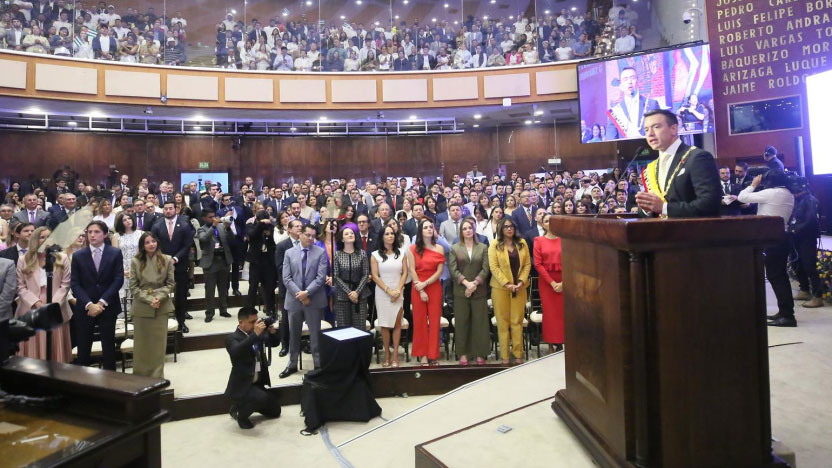
The president’s annual address put infrastructure and public health at the center of his new term.
President Daniel Noboa used his first State of the Nation address of the 2025–2029 term to place three priorities at the center of his government’s agenda: Quito, Guayaquil and the public health system.
Speaking before the National Assembly on May 24th, Noboa presented his administration as one that has stabilized the economy, reduced poverty, promoted employment and lowered country risk. But the most politically significant part of the address was not the list of figures shown in official videos. It was the direction the president chose for the year ahead.
After months in which public works have become a growing part of the government’s message, Noboa made clear that major infrastructure projects will now be treated as central to his administration. He highlighted the Fifth Bridge project, the Nobol-Progreso road corridor and the expansion of the Quito Metro, all of which carry both practical and political weight.
The projects would affect Ecuador’s two largest urban centers and, by extension, the country’s most important electoral battlegrounds. Quito and Guayaquil together account for just over four million voters, nearly 30% of Ecuador’s electorate. Both cities are currently governed by figures aligned with former President Rafael Correa, whose movement has remained one of Noboa’s most consistent political rivals.
Public works become political territory
Noboa’s emphasis on infrastructure did not appear by accident. The country is moving toward local elections that were advanced by the National Electoral Council, and control of the largest cities will be one of the defining struggles of that contest.
The president’s message suggested that the national government intends to take a leading role in projects that local officials have also treated as their own. In Guayas, the Fifth Bridge has already been a source of conflict between Noboa and Guayaquil Mayor Aquiles Alvarez. Shortly after taking office in November 2023, Noboa withdrew from the municipality the authority to carry out the project, reversing a decision made under the previous administration.
That dispute now sits alongside the Nobol-Progreso corridor, another project with implications for Guayas and for access between Guayaquil and the coast. The road plan also intersects with a stalled municipal proposal for an alternate route to the coast, placing the national government and local authorities in overlapping political territory.
In Quito, the situation has followed a similar path. Early in his presidency, Noboa pledged support for the expansion of the Quito Metro. But relations with Mayor Pabel Muñoz have deteriorated since then, and the president’s latest remarks signaled a clear change in position.
“The expansion of the Quito Metro will also be done by our own hand,” Noboa said.
That statement immediately raised questions about how the administration could carry out such a project without a stronger political foothold in the capital. In practical terms, it would be far easier for the national government to move ahead with that kind of urban project if Quito were led by a mayor from Noboa’s National Democratic Action movement.
The same logic applies in Guayaquil. For Noboa, winning ground in Quito and Guayaquil would not simply be a matter of local administration. It would mean weakening two major bases of Correísmo and gaining daily political contact with millions of voters.
Quito and Guayaquil remain national launchpads
For decades, Ecuador’s two largest cities have been more than municipal prizes. They have served as platforms for national power, launching or strengthening political careers that later moved toward the presidency.
Local governments control visible services, public spaces, transport plans, roadwork and urban development. That gives mayors a direct relationship with residents that national officials often struggle to match. A functioning road, a stalled bridge, a clean park or a broken service can shape political loyalties more effectively than a campaign speech.
For Correísmo, local governments in Quito and Guayaquil have been especially important since Rafael Correa left the presidency. They have offered institutional strength, visibility and a continued connection to voters, even when the movement has been outside Carondelet Palace.
Noboa’s address showed that he understands those stakes. By presenting the Fifth Bridge, the Nobol-Progreso corridor and the Quito Metro expansion as projects his government intends to drive, he placed the Executive Branch directly into the political future of both cities.
That also means the ruling party will soon have to answer a basic question: who will it put forward to challenge the current political balance in Quito and Guayaquil?
A medicine announcement amid a health crisis
The most unexpected announcement came near the end of Noboa’s remarks, when he said his government had reached an agreement with India for a major purchase of medicines.
According to the president, the medicines would be “top-quality” and approved by the U.S. Food and Drug Administration. He described the arrangement as a government-to-government negotiation, suggesting that the agreement is already in place.
The announcement helps explain the creation of the Public Company for Supply, Infrastructure and Logistics in Health, known as AIL. That public company would serve as the Ecuadorian counterpart in the negotiations and could become a central vehicle for medicine procurement.
The timing is significant. Ecuador’s public health system has been facing severe shortages, failed emergency contracts and growing criticism over the lack of essential medicines in hospitals and clinics. In some reports, availability of basic medicines in the public network has fallen to roughly 30% nationwide.
Noboa’s announcement offered a possible new route around the contracting problems that have damaged the Ministry of Health over the past year. But the speech did not include a broader accounting of how the crisis reached its current point.
The president did not dwell on the ministry’s instability, even though five ministers have led the health portfolio in one year. That period also included a five-month assignment to Vice President María José Pinto.
Nor did the address offer a detailed explanation of failed emergency contracts, shortages in hospitals or deaths of children and newborns linked to failures inside the health system. For a speech constitutionally framed as an accountability report, the absence of that accounting was one of the most notable omissions.
Videos carried much of the message
Noboa’s appearance before the Assembly lasted about 35 minutes. Roughly 20 minutes were devoted to official videos highlighting statistics and achievements. His spoken remarks took up the remaining time.
The videos focused on areas where the government wanted to show progress, including poverty, employment, investment and the reduction of country risk. Noboa again referred to the country’s economic stabilization and repeated his argument that his administration rescued Ecuador from the brink of financial collapse.
But on public health, there were no figures to celebrate. The government did not present the health system as an area of success, and Noboa’s main response to the crisis came in the form of the medicine purchase announcement.
The contrast was sharp. Infrastructure was presented as a forward-looking agenda. Economic indicators were presented as evidence of improvement. Health, by comparison, was addressed through a promise of future relief rather than a review of past performance.
Security received less emphasis than before
Security, one of the central themes of Noboa’s presidency, occupied less space in this address than in previous ones.
In his reports in 2024, 2025 and 2026, Noboa spent significant time discussing organized crime, mafias and the forces he said were resisting his government. This time, he still referred to the need to confront criminal groups and said a president cannot change the country alone. But some of the language that once defined his security message was largely absent.
There was no major discussion of the internal armed conflict, the Phoenix Plan or cooperation with the United States. The word “war” appeared only briefly in connection with crime, and Noboa did not repeat last year’s pledge that reducing violent deaths was a “non-negotiable goal.”
That omission was especially notable because 2025 recorded 9,216 homicides, the highest number of violent deaths in Ecuador’s recent history. The president did not make that figure a central part of his address.
Instead, security was folded into a broader argument that the country’s problems were inherited, complex and tied to forces larger than the Executive Branch alone. As in previous speeches, Noboa directed much of his message toward the past, pointing to the burdens his government says it received and the interests it says it has had to confront.
Diesel subsidy cut gets brief mention
Another major decision received only passing attention: the elimination of the diesel subsidy.
The measure has been one of the government’s most consequential economic decisions, sparking a strike centered in Imbabura and producing unrest among transport, agricultural and other sectors. It also became one of the clearest signs that Noboa was willing to take politically costly steps in pursuit of fiscal goals.
Yet in the annual address, the president mentioned the subsidy cut only briefly. He gave more attention to the reduction of country risk, which he has repeatedly cited at home and abroad as proof that his government has improved Ecuador’s financial standing.
The result was a speech that leaned heavily on selected achievements while avoiding prolonged discussion of the decisions that have generated the most public resistance.
A year defined by promises still to be tested
By the end of the address, Noboa had sketched a government focused on large projects, health procurement and economic stabilization. But the speech also left important questions unanswered.
The infrastructure projects he named will take years to plan, finance and build. The medicine agreement with India may provide relief, but only if it can deliver supplies efficiently into a health system that has struggled with procurement, logistics and management. The administration’s security strategy remains under scrutiny, especially after the country’s record level of violent deaths in 2025.
For Noboa, the address was both a governing message and a political marker. He positioned his administration in the two cities that matter most electorally, offered a new answer to the health crisis and presented the economy as moving away from collapse.
Now the government will have to show whether those announcements can move beyond the Assembly floor and into roads, hospitals, pharmacies and transit systems that citizens can actually use.
0 Comments