
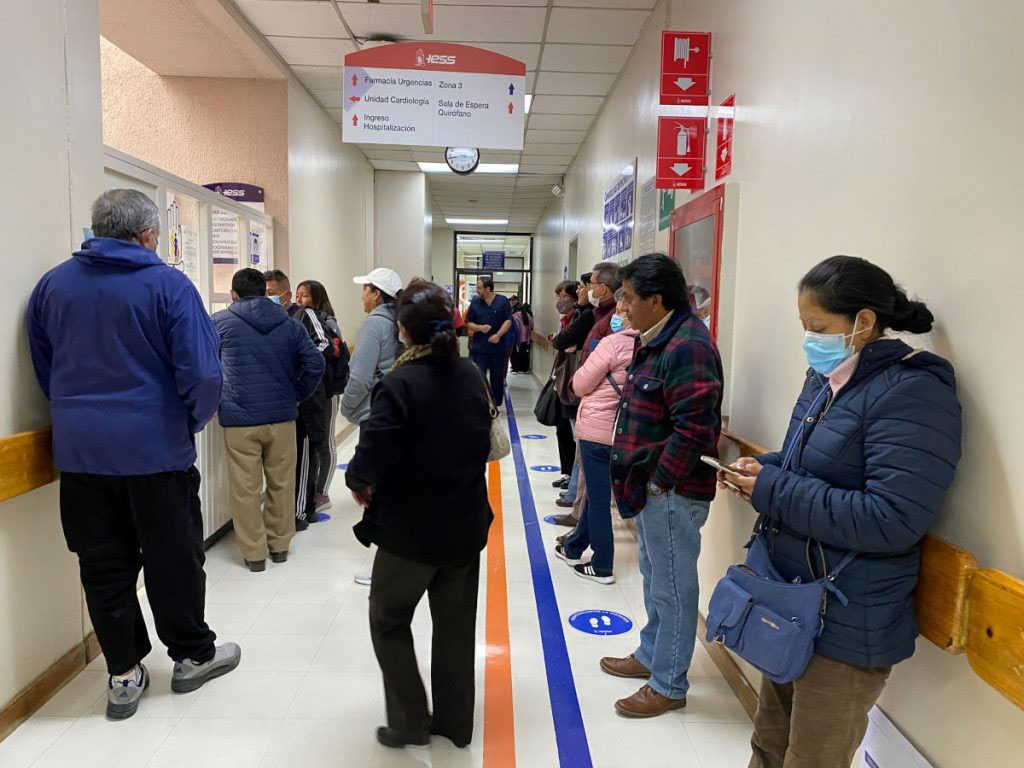
José Carrasco Arteaga is part of the first five-hospital rollout, giving some lower-complexity adult patients a remote consultation after an in-person triage.
IESS has begun a teletriage and telemedicine program at Hospital José Carrasco Arteaga in Cuenca, part of an effort to keep lower-complexity medical problems from consuming specialist emergency resources at Ecuador’s largest social-security hospitals. The service was formally launched in Cuenca on August 27th with remote connections to participating hospitals in Quito.
Despite the name, the process does not begin with a patient calling from home. A person still arrives at the hospital’s emergency area, where staff confirm IESS coverage, take vital signs and assess the severity of the condition. If the case is judged to be low complexity and the patient is between 20 and 50 years old, the patient may be offered a teleconsultation with a general-medicine doctor instead of continuing through the full traditional emergency-care route.
If the remote physician determines that an in-person examination or higher level of care is necessary, the patient is returned immediately to the conventional hospital flow. If the condition can be handled remotely, the doctor can issue a prescription that the patient may fill through the hospital pharmacy.
Why IESS is trying the model
José Carrasco Arteaga is a tertiary referral hospital, meaning it is designed for complex care and specialties that smaller facilities cannot provide. IESS says that through July the Cuenca hospital had seen more than 9,000 general-medicine patients whose complaints did not require the level of specialist care available at a third-level hospital. Diverting some of those cases is intended to reduce congestion and preserve emergency and specialist capacity for patients who actually need it.
The model was tested earlier in Quito, where more than 500 teletriage consultations were completed from June before the broader rollout. IESS is now extending the program to José Carrasco Arteaga in Cuenca, Hospital Carlos Andrade Marín and Hospital Quito Sur in the capital, and major hospitals in Guayaquil, with Portoviejo expected to follow. The institution says it plans a progressive expansion to additional second-level facilities.
For patients, the potential advantage is a shorter path through the hospital for uncomplicated problems. The limitation is equally important: teletriage is not a substitute for emergency evaluation when symptoms may be serious. Chest pain, major trauma, breathing difficulty, stroke symptoms or other urgent conditions still require immediate in-person assessment, and hospital staff—not the patient—determine whether the telemedicine route is appropriate.
What Cuenca patients should know
The program currently targets a relatively narrow group: insured adults roughly 20 to 50 years old whose initial in-person triage identifies a low-complexity problem. It should not be interpreted as a general video-doctor service available to every IESS member from home, nor as a replacement for appointments with a family doctor or specialist.
The distinction between triage and telemedicine can also be confusing. Triage is the initial clinical sorting process that determines urgency. Telemedicine is the remote consultation that may follow after that sorting. In José Carrasco Arteaga’s new workflow, both are connected: the patient is first examined enough to establish that the case is suitable, and only then is a remote general-medicine consultation offered.
If the system works as intended, the benefit will be measured not only by the number of video consultations but by whether waiting times fall and specialty resources are freed for more serious cases. IESS has not yet published enough Cuenca-specific outcome data to judge that. For now, the concrete change is operational: José Carrasco Arteaga has joined the first formal rollout, and some lower-complexity adult emergency patients can now be redirected into a remote consultation after hospital-based triage.
0 Comments