
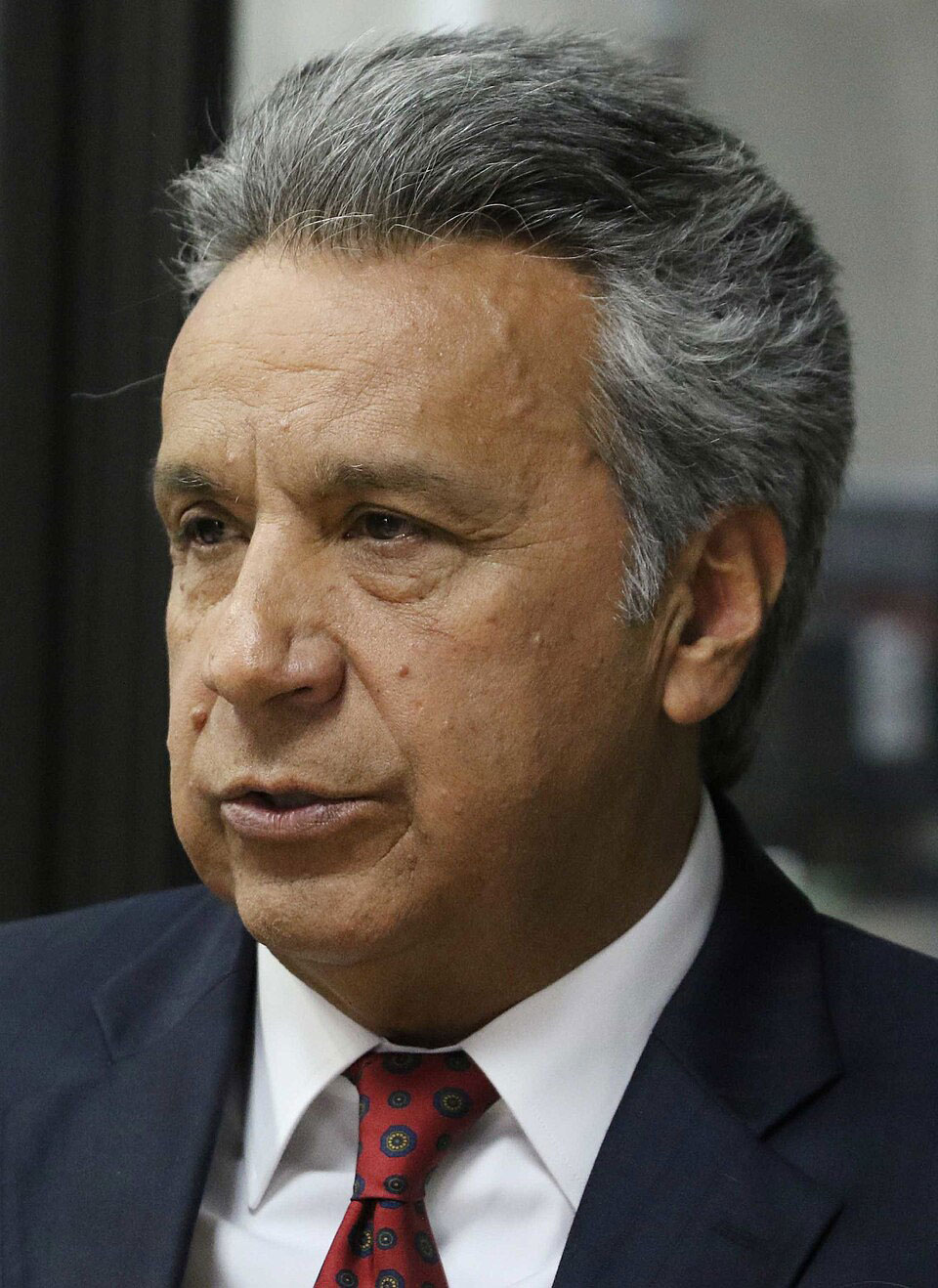
The former president will remain in Ecuador for now, his attorney says, while the first-instance bribery judgment also orders more than $163 million in restitution across 20 convicted defendants.
Former president Lenín Moreno was sentenced to five years in prison on August 28th after a National Court of Justice tribunal found him guilty of cohecho, Ecuador’s criminal offense covering bribery involving public officials, in the long-running Sinohydro case. Nineteen other defendants were also convicted, while one of the 21 people who went to trial was acquitted.
The ruling is a first-instance judgment, not a final resolution of the case. Moreno immediately rejected the verdict, and on August 30th his attorney, David Meza, said the defense plans to use both the ordinary appeal and, if necessary, the extraordinary cassation process. Meza also said Moreno remains in Ecuador and has no plan to leave the country.
Moreno has repeatedly maintained that he did not receive money from Sinohydro, did not intervene in the contracting process and is being blamed for conduct he says he did not commit. His denial remains an essential part of the current status because the conviction can still be challenged through Ecuador’s appellate system.
The case centers on the Coca Codo Sinclair hydroelectric project, the giant power plant built by Chinese state company Sinohydro during the government of Rafael Correa. Prosecutors argued that a network of officials, relatives, intermediaries and businesspeople received improper payments connected to the project and its financing. Fiscalía placed the payment structure at approximately $76.1 million, about 4 percent of the construction contract.
What the tribunal decided
After 31 days of trial proceedings, the three-judge National Court tribunal concluded that the bribery offense had been proven and assigned criminal responsibility individually. Moreno, businessman Conto Patiño and three Chinese nationals were among five defendants who received five-year sentences as direct perpetrators. Two other direct perpetrators received three-year terms, while accomplices received shorter sentences.
The judgment also imposed substantial financial and political consequences. Fiscalía says the individualized restitution orders for all of the convicted defendants total more than $163 million. The tribunal also ordered public apologies, publication of the judgment on several government websites, suspension of participation rights during the sentences and a permanent ban on holding public office for former public servants covered by the ruling.
Those sanctions, like the prison terms, remain part of a first-instance judgment subject to further review. For readers, that legal distinction matters: a trial court has now entered a formal finding of guilt, but the litigation is not over.
Moreno says the case was fabricated
Moreno has been emphatic in denying the central accusation. After the verdict, he said he had not received a single cent from Sinohydro and insisted that he never participated in negotiations for the hydroelectric project. He has described the case as politically motivated and has blamed former president Rafael Correa, from whom Moreno broke politically after taking office.
That political history makes the case unusually charged, but it does not change the present judicial record. The National Court tribunal has issued a formal first-instance conviction after a full trial, while Moreno has announced that he will challenge it.
Coca Codo Sinclair itself has been one of Ecuador’s most controversial public works for years because of its cost, technical problems and the scale of Chinese financing associated with the project. The Sinohydro prosecution adds a corruption judgment to that history. Whatever happens on appeal, the August 28th decision is one of the most consequential rulings nationally involving a former Ecuadorian president in recent years.
0 Comments