
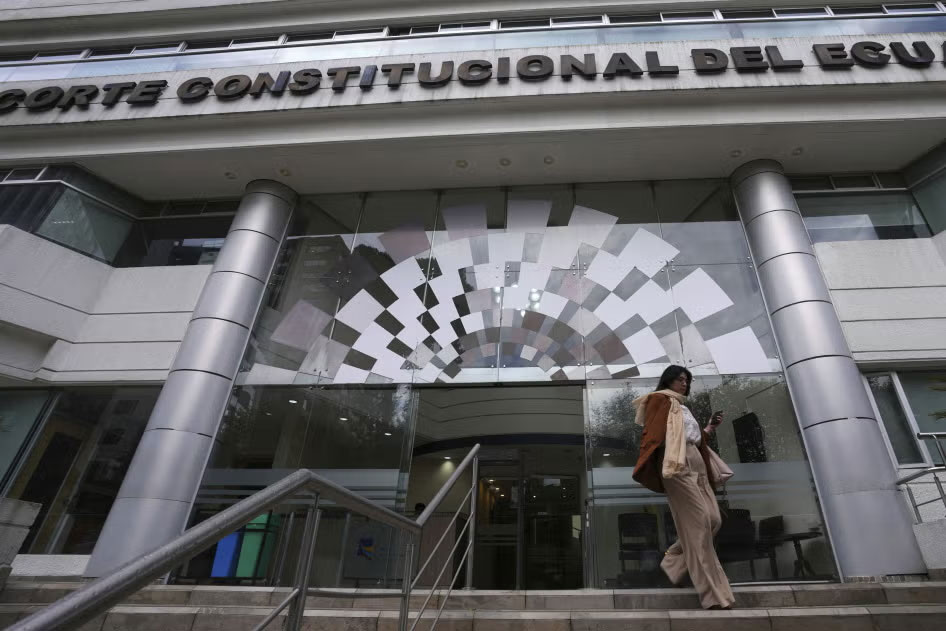
Judges are challenging the restructuring of Ecuador’s specialized corruption courts, while the Judicatura says every pending case still has a judge.
A restructuring of Ecuador’s specialized corruption and organized-crime courts has triggered a constitutional fight over hundreds of criminal cases, with judges taking the dispute to the Constitutional Court while the National Assembly’s Justice Commission has backed the Consejo de la Judicatura’s decision.
The newest legal challenges arrived during the week of October 5th.
Specialized judge Renán Andrade submitted two constitutional consultations on October 6th questioning Resolution 187-2026, the Judicatura measure that reorganized the courts handling corruption and organized-crime cases. Andrade and fellow judge Karol Zambrano have also filed an action alleging noncompliance with a previous Constitutional Court ruling.
The dispute matters because the affected judicial units have handled some of Ecuador’s most complicated criminal proceedings, including cases involving public corruption, organized crime, money laundering and senior government officials.
Legal challenges initially raised questions about the status of roughly 357 criminal cases. The Consejo de la Judicatura says a broader reassignment process has since distributed hundreds of cases among more than 50 judges and insists that no case has been left without a judicial officer.
The Constitutional Court will ultimately have to determine whether the reorganization complies with Ecuador’s Constitution and previous court rulings.
What the Judicatura changed
The controversy centers on Resolution 187-2026.
The Consejo de la Judicatura reorganized the specialized judicial structure that had concentrated corruption and organized-crime cases in designated courts in Quito.
The Judicatura argues that it did not eliminate specialized jurisdiction. Instead, it says the reform redistributes cases and judges in an effort to reduce backlogs, improve efficiency and balance workloads.
Opponents see a more fundamental problem.
They argue that specialized corruption and organized-crime courts were created through legislation and that an administrative resolution from the Judicatura may not have the legal authority to substantially change that structure.
That disagreement has become the central constitutional issue.
If the Constitutional Court concludes that the Judicatura exceeded its authority, questions could arise about how affected cases were reassigned and whether decisions taken under the new structure remain valid.
That does not mean those cases would automatically be dismissed or convictions overturned. Any consequences would depend on exactly what the Constitutional Court decides and how it structures a remedy.
Hundreds of cases have already moved
The Consejo de la Judicatura says the judicial system has continued functioning while those challenges proceed.
On October 8th, Denisse Coronel, the institution’s national director of procedural management, said 658 cases had been reassigned through the new process and were now being handled by more than 50 criminal and specialized judges.
Another 172 cases remain with the judges who were already handling them because hearings had begun, were suspended or were awaiting decisions.
Of those 172 cases, the Judicatura says 169 continue through the normal process and three have been sent to the Constitutional Court through consultations filed by Andrade.
The agency says no corruption or organized-crime case has been abandoned or left without a judge.
That assurance addresses the immediate operational concern, but it does not resolve the legal argument over whether the restructuring itself was constitutional.
Assembly commission sides with the Judicatura
The political side of the controversy also moved forward this week.
On October 8th, the National Assembly’s Justice Commission approved a report supporting the Judicatura’s restructuring.
The majority concluded that the change amounted to a reorganization rather than an elimination of specialized jurisdiction. According to that interpretation, judges continue to exercise specialized authority even though cases are now distributed differently.
Assembly members from Acción Democrática Nacional and allied legislators supported the report.
Opposition lawmakers disputed the conclusion and argued that the commission had not conducted a sufficiently thorough investigation before endorsing the Judicatura’s actions.
The Assembly report does not decide the constitutional issue.
That authority belongs to the Constitutional Court, which must evaluate the lawsuits, consultations and noncompliance action now before it.
Why the structure matters
Specialized courts were created in part because corruption and organized-crime prosecutions can be unusually complex.
They often involve large volumes of financial evidence, government contracting records, international transactions, organized criminal networks and defendants holding significant political or economic power.
Concentrating such cases among judges familiar with those areas was intended to develop expertise and reduce the risks associated with assigning highly complex prosecutions to courts that primarily handle routine criminal matters.
The Judicatura says its new model preserves specialization while spreading workloads more effectively.
Critics worry that decentralizing or redistributing those cases can weaken the specialized system and create uncertainty about jurisdiction.
The stakes are particularly high because procedural defects can become grounds for future appeals.
If a defendant can successfully argue that a case was handled by a court without proper legal authority, an otherwise substantive corruption prosecution could become entangled in years of litigation over procedure.
That is why the Constitutional Court’s eventual decision may matter well beyond the institutional dispute now unfolding in Quito.
For Ecuadorians, the issue is ultimately straightforward: the country has invested considerable resources in prosecuting corruption and organized crime, and those cases need both speed and legal certainty.
The Judicatura says the restructuring will make the system more efficient.
The judges challenging it say efficiency cannot override the legal rules governing which courts are authorized to hear those cases.
The Constitutional Court will now have to decide where that line lies.
0 Comments