
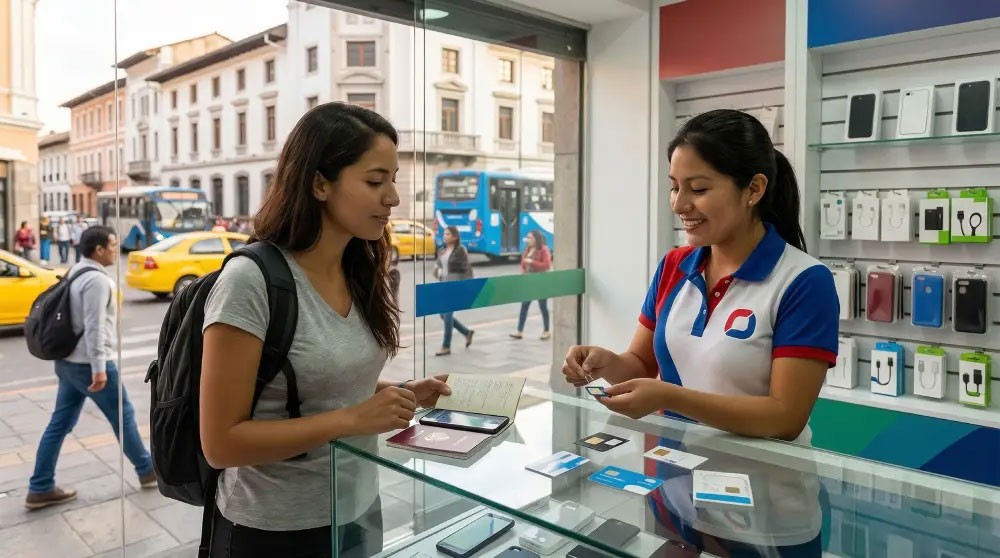
Mobile operators must strengthen identity verification for new and replacement SIM cards as authorities target extortion, fraud and anonymous phone use.
Ecuador is tightening the rules for obtaining and replacing cellphone SIM cards, requiring telecommunications companies to use stronger identity checks—including biometric verification—as the government tries to make it harder for criminals to obtain mobile lines using false or stolen identities.
The new requirements apply to activation of mobile service, SIM-card replacements and other procedures in which an operator needs to confirm the identity of the person controlling a telephone number.
For residents, the practical result is that getting a new Ecuadorian cellphone line or replacing a lost or damaged SIM may now involve more than presenting an identification document.
Operators must verify the customer’s identity against official records and use additional authentication procedures designed to establish that the person physically requesting the service is the legitimate holder of the identification.
Biometric methods can include facial verification or other electronic comparison with official identity data.
The change is part of Ecuador’s broader response to extortion, identity theft, fraudulent bank transactions and the use of anonymously obtained cellphone lines by organized criminal groups.
Why SIM cards have become a security issue
A cellphone number is now tied to far more than telephone calls.
It may be used to receive banking security codes, confirm purchases, recover online accounts, access messaging services and verify identity with government or private services.
That makes control of a mobile number valuable to criminals.
One form of fraud known internationally as SIM swapping occurs when someone convinces or tricks a mobile provider into transferring another person’s telephone number to a SIM card controlled by the criminal.
Once that transfer occurs, security messages and one-time banking codes sent to the victim’s number can be intercepted.
Ecuador faces another problem as well: SIM cards acquired using false identification or intermediaries can give extortionists and organized-crime groups disposable phone numbers that are difficult to trace back to the actual user.
Authorities say stronger registration controls are intended to close those gaps.
The objective is not simply to know the name entered into a carrier’s database but to verify that the person completing the transaction is actually that individual.
What customers should expect
The exact process can differ somewhat among Ecuador’s mobile operators, but customers should expect greater scrutiny when activating or replacing a line.
For Ecuadorian citizens, verification can be performed using identity information held by the Registro Civil.
Foreign residents should be prepared to present the identification document associated with their mobile account, such as a valid cédula or other documentation accepted by the operator.
That is particularly important for long-term foreign residents whose telephone numbers may have been activated years ago using passports, older cédulas or identification details that have since changed.
Customers whose information does not match carrier records may need to update their account before certain transactions can be completed.
A lost phone provides a good example.
Previously, a customer might have been able to visit a store, present identification and quickly receive a replacement SIM containing the existing phone number. Under stronger verification procedures, the operator may also require electronic identity confirmation before transferring the number to the new chip.
The extra step may be inconvenient, but it is precisely the point of the reform: replacing a SIM should be difficult for someone pretending to be the legitimate customer.
Foreign residents have another reason to check their records
Expats can face complications when personal information is not consistent across Ecuadorian systems.
Names may appear differently on passports and cédulas. A person may have obtained a cellphone line before receiving Ecuadorian residency. Another may have changed passport numbers, marital status or identification documents without updating the mobile account.
Those discrepancies matter more when a carrier must electronically compare customer information with official databases.
Residents who rely heavily on an Ecuadorian number for banking or authentication should therefore make sure the line is registered in their own name and that the carrier has current identification information.
That becomes especially important before international travel.
Losing a phone overseas can already make replacing an Ecuadorian SIM difficult. A customer whose account information is outdated may encounter an additional obstacle when trying to regain access to a number that controls banking or online accounts.
Using an eSIM does not eliminate the identity requirement. An eSIM changes the physical format of the mobile subscription but still assigns service to an identified customer.
Not every suspicious call becomes traceable
The stronger rules should also not be interpreted as making anonymous criminal communications impossible.
Criminal groups can use internet-based messaging, foreign telephone numbers, stolen phones and other techniques to hide their identities.
A properly registered SIM can also be used by someone other than the person whose name appears on the account.
The reform therefore adds another investigative and fraud-prevention tool rather than creating perfect traceability.
For consumers, however, it provides an important additional barrier against unauthorized transfers of their own telephone numbers.
That matters because a mobile number has effectively become part of a person’s financial identity.
Residents who want to avoid problems should take a few straightforward steps: make sure their Ecuadorian line is registered in their own name, update identification information when documents change, protect carrier account passwords or PINs and treat an unexpected loss of cellphone service as a possible security warning rather than merely a network problem.
If a phone suddenly loses service while other phones nearby remain connected, contacting the carrier quickly can help determine whether the problem is technical or whether the number has been transferred without authorization.
The new registration rules make mobile service slightly less convenient to obtain.
They are designed to make stealing someone else’s mobile identity considerably harder.
0 Comments