
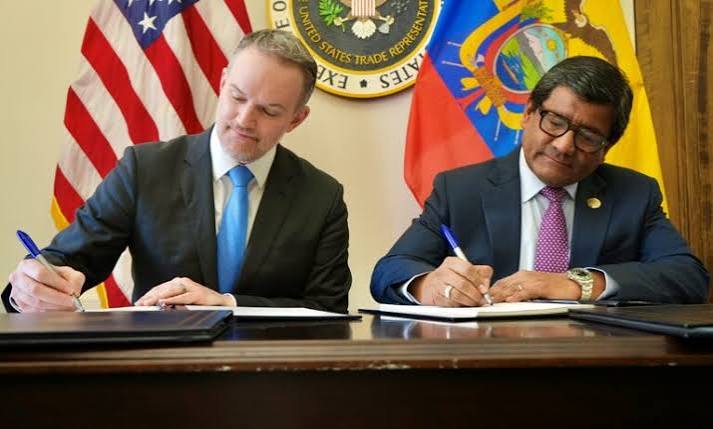
Deals with the United States, Canada and the UAE remain stuck at different stages of Ecuador’s approval process.
Ecuador’s exporters are asking the Constitutional Court to accelerate work on three trade agreements that could affect some of the country’s most important non-oil exports, arguing that delays are leaving Ecuador at a competitive disadvantage to neighboring countries with broader access to overseas markets.
The Ecuadorian Federation of Exporters sent a letter this week asking the Court to prioritize the legal processing of agreements with the United States, Canada and the United Arab Emirates. All three were signed in 2026, but none can simply take effect because signing is only one step in Ecuador’s constitutional approval process.
The United States agreement is the clearest example. The Constitutional Court has already determined that the reciprocal trade agreement requires approval by the National Assembly before ratification. The Court must also continue its constitutional review of the treaty.
Three agreements, three approval tracks
The agreement with the United States was signed in Washington on March 13th. Ecuador’s agreement with Canada was signed July 24th in Ottawa, while the Comprehensive Economic Partnership Agreement with the United Arab Emirates was signed March 1st in Quito.
Exporters say only about 53% of Ecuador’s non-oil exports currently enjoy coverage under trade agreements, compared with more than 85% for competitors such as Colombia, Peru and Chile. That gap matters in products where a few percentage points of tariff can decide whether an Ecuadorian shipment is competitive.
The U.S. relationship is especially important because American tariff policy has changed during the year. The original reciprocal agreement was negotiated in part around a 10% surcharge that affected a large share of Ecuadorian exports. That earlier measure expired, but a new 10% surcharge now applies to a different group of products under a U.S. action related to imports associated with forced labor concerns.
Who is exposed
According to exporter estimates cited in current reporting, roughly 46% of Ecuador’s non-oil exports to the United States are affected by the newer 10% surcharge. Shrimp is among the products exposed, along with broccoli, canned tuna, pitahaya and some other fruits. Non-food goods such as certain straw hats, luggage, clothing, footwear and manufactured products are also affected.
Other exports, including bananas, cocoa, flowers and designated critical minerals, are exempt from the newer surcharge. That uneven treatment is one reason a broad trade framework matters: different sectors have very different exposure to tariff changes.
Why residents should care
Trade agreements can sound remote from everyday life in Cuenca, but Azuay is tied into national export supply chains through agriculture, manufacturing, logistics, services and household income. Export growth can affect jobs and investment even when the products leave through ports hundreds of kilometers away.
The agreements also matter on the import side. The U.S. accord includes lower or zero tariffs for some agricultural machinery and industrial equipment, including certain construction machinery. That could eventually affect input prices for Ecuadorian businesses, although the actual tariff schedule depends on the final ratified text.
The important caution is that none of this should be written as if the agreements are already in force. The current development is procedural: exporters are pressing the Constitutional Court to move pending reviews, and the U.S. agreement is known to require Assembly approval. Until those constitutional and legislative steps are complete, the benefits remain prospective rather than guaranteed.
0 Comments