
Warnings of crop losses, disrupted transport and absent reserves revive memories of the devastating 1997 disaster.
Ecuador is entering the early stages of a potentially powerful El Niño with little of the public food-storage capacity that helped the country respond to previous agricultural disasters, raising fears that severe flooding could turn a climate emergency into a nationwide supply crisis.
United Nations projections indicate that approximately 2.6 million Ecuadorians could face acute food insecurity by July 2026. About 2.5 million people are expected to fall into the crisis category, while another 95,000 could reach the more severe emergency classification under the Integrated Food Security Phase Classification system.
The warning does not mean that Ecuador is already facing a generalized shortage. But agricultural specialists say the combination of flooded farmland, crop disease, damaged roads, interrupted distribution networks and limited government reserves could rapidly place basic foods beyond the reach of vulnerable families.
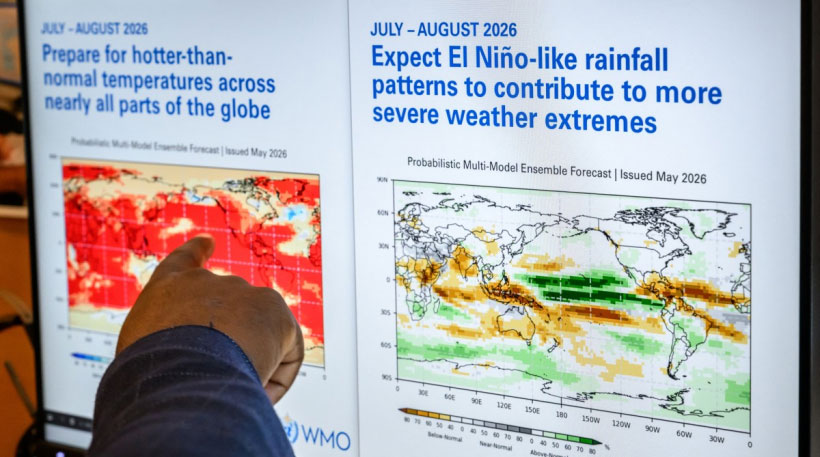
The Oceanographic and Antarctic Institute of the Ecuadorian Navy has said the 2026-2027 El Niño is already in its initial phase. The Ministry of Agriculture expects the most difficult period to extend from October 2026 through February 2027, when prolonged rainfall could affect both harvesting and the movement of food from farms to markets.
For farmers and former officials who experienced the catastrophic 1997-1998 event, the emerging forecasts carry a familiar and troubling message: Ecuador may again be forced to import large quantities of food while attempting to protect agricultural producers from financial collapse.
A warning written in the fields
The 1997-1998 El Niño remains the most significant recent example of how an oceanic and atmospheric event can spread through nearly every part of Ecuador’s economy.
Reports prepared by regional and international organizations estimated that close to seven million people — approximately 60% of the country’s population at the time — suffered direct or indirect consequences.
Agriculture was among the sectors hit hardest. More than 843,000 hectares of crops were affected, while government and United Nations figures indicated that 106,388 farmers sustained losses.
Former Agriculture Minister Alfredo Saltos Guale, who served during the height of that emergency, recalls that the destruction extended far beyond drowned fields. The collapse in production led farms to suspend workers, reduced rural incomes and contributed to migration from areas where agricultural employment disappeared.
The economic damage attributed to the 1997-1998 El Niño reached an estimated $2.882 billion. Adjusted for inflation through May 2026, that would equal more than $6 billion.
Those losses were not concentrated in one crop or province. Cocoa, mango and banana plantations in Guayas and Los Ríos suffered extensive damage, according to agronomist Sergio Cedeño, who managed coastal plantations during the disaster.
In many areas, water remained on the land long after the initial flooding. Farmers struggled to drain plantations, machinery could not enter saturated fields and fungus spread quickly through crops already weakened by excess moisture.
Harvesting a product was only part of the challenge. Even crops that survived could spoil before reaching buyers because flooded or damaged roads prevented trucks from entering production zones. Warehouses, processing plants and local markets also faced interruptions.
The result was a chain reaction: farmers lost their crops, laborers lost their wages, banks stopped receiving loan payments and consumers faced fewer products at higher prices.
Climate damage becomes financial damage
The Central Bank later concluded that the 1997-1998 El Niño altered the agricultural cycle and deepened existing problems involving inflation, financial-sector solvency and macroeconomic stability.
Some agricultural specialists believe the disaster contributed to the economic deterioration that culminated in Ecuador’s 1999 banking crisis and the adoption of the U.S. dollar in 2000.
Economist Marco Naranjo, however, cautions against treating El Niño as the principal cause of the banking collapse. He argues that weak management of oil revenues, rising public debt and poor financial regulation created structural problems long before the rains arrived.
Even so, the previous disaster demonstrated how quickly weather damage can intensify existing weaknesses. Farmers who lose an entire season may be unable to repay loans or finance the next planting. Banks then become reluctant to extend credit precisely when producers need it most.
That pattern is especially dangerous for small farmers, who often lack insurance, savings or access to emergency financing. A large agricultural company may absorb one failed harvest or shift production elsewhere. A family farm may not survive even a partial loss.
The danger in 2026 is therefore not limited to the amount of food produced during one season. The country could also lose productive capacity for later seasons if farmers are forced to sell land, abandon crops or leave agriculture altogether.
Food imports prevented a deeper emergency
During the 1997 crisis, Ecuador responded by importing enormous volumes of basic products.
Saltos said the country brought in approximately 200,000 metric tons of sugar, 140,000 metric tons of corn and an additional 60,000 metric tons of soybeans. Rice-sector representatives have also estimated that around 200,000 tons of rice were imported because of the disaster.
Those purchases helped prevent agricultural losses from becoming an even more serious humanitarian crisis. But emergency imports came with their own risks, including international price fluctuations, shipping delays and the need for sufficient port and storage capacity.
A country forced to buy food after a disaster may also find itself competing with other nations affected by the same climate pattern. If El Niño damages production across several countries simultaneously, prices can rise before Ecuador secures the supplies it needs.
Imports also do little to protect farmers who have lost their crops. In some circumstances, poorly timed foreign purchases can reduce local prices and make recovery even harder for producers who still have something to sell.
The challenge for the government is to bring in enough food to stabilize domestic markets without undermining surviving national production.
The reserve system that disappeared
The most significant difference between the current situation and the 1997 emergency may be Ecuador’s reduced capacity to store strategic food supplies.
At the time of the previous disaster, the country had a public organization responsible for storage and marketing. That institution maintained infrastructure that could hold grain and help the government respond when production fell.
The system was gradually dismantled and no longer operates in its previous form. Ecuador must now depend heavily on private warehouses, mills, traders and agricultural businesses for information about available stocks and for the physical space needed to store emergency supplies.
Saltos believes cooperation with the private sector will be essential because rebuilding a complete government storage network before the most dangerous months would be difficult.
The absence of a national reserve does not necessarily mean Ecuador has no food stored. Rice mills, animal-feed companies, exporters, importers and wholesalers maintain inventories for commercial purposes. But privately held stocks are not the same as a coordinated public reserve that can be released according to national need.
Commercial inventories may already be committed to customers, concentrated in certain provinces or unavailable at prices that low-income families can afford. Without accurate information, the government may not know how much food exists, where it is located or how long supplies will last.
A successful emergency plan would therefore require agreements with private operators before shortages begin, rather than negotiations after supermarket shelves start to empty.
Not every crop can be placed in a warehouse
Grain reserves are only one part of Ecuador’s vulnerability.
Rice, corn and soybeans can be stored under controlled conditions, but much of Ecuador’s agricultural economy depends on products that are highly perishable or intended for export. Bananas, mangoes and many other fruits cannot simply be placed in silos until roads reopen.
Cocoa can be stored longer than fresh fruit, but excessive moisture can disrupt the fermentation and drying of the beans, encourage mold and reduce their quality. Farmers who cannot complete those post-harvest steps properly may struggle to meet export standards even when part of the crop survives.
Rice presents its own technical problem. Grain generally cannot be stored safely when its moisture content exceeds approximately 13%. During weeks of heavy rainfall, producers may be unable to dry harvested rice to the required level.
That creates a cruel possibility: grain may exist in the fields or arrive at collection centers but still be unsuitable for long-term storage. Without adequate drying equipment, farmers could watch a potentially marketable harvest deteriorate.
Specialists say the country must therefore assess not only warehouse capacity but also dryers, drainage pumps, rural roads, bridges, processing plants and backup electricity for agricultural facilities.
Livestock and fishing also face disruption
The damage from a severe El Niño would not stop with crops.
During the 1997-1998 emergency, poultry-producing areas around Bahía de Caráquez, Tosagua and Portoviejo were forced to reduce or abandon activity. Flooded farms, animal disease, damaged buildings and shortages of feed made continued production impossible in some locations.
A similar disruption today could affect supplies of chicken and eggs, two important and relatively affordable sources of protein for Ecuadorian families.
Feed availability is particularly important because the poultry and livestock industries depend heavily on corn and soybeans. If domestic grain production falls, producers must either import more feed or pay higher prices. Those costs eventually reach consumers.
Changes in ocean temperature can also affect fishing. During strong El Niño events, species such as sardines may move in search of cooler water, while tuna reproduction and migration patterns can change.
That reduces catches, increases fuel expenses for fishing fleets and threatens employment in coastal communities. It also removes another source of protein from domestic markets precisely when meat, poultry and grain prices may already be rising.
Transport could decide which communities eat
The condition of Ecuador’s roads may prove as important as the condition of its farms.
A shortage can develop locally even when food remains available elsewhere. If landslides, collapsed bridges or flooded highways isolate a city, residents may face empty markets while products spoil in another province.
The 1997 disaster showed that distribution failures can magnify agricultural losses. Trucks could not reach plantations, and farmers could not move surviving products before they deteriorated.
Ecuador’s mountainous geography makes the problem particularly difficult. Coastal flooding may occur at the same time that intense rainfall triggers landslides in the Andes. A route used to bypass one obstruction may itself become impassable.
Authorities would need to identify priority corridors for food, fuel and medical supplies, while keeping alternative routes ready. Municipal governments, provincial authorities, the military, police and private transport companies would have to coordinate closely.
Without that preparation, the first visible sign of the crisis may not be a destroyed crop but a sudden price increase in a city hundreds of kilometers away.
The poorest households face the greatest danger
Food insecurity is not defined only by whether food exists. It also depends on whether families can afford it.
A household may live near a fully stocked market and still face hunger if prices rise faster than wages. Families in rural areas, informal workers, unemployed people and communities already struggling with poverty are likely to suffer first.
As basic foods become more expensive, households often respond by buying less meat, dairy, fruit and vegetables. They may continue eating but consume meals with fewer nutrients, creating longer-term health consequences for children, older adults and pregnant women.
The United Nations projection of 2.6 million people facing crisis or emergency conditions reflects that wider danger. Flooding can destroy a farmer’s harvest, eliminate a laborer’s job and raise the cost of food at the same time.
Agricultural experts say Ecuador still has time to reduce the risk, but the window for preparation is narrowing. Agreements on private grain stocks, emergency imports, crop insurance, loan restructuring, drainage equipment and road protection must be organized before the heaviest rains arrive.
For farmers, the coming months will determine whether they can harvest, dry and sell their crops. For the government, they will test whether the lessons of 1997 were preserved after the floodwaters disappeared — or whether Ecuador will again be forced to build a food-security response in the middle of the disaster.
0 Comments