
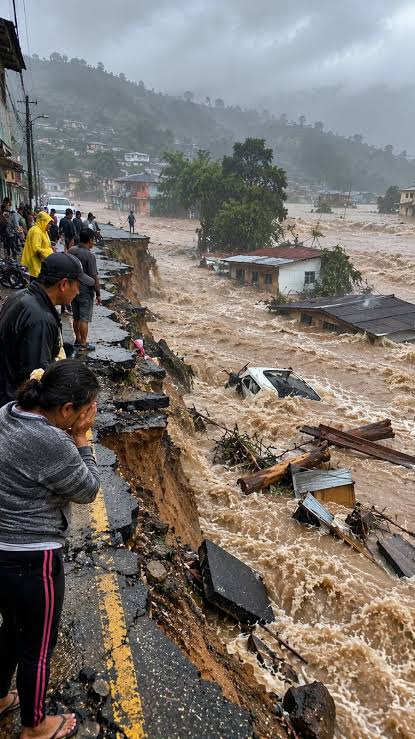
The weekend deluge damaged roads, disrupted water service and forced evacuations in one of Ecuador’s most important tourism centers.
Galápagos entered November under emergency conditions after torrential El Niño rains flooded large sections of Santa Cruz, damaged the main island road, disrupted drinking-water service and forced families from their homes in one of the archipelago’s most serious weather emergencies of the year.
Authorities estimated that about 2,000 people were affected after rain beginning the night of October 30th continued for hours into October 31st. ECU 911 initially confirmed one death in Bellavista and two people missing in Divino Niño; later local authorities reported that the death toll had risen to two, a figure that was not yet reflected consistently across all national emergency updates on Sunday. Neighborhoods including La Cascada, Bellavista, Santa Rosa, Aguacatal, Miramar and Divino Niño reported flooding, while some residents were evacuated by boat as water rose through streets and homes.
By Sunday morning, November 1st, rain was continuing across the islands, although at lower intensity in Santa Cruz. The national government had moved humanitarian supplies to the archipelago, five temporary shelters had been prepared with capacity for about 1,000 people, and emergency crews were assessing damage to homes, utilities and transportation routes.
Why the Galápagos emergency matters nationally
Galápagos is geographically isolated, heavily dependent on air and sea logistics and unusually sensitive to disruptions in water, electricity and transportation. A flood that might be difficult on the mainland can become more complicated on an island where replacement equipment, food, fuel and construction materials have to arrive from elsewhere.
Puerto Ayora’s drinking-water system was temporarily disrupted, and authorities relied on stored reserves, tanker trucks and wells while repairs and assessments continued. The road linking Puerto Ayora with the highlands and the route toward the Baltra airport area suffered damage in multiple places, complicating movement at the same time tourists and residents were trying to navigate the emergency.
The Galápagos National Park also temporarily closed several visitor sites on Santa Cruz and San Cristóbal because of unsafe access and weather conditions. Flight operations were disrupted on Saturday, adding a tourism and logistics problem to the local emergency.
El Niño is no longer an abstract forecast
The Santa Cruz flooding is important because it provides another clear sign that the current El Niño event is already producing damaging impacts across very different parts of Ecuador. During the same week, rivers overflowed on the mainland, Guayas and El Oro reported serious flooding, and INAMHI warned that unusually intense rainfall would continue across the Coast, parts of the Sierra and the islands.
At one point this week, Risk Management was monitoring at least 14 overflowing rivers in several provinces. Coastal communities were already dealing with saturated ground, damaged roads and repeated flooding before the Galápagos emergency developed.
For Azuay residents, the lesson is not that Cuenca will experience the same kind of flooding as Santa Cruz. The risks are different. In the highlands, prolonged rainfall more often translates into landslides, blocked highways, river increases and unstable slopes. The Cajas and lower-elevation parts of Azuay have already appeared in weather warnings during the current event.
What happens next
The immediate priority in Santa Cruz is restoring basic services and determining which homes and roads can safely be used. Authorities also have to evaluate agricultural losses and the condition of infrastructure that could fail if additional heavy rain arrives before the ground has time to drain.
Emergency officials sent 10 tons of humanitarian assistance to Galápagos late Saturday, including first-response and sleeping kits. The government also sent pumps to help remove water from affected agricultural areas.
The broader concern is duration. El Niño is expected to influence Ecuador well beyond this weekend, and repeated rainfall can compound damage even when individual storms are less dramatic. Roads weakened in one event can fail later; water systems can be contaminated; and tourism businesses can face cancellations long after the weather improves.
For residents and travelers, the practical rule is to treat Galápagos conditions as changing rather than fixed. Anyone with upcoming travel should check airline notices, National Park access restrictions and local emergency information shortly before departure. The emergency is real, but the exact impact on an individual itinerary will depend on which island, road and visitor site is involved.
0 Comments