
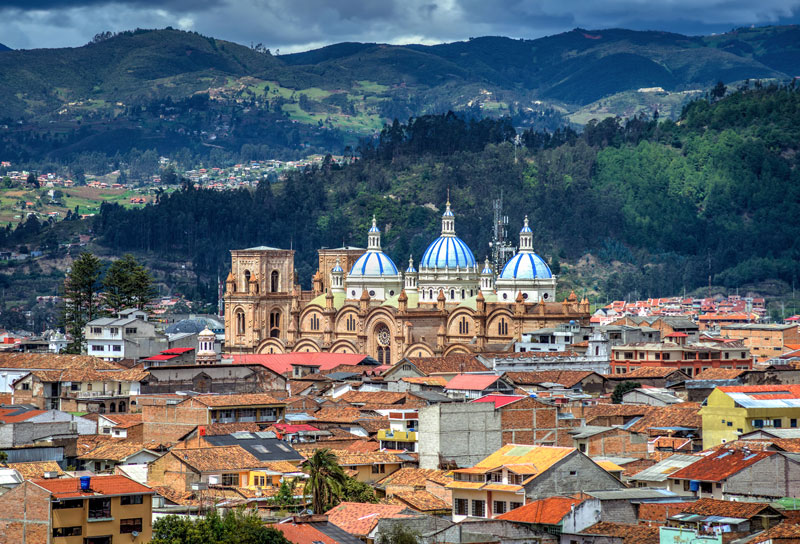
The qualities drawing new residents and investment are also pushing housing costs, outward expansion and traffic pressure.
Cuenca enters its 206th Independence celebration with something many Ecuadorian cities would like to have: people increasingly want to live there. The harder question is whether the city can absorb that popularity without damaging the quality of life that made it attractive in the first place.
Current reporting around the anniversary highlights the same combination that foreign residents have talked about for years — comparatively strong basic services, green space, cultural life, a manageable urban scale and a sense of security that stands out nationally.
A recent local quality-of-life survey found that more than 93% of respondents were satisfied to live in Cuenca and a similar share said they were proud of the city. ETAPA data cited in the reporting put potable-water coverage above 95%, while the tram and extensive river corridors add amenities that are unusual for a city of Cuenca’s size.
But the anniversary coverage also brought the other side of the story into focus.
The city is spreading faster than its population
Urban researchers say Cuenca’s physical footprint has expanded far more rapidly than its population over recent decades. New housing and commercial development increasingly pushes toward areas that were once rural or semi-rural.
That creates a basic municipal problem: every new low-density expansion needs roads, water, sewerage, transport and other services. The farther development spreads, the more expensive those systems can become to provide.
Researchers interviewed this week argued for more development inside the existing urban boundary, with neighborhoods dense enough to support services but not dominated by extremely tall buildings.
Housing prices are part of the pressure
Cuenca has also become an important real-estate investment market. New apartment buildings, medical facilities, offices and commercial projects are visible across the city, particularly in high-value zones.
That investment brings jobs and construction activity, but it also contributes to a growing debate over land and housing costs. Academics interviewed in the current reporting warned that rising prices can make central and established neighborhoods less accessible to Cuencanos and push households toward the urban edge.
Foreign residents are not the only reason for higher prices, and it would be simplistic to blame them for the city’s housing market. Cuenca is attracting Ecuadorians from other provinces, returning migrants, businesses, investors and tourists as well.
Still, international demand is part of the market in some neighborhoods, particularly where buyers have greater purchasing power in dollars or retirement income.
Cars are growing much faster than people
One of the clearest warning signs is traffic. Between 2018 and 2025, the number of vehicles in Cuenca reportedly increased about 32%, while population grew only about 6%.
That explains a familiar contradiction: distances in Cuenca remain relatively short, but the time required to travel those distances keeps increasing.
The tram provides a high-capacity electric spine through the city, but it cannot solve congestion alone. Bus quality, walkability, cycling, parking policy and land-use decisions all determine whether residents feel they need a private car for routine trips.
Growth can either strengthen or erode what people came for
The interesting thing about Cuenca’s current boom is that the city’s strengths are also creating its risks. Safety, services, restaurants, culture and attractive neighborhoods draw more residents and investment. More residents and investment then raise pressure on roads, land and services.
That is not an argument against growth. It is an argument for managing it.
For foreign residents, the issue is worth watching because the qualities that make Cuenca attractive are public goods. Clean rivers, reliable water, accessible parks, functioning transit and a historic center do not preserve themselves simply because demand is strong.
Cuenca’s next urban success may therefore depend less on attracting people than on making sure the people who arrive — Ecuadorian and foreign alike — can be accommodated without pushing the city into the same congestion, housing and infrastructure problems residents were trying to escape elsewhere.
Urban spread will reduce farming possibilities while ugly high rises will undermine the charm of colonial Cuenca. Maybe the city ought to concentrate on a stable population and improved facilities. A plebiscite would determine the near future of the town.