
The president’s U.S. agenda blended anti-crime cooperation with a pitch for confidence in Ecuador’s financial direction.
President Daniel Noboa closed a high-profile visit to Washington by presenting Ecuador as a country seeking stronger international backing on two fronts at once: the fight against organized crime and the effort to rebuild economic confidence abroad. Over two days of meetings with U.S. officials, regional diplomats and multilateral lenders, Noboa argued that Ecuador has become a reliable partner in security matters while also taking the fiscal steps needed to regain access to global capital markets.
A visit built around security cooperation
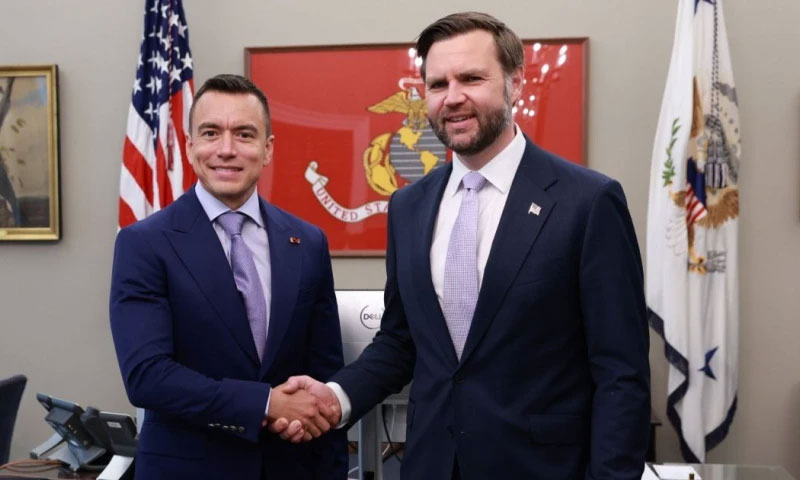
Noboa’s Washington agenda placed crime and narcotrafficking at the center of Ecuador’s relationship with the United States. After meeting with U.S. Vice President JD Vance on May 13th, the president said both countries face criminal networks that operate beyond national borders and must be confronted through coordinated action.
“Ecuador and the United States are fighting against enemies that recognize no borders,” Noboa said after the meeting, framing the bilateral relationship as one rooted in shared security interests.
The visit came as Ecuador continues to seek expanded U.S. assistance against drug trafficking, illegal mining and armed criminal groups. Although the Ecuadorian government did not release detailed information about the meeting with Vance, Noboa used the encounter to emphasize that cooperation with Washington remains central to his security policy.
His administration has increasingly described Ecuador’s internal violence as part of a broader regional criminal economy, one linked to cocaine production in neighboring Colombia, maritime trafficking routes, and armed groups operating near the northern border. In Washington, Noboa returned repeatedly to that argument, insisting that Ecuador should be viewed not merely as a country facing domestic insecurity, but as a frontline state in a hemispheric struggle against transnational crime.
Defense of the Sucumbíos operation
That message became sharper during an interview with CNN, when Noboa defended a March military strike in Sucumbíos that was carried out with U.S. cooperation and later drew criticism from Democratic members of Congress.
The president said the target was located in a conflict zone near the Colombian border where drug traffickers, guerrilla factions and dissident armed groups operate. He said traffickers use waterways and nearby rural properties to move drugs, making intelligence cooperation with allied countries essential.
According to Ecuadorian authorities, the operation was directed at a camp linked to the Border Commandos, a dissident faction with roots in the former FARC structure. Questions over the strike intensified after a U.S. newspaper reported that the site may have been a dairy farm rather than a criminal camp, and several Democratic lawmakers asked the U.S. government to review recent joint operations in Ecuador amid concerns about possible human rights violations.
Noboa rejected the criticism, maintaining that the zone was heavily influenced by narcotrafficking and that Ecuador had acted against a legitimate criminal threat. He said the site was close to coca-growing areas in the Sucumbíos-Putumayo border corridor and argued that his government relies on intelligence from international partners because the networks operating there extend well beyond Ecuador’s territory.
The president’s comments signaled that his administration has no intention of retreating from controversial security cooperation with the United States, even as the political debate around those operations grows in Washington.
A warning aimed at reluctant partners
Noboa also used the trip to deliver a pointed message to governments he believes are not fully cooperating against drug trafficking. Speaking with reporters during his visit to the Organization of American States, he said Ecuador would keep its “distance” from countries that fail to support the fight against organized crime.
The remark appeared aimed, at least in part, at tensions with Colombian President Gustavo Petro, whose government has had a strained relationship with Ecuador on border security questions. Noboa has pressed for greater cross-border collaboration as Ecuador confronts armed groups operating in northern provinces, particularly in areas where criminal structures are tied to cocaine production and trafficking routes from Colombia.
At the OAS, Noboa presented Ecuador’s security crisis as a regional challenge requiring broader diplomatic and operational coordination. His appearance before the organization’s Permanent Council gave him a forum to argue that organized crime, illegal mining and narcoterrorism cannot be contained by national governments acting alone.
Washington backing, but also scrutiny
The administration of U.S. President Donald Trump has spoken favorably of Ecuador’s role in regional security and migration policy. During Noboa’s visit, the State Department’s Bureau of Western Hemisphere Affairs described Ecuador as an excellent partner for the United States on security and illegal immigration.
The trip also included a diplomatic cooperation agreement signed by Foreign Minister Gabriela Sommerfeld and U.S. Undersecretary Christopher Landau, focused on strengthening training and institutional exchanges.
Still, Noboa arrived in Washington at a moment of mixed signals. A newly released Trump administration anti-drug strategy had not prominently mentioned Ecuador, despite recent cooperation between the two governments. At the same time, Democratic lawmakers were pressing for answers about U.S.-supported military actions inside Ecuador.
That combination left Noboa with a delicate task: reaffirming Ecuador’s usefulness to Washington while defending tactics that have attracted attention from critics in the U.S. Congress.
An economic message at the IDB
Security was only one half of Noboa’s Washington message. At the headquarters of the Inter-American Development Bank, he turned to Ecuador’s fiscal outlook, investment climate and efforts to improve international credibility.
In a discussion with IDB President Ilan Goldfajn, Noboa argued that his government is pursuing a disciplined economic and political plan designed to stabilize public finances, attract investment and restore confidence in Ecuador’s ability to meet its obligations. He acknowledged that the country still faces difficult challenges in growth and fiscal sustainability but insisted that recent indicators show progress.
“We are in a transition process; institutions are being strengthened,” Noboa told attendees, adding that his government wants its reforms to become lasting state policies rather than temporary measures tied only to one administration.
He also said Ecuador’s recent economic performance demonstrates that the country is moving in the right direction. The administration has spent the last two years working to reduce country risk, reinforce relations with international lenders and reopen the path toward global debt markets after a long period of restricted access.
That effort has taken place alongside severe domestic pressures. Ecuador continues to face high security spending needs, a fragile fiscal position and demands for social investment. Noboa’s pitch in Washington was that the government is trying to address those pressures without abandoning macroeconomic discipline.
Multilateral support and the Ecuador 2040 agenda
The IDB signaled continued support for Ecuador during Noboa’s visit. Goldfajn said the bank was prepared to assist the country’s long-term growth strategy, including the Ecuador 2040 agenda and the use of the Ecuador Crece initiative to help guide reforms, investment sequencing and measurable results.
For Noboa, the meeting offered a chance to show that Ecuador is not only asking for help, but presenting itself as a country with a reform program that international institutions can support. His administration has leaned heavily on relationships with the IDB, the International Monetary Fund and the World Bank as it seeks financing, technical assistance and credibility with investors.
The broader political message of the Washington trip was that Ecuador’s security and economic challenges are deeply connected. Noboa portrayed organized crime as a threat to sovereignty, investment and daily life, while describing fiscal stability as essential to sustaining the state’s ability to respond. His meetings in the U.S. capital were aimed at persuading foreign officials and lenders that Ecuador deserves both strategic support and renewed confidence.
0 Comments