
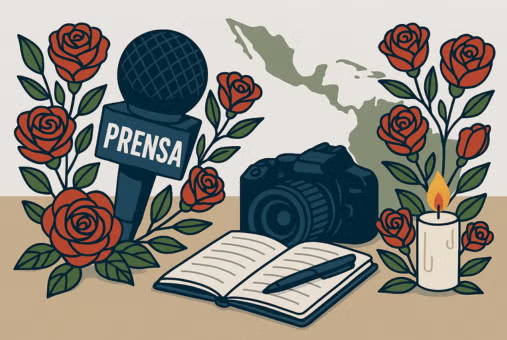
Global watchdogs warn that intimidation, killings and disinformation are weakening journalism in Ecuador and across the Americas.
A dangerous year for journalists
World Press Freedom Day arrived this year with a grim reminder of how dangerous journalism has become, not only in war zones and authoritarian states, but also in countries where organized crime, political hostility and public distrust are reshaping the limits of what reporters can safely do.
At least 60 journalists were killed in 2025 because of their work, according to Reporters Without Borders. The highest number was recorded in the Palestinian territories, where 25 journalists were killed. Mexico followed with nine deaths, Peru with four, and Ecuador and Ukraine with three each. Bangladesh, the Democratic Republic of Congo and Sudan recorded two each.
That placed Ecuador fifth among countries with the highest number of journalist deaths documented by the organization in 2025, a troubling position for a country where media workers have faced growing threats from criminal groups, online harassment, political attacks and economic pressure.
May 3rd, marked globally as World Press Freedom Day, was created by the United Nations General Assembly in 1993 to draw attention to the role of journalism in democratic societies. It is also a day to honor journalists who have been killed while doing their jobs and to measure how governments, institutions and citizens are protecting—or failing to protect—the right to inform and be informed.
Ecuador falls sharply in global ranking
Ecuador dropped 31 places in the latest World Press Freedom Index, falling from 94th to 125th out of 180 countries evaluated by Reporters Without Borders. The decline reflects a worsening environment for journalists, especially in areas where organized crime has expanded its influence and where reporters have increasingly been forced to choose between publishing sensitive information and protecting their lives.
The organization describes Ecuador’s media environment as one marked by insecurity, hostility and self-censorship. That assessment is reinforced by local press freedom groups, which have documented hundreds of attacks, threats and intimidation efforts against journalists in the country.
The deterioration is not limited to Ecuador. For the first time since the index was created, more than half of the world’s countries are now classified as having a “difficult” or “very serious” situation for press freedom. The Americas, once considered comparatively safer for journalism than other regions, have also experienced a significant slide.
The United States fell seven places, from 57th to 64th. Twelve Latin American countries also declined. Peru dropped to 144th, El Salvador fell to 143rd, Argentina to 98th, Panama to 65th, Paraguay to 88th, Chile to 70th and Costa Rica to 38th.
Some countries improved, including Colombia, Brazil and Uruguay. But several countries in the region remain near the bottom of the global table, including Nicaragua, Venezuela and Mexico, where journalists continue to work under extreme pressure.
Killings on the coast
The three journalist killings in Ecuador documented by Reporters Without Borders in 2025 occurred in coastal provinces, where the growth of criminal organizations has collided with local reporting on security, politics and public affairs.
Patricio Aguilar, who reported on politics and security for a local outlet in Quinindé, Esmeraldas, was killed after receiving a phone call and leaving his home. Witness accounts indicated he was ambushed, and 27 bullet casings were later found at the scene.
Fernando Álvarez, who reported through the Facebook page FernandoTV, covered security conditions and public infrastructure in Salitre, Guayas. His page had 131,000 followers, giving him a broad local audience in an area where community reporting often fills gaps left by larger media outlets. He was killed while playing soccer in a coliseum, when a man approached and shot him repeatedly before escaping on a motorcycle driven by another person.
Darwin Baque ran the Facebook page “Guayaquil al rojo vivo,” which had more than 800,000 followers. He reported from parts of Guayaquil where organized crime groups were active. He was intercepted after leaving a family gathering and shot by armed men on a motorcycle.
Another organization, the Journalists Without Chains Foundation, also recorded the deaths of Sebastián Rivadeneira in Manta and Xavier Ramos in Guayaquil, warning that the safety of journalists in Ecuador had deteriorated sharply.
The killings illustrate a broader shift in the risks faced by Ecuadorian reporters. While journalists have long dealt with political pressure, lawsuits, harassment and threats, the spread of criminal violence has added a more immediate danger, especially for those reporting on gangs, corruption, trafficking routes, prison violence and local security failures.
Self-censorship becomes a survival tool
Violence is only one part of the problem. Press freedom groups say Ecuadorian journalists are also working in an environment where self-censorship is becoming more common. In some communities, reporters avoid naming criminal groups, publishing details about police operations or investigating local authorities because the consequences can be direct and personal.
That silence does not always come from formal censorship. In many cases, it comes from fear. A reporter may stop covering certain neighborhoods. An editor may decide not to publish a name. A digital journalist may remove a post after receiving threats. A radio host may soften criticism of local officials or criminal actors. Each decision may look small on its own, but together they narrow the public’s access to information.
The global picture shows the same trend. UNESCO has warned that the Freedom of Expression Index has declined by about 10% since 2012, reflecting a contraction in civil liberties worldwide. The agency points to stricter censorship, more frequent harassment of journalists, increased media bias, self-censorship and shrinking space for public criticism.
UNESCO has also warned that 85% of journalist killings go unpunished. That lack of accountability sends a clear message: attacking a journalist often carries little consequence. The result is not only fear among reporters, but also less information for citizens.
Disinformation adds another layer of pressure
The rise of digital platforms has created new ways for journalists to reach audiences, but it has also exposed them to coordinated attacks, smear campaigns and disinformation. In Ecuador, social media accounts increasingly distort facts, question the motives of reporters and promote narratives that serve political, criminal or economic interests.
This environment makes it easier to discredit journalism before the public even considers the evidence. When reporters investigate public contracts, security failures, corruption allegations or abuses of power, the response is often not a factual rebuttal, but an effort to undermine the reporter’s credibility.
Authorities also play a role. Press freedom organizations have warned that some public officials avoid accountability by attacking the press instead of answering questions. In democratic systems, public officials are subject to scrutiny precisely because they hold power. When they portray scrutiny as hostility, they weaken one of the basic mechanisms of public oversight.
Nearly 300 attacks against journalists were documented in Ecuador in 2025 by various non-governmental organizations. Those attacks included threats, harassment, intimidation, physical aggression and other forms of pressure.
Why press freedom matters beyond journalism
The Gabo Foundation, created by Nobel Prize-winning author Gabriel García Márquez, marked World Press Freedom Day by stressing that free journalism is not simply a professional concern for reporters. It is a public safeguard.
When independent media disappear or become too intimidated to operate, fewer people investigate irregular contracts, monitor corrupt officials or explain what leaders are doing with public money. Citizens then receive less verified information at the very moment they most need it.
That absence creates space for manipulation. Disinformation spreads more easily when trusted reporting is weakened. Corruption becomes harder to detect. Violence becomes easier to normalize. Public institutions operate with less scrutiny. In that sense, press freedom is not an abstract democratic value; it is part of the system that allows citizens to understand what is happening around them.
Ecuador’s decline in the global ranking is therefore not only a warning for media organizations. It is also a warning for the public. A country where journalists cannot safely investigate crime, corruption or abuses of power becomes a country where citizens are left with rumors, official statements and fear.
For Ecuador, the challenge is no longer simply to defend the idea of a free press. It is to make sure that journalists can continue doing their work without being threatened, silenced or killed for reporting what the public has a right to know.
0 Comments