
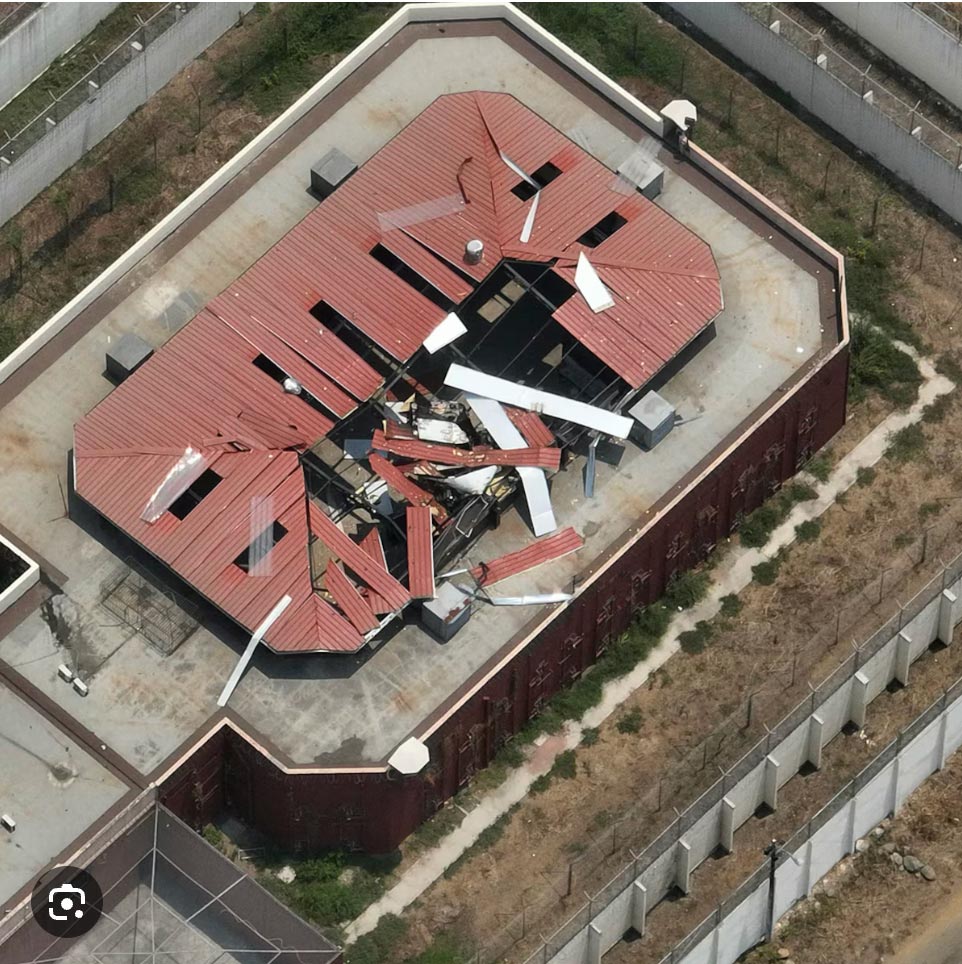
Interior minister says hundreds of gang drones have targeted El Encuentro as government prepares larger prison.
A prison strategy built around isolation
Ecuador’s government is preparing to expand its high-security prison system as part of its escalating campaign against organized crime, with Interior Minister John Reimberg saying the country will build as many maximum-security facilities as it needs to isolate gang leaders and other high-risk inmates.
The next project, expected to begin construction in May, would hold about 15,000 prisoners and could be completed within 18 months, Reimberg said in an interview on April 28th. The government has not disclosed where the new facility will be built, citing security concerns.
The plan follows the opening in November of El Encuentro, Ecuador’s first extreme-security prison, located in the coastal province of Santa Elena. The prison currently holds about 600 inmates, including mafia bosses and politicians convicted of corruption. Prisoners there wear orange uniforms, have their heads shaved, and are kept under strict controls designed to break the influence of criminal groups that have long operated from inside Ecuador’s prison system.
President Daniel Noboa, who first came to power in 2023, has made prison control a centerpiece of his security agenda. His administration has drawn comparisons to El Salvador’s hardline model under President Nayib Bukele, particularly the use of heavily restricted prisons intended to sever criminal networks from the outside world.
Reimberg made clear that the government does not see El Encuentro as the end of that strategy.
“A third prison? Yes, probably,” he said. “And as many as are necessary for these criminals.”
Drones aimed at El Encuentro
According to Reimberg, criminal gangs have repeatedly tried to interfere with El Encuentro since construction began. He said authorities have detected nearly 600 drones attempting to reach the facility, efforts he attributed to organized crime groups angry about the government’s prison strategy.
“We have seen nearly 600 drones attempt to reach El Encuentro prison since the day its construction began,” Reimberg said, adding that officials believe the flights were meant to disrupt the project or breach its security. He said authorities had prevented the drones from reaching their intended target.
The use of drones has become an increasing concern for prison authorities. In recent years, Ecuador has seen attacks involving drones carrying explosives against other prisons, part of a wider pattern of criminal groups using new methods to challenge state control. Prisons have also served as command centers for drug trafficking organizations, allowing gang leaders to coordinate violence, extortion and drug shipments from behind bars.
Reimberg said the next prison will be used for “highly dangerous criminals” who need to be kept in isolation. He did not provide details about the design, security systems or region where it will be located.
Government rejects negotiations
Ecuador’s prison policy has been criticized by human rights organizations, which have raised concerns about abuses, poor conditions and deaths behind bars. Hundreds of inmates have died in recent years from prison clashes or illness, including tuberculosis, while some relatives have reported malnutrition among prisoners.
Reimberg rejected criticism that the government’s approach is authoritarian, saying the administration has a responsibility to respond firmly to a country under siege from criminal networks.
“What do they mean by authoritarians?” he said. “I have to answer the country with certainty.”
The minister said the government will not seek deals with gangs or attempt to manage violence through negotiation.
“We are not going to negotiate, we are not going to make a deal,” he said. “We are going to attack them, we are going to weaken them.”
The scale of Ecuador’s security crisis remains severe. The country recorded 51 homicides per 100,000 inhabitants last year, one of the highest rates in the region. Authorities say Ecuador’s ports, highways and prison system have become key pieces in the international cocaine trade, with roughly 70% of the cocaine produced in neighboring Colombia and Peru passing through Ecuador.
Reimberg said 74,000 people were arrested last year, a figure he presented as evidence of the government’s effort to dismantle criminal structures.
U.S. support expands
Noboa has also strengthened security cooperation with the United States, making Ecuador one of Washington’s closest partners in Latin America on anti-crime and anti-drug operations.
The U.S. has recently established a permanent FBI office and a Homeland Security Investigations branch in Ecuador. Reimberg said the cooperation is focused on intelligence and information sharing, including the identification of criminal targets and locations where drugs are being stored.
The minister also said U.S. personnel are working alongside Ecuadorian forces and that American military aircraft are present in the country.
“We have planes here from the United States Armed Forces,” he said.
Noboa had sought voter approval to allow foreign military bases in Ecuador, but that proposal failed in a referendum. Even without that constitutional change, the government continues to deepen operational cooperation with U.S. agencies as it tries to confront drug trafficking groups tied to international cartels.
Blame placed on justice system and Colombia
Noboa declared Ecuador to be in an internal armed conflict shortly after taking office, allowing the military to be deployed in the streets against gangs classified by the government as terrorist organizations. The measure has been popular among many Ecuadorians frightened by violence, but it has also generated complaints about abuses by security forces.
Asked why homicide and violence figures have not fallen despite the government’s measures, Reimberg pointed to several causes. He blamed a justice system he said is sometimes penetrated by corruption, past leftist governments, and Colombia, where President Gustavo Petro’s administration has had strained relations with Quito.
“We have a neighboring country that is not working on the border, that is not attacking criminal groups,” Reimberg said. “We are fulfilling our part.”
The comments come amid a worsening diplomatic dispute between Ecuador and Colombia, including the withdrawal of ambassadors and the imposition of tariffs worth millions of dollars. For Ecuador’s government, the border remains a key pressure point in a conflict shaped by cocaine routes, armed groups and weakened institutions.
For now, Noboa’s administration is betting that more prisons, tighter isolation and deeper security cooperation will give the state the upper hand. But the drone attempts around El Encuentro show that the gangs are also adapting, testing the government’s defenses even before the next mega-prison breaks ground.
I don’t understand why I crime countries in Latin America reject capital punishment