
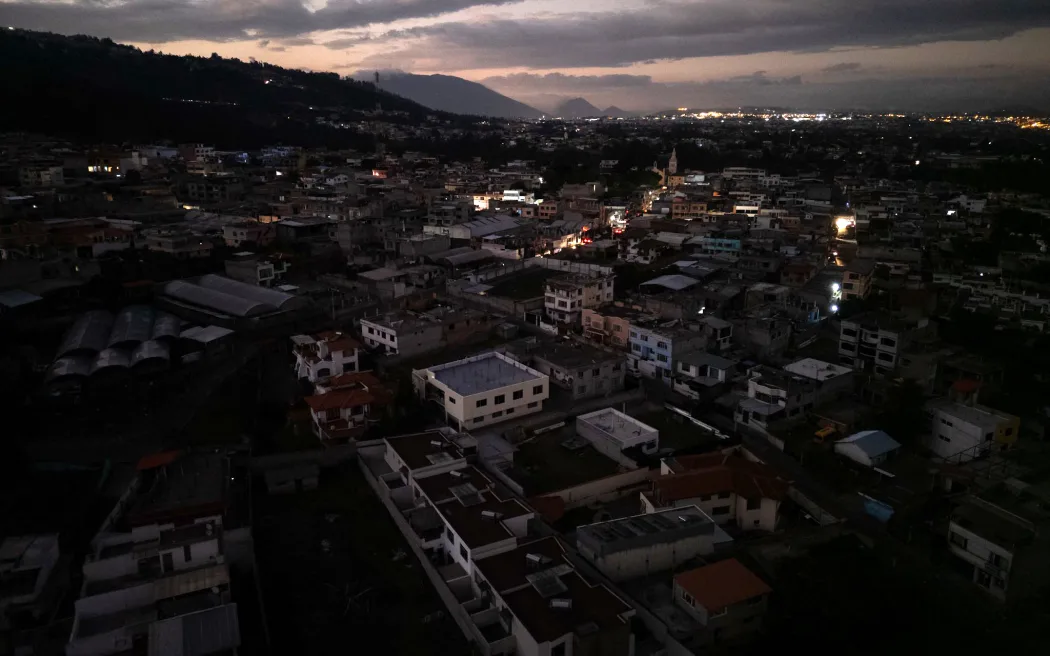
Energy operator warns hydropower instability and suspended imports could leave the grid exposed by October.
Ecuador’s electricity system could face a renewed risk of blackouts when the next dry season begins in October 2026, even though river flows have improved in recent weeks and the country’s main hydroelectric plants are currently receiving more water.
A technical report from the National Electricity Operator, Cenace, warns that the country remains structurally vulnerable because it depends heavily on hydroelectric generation and no longer has access to electricity imports from Colombia. Under a critical drought scenario, the operator estimates an 18% probability of power shortages if Colombian energy remains unavailable.
The warning comes after months of tension between the two countries. Colombia suspended electricity sales to Ecuador on January 22nd, 2026, in response to the security tax imposed by the Daniel Noboa administration on Colombian imports. Before that suspension, Ecuador could receive up to 450 megawatts from Colombia, equal to roughly 10% of average national demand.
That cushion, Cenace says, matters most when Ecuador’s rivers fall and its hydroelectric system is under stress.
Improved rains do not erase the risk
River flows feeding Ecuador’s main hydroelectric plants increased in early May, offering some relief after lower water levels were recorded in March and the first weeks of April near the Coca Codo Sinclair plant and the Paute Integral hydroelectric complex.
Those earlier drops forced the government to take short-term measures, including asking mining companies, steel producers and other large industrial consumers to disconnect from the grid during certain periods.
But Cenace’s March 6th report makes clear that better rainfall does not solve the deeper problem. Ecuador’s electricity system is still exposed to shortages when hydrological conditions deteriorate, especially because the country’s largest source of generation remains vulnerable to both drought and excessive rain.
The dry season usually runs from October through March, when reduced rainfall lowers river levels and limits hydroelectric production. In a year of minimum projected flows, Cenace said domestic generation would not be enough to meet demand without Colombian imports.
The report describes that situation as evidence of a “structural vulnerability” in the system when it faces critical hydrological conditions.
Colombian imports remain a key backup
Ecuador’s reliance on Colombia is not new, but Cenace’s report shows how important that supply has become in preventing shortages.
Although Ecuador avoided blackouts in January and February after Colombia halted sales, the absence of imported power forced the system to rely more heavily on thermal generation, which is more expensive. Energy sector specialist Ricardo Buitrón said that, while consumers did not feel the impact through power outages at the start of the year, the country still paid a cost by dispatching more costly generation.
Cenace also noted that the reserve margins for power and energy have been affected by the loss of Colombian supply. The report said some of the thermal generation used during that period might have been displaced if Colombia had maintained electricity sales to Ecuador.
The operator’s projections for 2026 are based on expected water flows for the year. According to Buitrón, Cenace’s reference to a “90% probability of water overshoot” means there is a 90% chance that flows will remain above the minimum critical level projected for the year.
That still leaves a 10% chance that flows could fall to those critical levels. It is under that scenario that Cenace says Ecuador would need Colombian electricity to reduce the risk of shortages during the October-to-March dry season.
Too much rain can also shut down generation
Coca Codo Sinclair, Ecuador’s largest hydroelectric plant, presents another problem: it can be affected not only by low water levels but also by excessive rainfall.
When heavy rains wash large volumes of sediment into the rivers feeding the plant, water quality can deteriorate to the point that operations must be suspended. Cenace said the shutdown of Coca Codo Sinclair due to poor water quality has become a recurring event, with increasing frequency, and that it can put electricity coverage at risk during periods of high demand.
In 2025, Coca Codo Sinclair recorded at least one operational exit per month beginning in April. In total, the plant went offline 33 times during the year.
Cenace said the probability of Coca Codo going offline is higher during the rainy season. If that occurs while Colombian imports remain unavailable, the national system may be unable to meet demand during peak consumption periods, making load shedding unavoidable.
The operator said repeated shutdowns of the plant show the need to strengthen reserve capacity so Ecuador can reduce the risk of shortages when demand is high.
Economic losses could be severe
The threat is not only operational. Cenace warned that blackouts during the next dry season would create a serious economic risk for the country.
Using the value of unsupplied energy, the operator estimated that the expected economic impact of shortages could reach $41.31 million, based on a price of $1.53 per kilowatt hour. Under more critical drought conditions, that figure could rise to $252.4 million. In an extreme drought scenario, losses could climb as high as $823.7 million.
Those projections underscore the cost of relying on a system with limited reserves, uncertain hydrology and reduced access to imported power. They also show why the dispute with Colombia has consequences beyond trade policy.
For now, May’s improved river flows have eased immediate pressure on the grid. But Cenace’s warning points to a different problem waiting later in the year: if the rains fade, Coca Codo remains unstable and Colombian power is still unavailable, Ecuador could again find itself managing electricity not by abundance, but by rationing risk.
0 Comments