
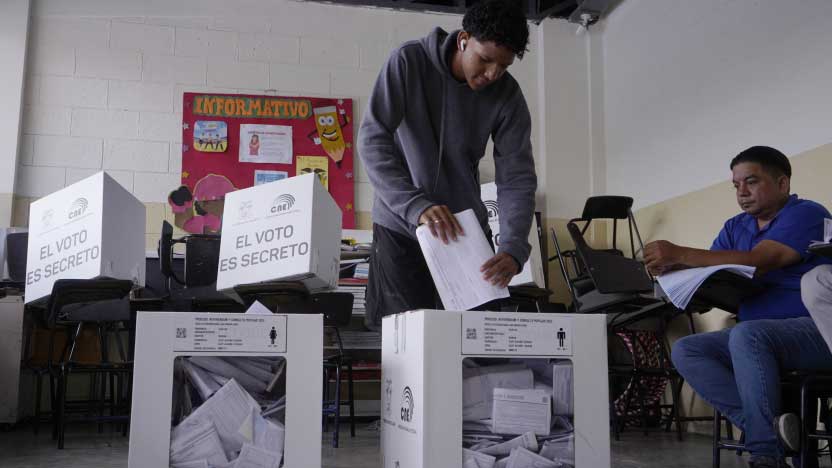
An accelerated local voting calendar is forcing alliances, primaries and survival strategies into overdrive.
Ecuador’s political organizations are being forced into a rapid reorganization after the National Electoral Council moved the country’s 2027 local elections up to November 29th, 2026, compressing the timeline for primaries, candidate registration and campaigning, while deepening uncertainty for several parties already entangled in legal or administrative disputes.
The revised calendar advances the vote for mayors, prefects, councilors and parish board members by 79 days from its original date of February 14th, 2027. That single decision has rippled across the political system, pushing internal party elections into late June and early July, shortening registration windows, and leaving less time for movements that were still trying to build alliances or resolve problems with electoral authorities.
For parties with established structures and nationwide organization, the change is unwelcome but manageable. For others, especially those facing suspension or cancellation proceedings, it may prove decisive.
A compressed road to the ballot
Under the new schedule, political organizations must now hold their internal democracy processes between June 18th and July 2nd, instead of between July 31st and August 14th. That means parties have lost several crucial weeks they had expected to use to negotiate alliances, settle internal disputes and define candidate lists.
The registration period has also been shortened. Instead of having until late September to inscribe candidates, organizations will now have from August 2nd through August 26th, a reduction of roughly two weeks from the original plan. The formal campaign season has been tightened as well, with candidates now expected to make their case to voters between November 12th and November 26th rather than over the longer January-to-February stretch first envisioned.
That shorter runway could favor parties with existing territorial machinery, recognizable local leaders and money ready to deploy. It is less favorable for smaller movements, newer alliances or groups that were still in exploratory talks.
Several organizations had been using the original calendar as breathing room to construct joint lists and local agreements. Those conversations now have to move at a much faster pace, and some may not survive the rush.
Correism faces a narrowing path
No group appears more squeezed by the new timetable than Revolución Ciudadana, the political movement associated with former President Rafael Correa.
The movement is currently serving a nine-month suspension while prosecutors investigate allegations of illegal foreign financing linked to money laundering in the so-called Caja Chica case. Its leaders had been holding out hope that the suspension could be overturned in time for the movement to organize primaries and compete under its own banner and ballot number.
That possibility now looks far less realistic.
With the elections moved forward and appeals already rejected multiple times by both the CNE and the Electoral Disputes Tribunal, Correism finds itself with shrinking legal options and even less time to maneuver politically. If it cannot restore its status quickly, its candidates may have to seek refuge on the lists of other organizations.
That is a difficult task under ordinary circumstances. Under an accelerated electoral calendar, it becomes even more complicated, requiring quick agreements, local compromises and a willingness by other parties to absorb candidates who may bring both votes and controversy.
Even that escape route is not entirely secure. RETO, a movement often seen as a natural ally for Correism, is dealing with internal tensions of its own, and questions surrounding the control of the organization could make it a less stable vehicle than it might otherwise have been.
Two more groups race against cancellation
Revolución Ciudadana is not alone in facing danger.
Construye and Unidad Popular are also running short on time after entering cancellation proceedings tied to allegations that they failed to maintain the required percentage of members under Ecuador’s Democracy Code. The full CNE adopted that decision on March 26th, giving the two organizations 10 days to present evidence in their defense.
If the electoral council later ratifies the cancellation process, the legal fight could continue into the courts, including a possible challenge before the Constitutional Court. That would add more uncertainty and consume more time, precisely what the revised electoral calendar no longer provides.
The danger for both groups is not simply legal. It is practical. Even if they eventually prevail, they would need to do so fast enough to organize primaries, register candidates and mount local campaigns in a drastically shortened season. Politics often rewards patience, but election calendars do not.
Who remains on firm ground
While several organizations are scrambling, the CNE has said that 14 national parties and movements currently meet the membership requirement needed to remain in the Registry of Political Organizations and therefore face no immediate obstacle to participating in the November contest.
Those on safer ground include established names such as the Social Christian Party, Pachakutik, Democratic Left, CREO, Avanza, SUMA, Democracia Sí, the Ecuadorian Socialist Party, National Democratic Action and RETO, among others.
That does not mean they are all equally pleased with the new timetable.
CREO leader Luis Fernando Flores said his movement is prepared for the shift and has already been organizing across parishes, cantons and provinces. His message suggested that some parties had anticipated the need to be ready early, whether or not the formal calendar changed.
The Social Christian Party took the opposite view, arguing that the council’s decision lacks a sound constitutional foundation. The party criticized the justification tied to the possible effects of a worsening rainy season and the El Niño phenomenon in early 2027 and warned that the measure could still face eventual review by the Constitutional Court.
Its complaint highlights a broader political problem now hanging over the process: even as parties begin adapting to the new calendar, questions over its legality could continue to shadow the election.
A campaign shaped by urgency
The practical effect of the CNE’s move is that Ecuador’s next round of local elections is no longer a distant contest sitting safely on the 2027 horizon. It has become an immediate organizational test.
Parties must now make decisions faster, lock in alliances sooner and identify viable candidates with less time for negotiation, polling and internal consensus. Movements that rely on improvisation or last-minute deals may find themselves stranded. Those with disciplined structures may gain an edge before a single campaign poster goes up.
The earlier date also changes the political rhythm of the year. Instead of spending late 2026 preparing for a 2027 vote, Ecuador’s political class now faces a compressed battle that will unfold as legal disputes, party survival fights and alliance talks all collide at once, making November 29th feel less like a routine local election and more like a stress test for the country’s fractured party system.
0 Comments