
Preliminary results give the conservative outsider a fragile mandate while his opponent challenges thousands of polling stations.
Colombia’s presidential election remained politically unsettled Monday after conservative lawyer Abelardo de la Espriella claimed victory by less than one percentage point, promising national unity even as his defeated rival prepared an extensive challenge to the preliminary vote count.
With virtually all polling stations reporting, De la Espriella received approximately 12.96 million votes, or 49.66%, while leftist Senator Iván Cepeda collected about 12.71 million, or 48.70%. The margin of roughly 251,000 votes was far narrower than opinion polls had predicted and represented the closest second-round presidential contest in modern Colombian history.
The preliminary figures gave De la Espriella a lead of just 0.96 percentage points, less than half the advantage he achieved in the first round. More than 26.3 million Colombians cast ballots, producing a turnout of 63.59%, an unusually high level of participation for a presidential runoff.
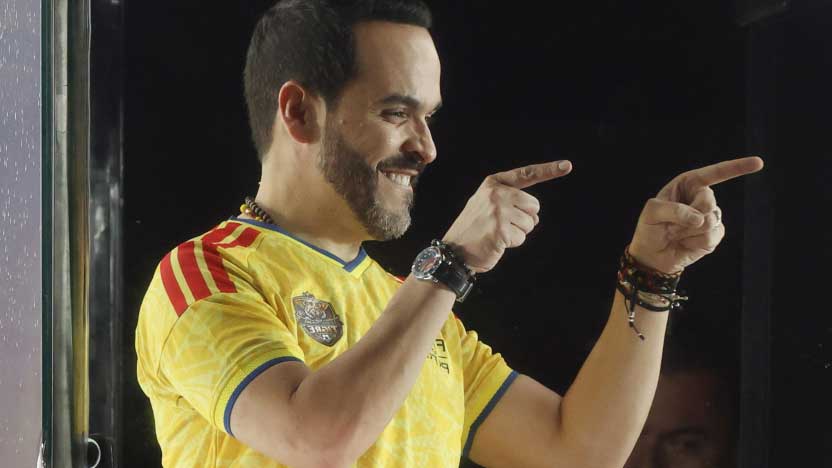
De la Espriella addressed thousands of supporters gathered near Barranquilla’s Ventana al Mundo monument, declaring that the campaign was over and calling on Colombians to put aside the bitter divisions that had defined the race.
“I will govern for those who voted for me and those who chose another candidate,” he said, promising an “absolutely democratic” administration that would respect Congress, the courts and the separation of powers.
He is scheduled to take office August 7 if the official count confirms his victory.
Cepeda prepares a sweeping challenge
Cepeda acknowledged the preliminary figures but stopped short of conceding the election, emphasizing that the rapid count released on election night was neither official nor legally binding.
His campaign said it would challenge results from approximately 33,000 polling stations during the formal review conducted by judges and notaries. The scale of the planned objections could prolong political uncertainty in a country already divided by accusations of corruption, electoral manipulation and warnings of post-election protests.
National Registrar Hernán Penagos urged the public and both campaigns to remain calm while the official count proceeds. He said the legally binding result would emerge from the examination of tally sheets, not from the preliminary reporting system used to inform the public on election night.
President Gustavo Petro also said he would await completion of the legal verification process before recognizing the winner. Petro suggested he would accept a De la Espriella victory if the final count upheld it, while encouraging supporters of the governing Historical Pact to observe the review closely.
Petro also warned the apparent president-elect against dismantling social and economic reforms enacted or proposed during his administration.
The dispute left Colombia in an unusual position: De la Espriella was celebrating as president-elect, but the final certification remained pending while Cepeda’s campaign searched for enough disputed ballots to overcome a quarter-million-vote deficit.
An outsider built for social media politics
De la Espriella, a 47-year-old lawyer and businessman, will enter the presidency without having previously held elected office. He built a national following through a combative media presence, a highly personalized political movement and campaign imagery centered on the tiger, the Colombian national soccer jersey and military-style salutes.
Calling himself “El Tigre,” he created the Defenders of the Homeland movement in July 2025 and positioned himself as a conservative outsider capable of confronting crime, corruption and the political establishment.
His campaign combined festival-like rallies with provocative social media messages and promises to govern with an “iron fist.” The approach attracted many middle-class voters who had backed Petro four years earlier but had grown dissatisfied with the direction of the country.
De la Espriella consolidated conservative support after defeating Paloma Valencia, the candidate associated with former President Álvaro Uribe’s political movement, in the first round. He also benefited from public expressions of support from US President Donald Trump and developed friendly ties with Ecuadorian President Daniel Noboa.
His legal career, however, has brought persistent controversy. He has represented wealthy and politically connected clients, including Colombian-Venezuelan businessman Alex Saab, who was accused by US authorities of serving as a financial intermediary for Venezuelan President Nicolás Maduro.
Cepeda also used the campaign’s final weeks to raise questions about De la Espriella’s past participation in peace initiatives involving the United Self-Defense Forces of Colombia and to allege improper conduct linked to health-sector funds. De la Espriella rejected attacks on his record and presented them as evidence that traditional political interests feared his rise.
Security agenda promises a dramatic break
The apparent winner campaigned on one of the most aggressive security platforms proposed by a Colombian presidential candidate in decades.
His “Plan Colombia II” would restore close cooperation with Washington, expand operations against drug-trafficking groups and guerrillas, resume the eradication of coca crops with herbicides and permit a larger US military presence in Colombian territory.
De la Espriella has also spoken favorably about bombing armed groups and criminal organizations with American assistance. His proposal recalls the original Plan Colombia, the multibillion-dollar security partnership launched at the beginning of the century to weaken guerrilla organizations and reduce cocaine production.
The plan represents a sharp departure from Petro’s more cautious approach to counternarcotics operations and negotiations with armed groups. Relations between Bogotá and Washington had become strained during Petro’s term, particularly as regional governments pursued increasingly hardline security alliances.
De la Espriella also wants to build 10 high-security mega-prisons, borrowing ideas associated with the governments of Noboa and Salvadoran President Nayib Bukele. During the campaign, he described underground facilities where the country’s most dangerous prisoners would face exceptionally harsh conditions.
Human rights organizations have warned that mass-incarceration strategies and severe prison conditions can produce abuses, while political opponents argue that De la Espriella’s rhetoric could intensify violence rather than reduce it.
He has additionally proposed easing restrictions on civilian gun ownership for people who demonstrate physical and psychological fitness.
Dollarization and a smaller state
De la Espriella’s economic program could be just as disruptive as his security agenda. He has said dollarization would be the “ideal” long-term solution for Colombia, although he has provided limited detail about how the country would replace the peso or manage the transition.
Colombia has maintained its own currency throughout its modern history, making dollarization a politically and economically ambitious proposal. Supporters argue that adopting the dollar could reduce inflation and currency instability, while critics warn that Colombia would surrender control over monetary policy and lose the ability to respond independently to economic shocks.
De la Espriella also wants to reduce the size of the national government by as much as 40%, lower corporate taxes and permit fracking to increase domestic energy production. His proposals resemble parts of Argentine President Javier Milei’s austerity program and would reverse the expansion of public spending under Petro.
The new administration would inherit a fiscal deficit approaching 7% of gross domestic product, placing immediate pressure on De la Espriella to reconcile his tax-cutting agenda with the need to stabilize government finances.
His foreign policy proposals are equally confrontational. He has questioned Colombia’s continued participation in the United Nations, the Organization of American States and the Inter-American human rights system, describing some international institutions as ideologically biased and ineffective.
He has also proposed closing selected Colombian embassies and converting others into centers focused primarily on trade and investment.
A divided Congress could restrain the new president
Even after winning the presidency, De la Espriella may struggle to implement the platform that carried him to victory.
Colombia’s Congress is fragmented among right-wing, centrist, left-wing and unaffiliated lawmakers. The right holds the largest identifiable bloc with approximately 71 legislators, but it lacks the numbers required to govern alone. Centrist parties control about 66 seats, the left has roughly 52 and another 72 lawmakers do not fit neatly into a single ideological category.
That balance will require De la Espriella to negotiate with parties he attacked during the campaign. He has said he will appeal to lawmakers’ “historical responsibility” rather than distribute government posts and political favors in exchange for votes.
Such a strategy may be difficult to sustain when proposals involving dollarization, fracking, prisons, international treaties and sweeping reductions in government employment reach Congress.
Cepeda’s strong showing also indicates that Colombia’s left remains a powerful national force. Rather than disappearing with Petro’s departure, it could become a disciplined opposition capable of organizing street protests, challenging legislation and blocking constitutional reforms.
As celebrations continued in Barranquilla and Cepeda supporters monitored the official review in Bogotá, the unusually narrow result offered De la Espriella little room for political overreach. He may have won the presidency on promises of dramatic change, but he will begin his term facing nearly 13 million voters who chose a different direction.
0 Comments