
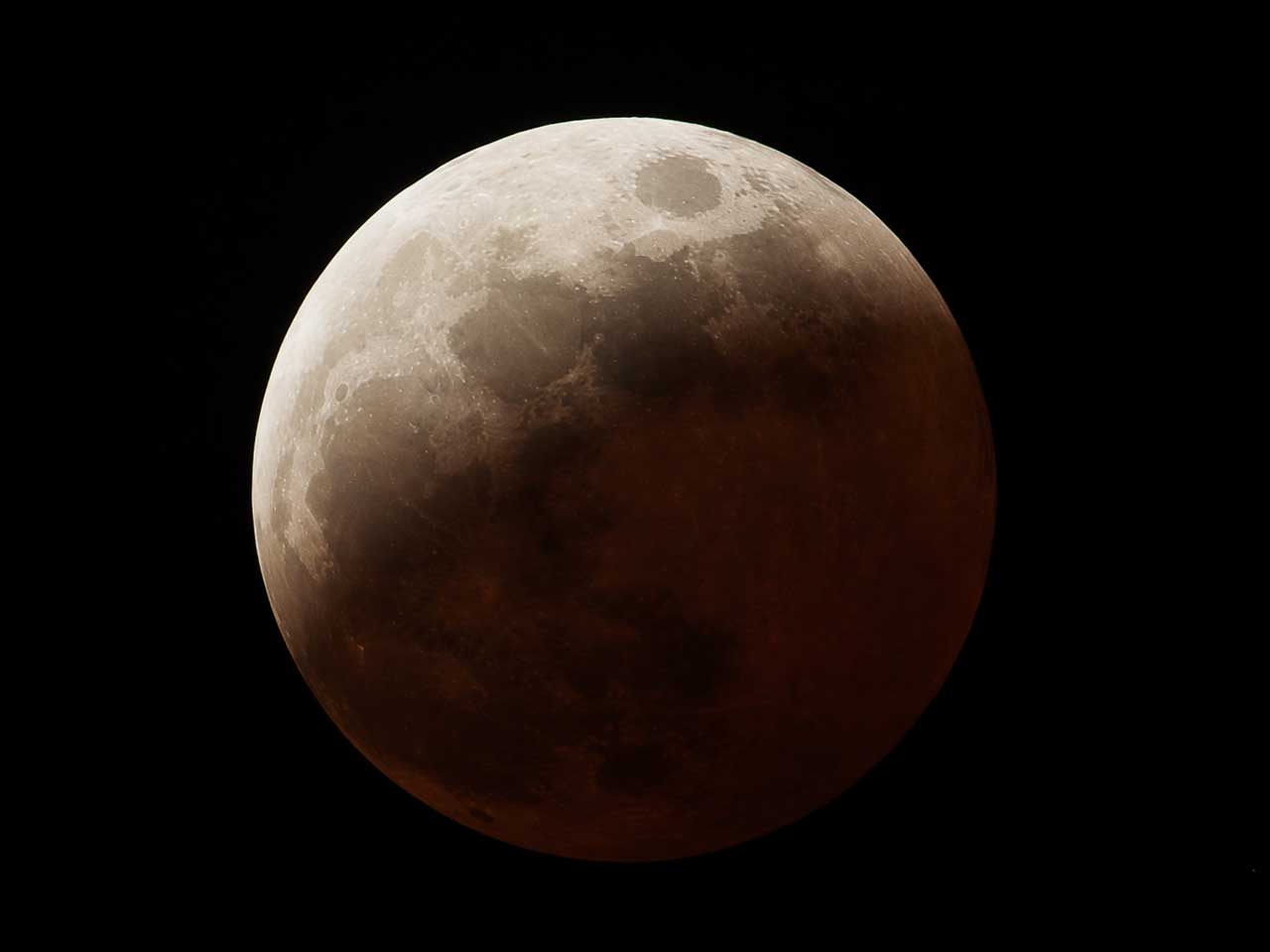
Most of the Moon will enter Earth’s dark shadow on August 27th, with the eclipse reaching its maximum over Cuenca at about 11:12 p.m.
Cuenca will have a front-row seat to one of the year’s best astronomical events on the night of August 27th and the early morning of August 28th, when a deep partial lunar eclipse will be visible across Ecuador.
Unlike a solar eclipse, a lunar eclipse is completely safe to watch with the naked eye. No special glasses or filters are required because observers are simply looking at the Moon as it moves through Earth’s shadow.
The August 27th-28th event is a partial lunar eclipse visible from the Americas, Europe, Africa and parts of western Asia. The eclipse has a magnitude of about 0.93, meaning most of the Moon’s diameter will enter Earth’s dark central shadow even though the eclipse will stop short of totality.
When to look up
For Cuenca, the long event begins with the subtle penumbral phase at about 8:23 p.m. on Thursday, August 27th. The more obvious partial phase begins later in the evening as Earth’s darker umbral shadow moves across the lunar surface.
Maximum eclipse in Cuenca is expected at about 11:12 p.m. At that point, roughly 93% of the lunar diameter will be immersed in the umbra. The partial phase ends shortly after midnight, while the fainter penumbral phase continues until about 2:01 a.m. on Friday, August 28th.
The entire event lasts more than five and a half hours, although the visually dramatic portion is shorter.
Why the Moon can turn red
During the deepest part of the eclipse, the shadowed section of the Moon may take on a reddish or copper color. That happens because some sunlight passing through Earth’s atmosphere is bent and scattered into the shadow.
How to get the best view
Weather will decide how good the view is. Cuenca’s cloud cover can change quickly, and high terrain can block parts of the sky depending on the observer’s location. A spot with a broad view and relatively little direct lighting will provide the best experience.
Because the eclipse unfolds gradually, observers can also use familiar landmarks to notice how high the Moon moves across the sky during the event. A location with an unobstructed view is more important than traveling far from the city, although darker surroundings can make the experience more pleasant.
Binoculars can make the boundary of Earth’s shadow and lunar surface features more interesting, but they are not necessary. A telescope will provide more detail, while a phone or camera on a stable support may capture the changing appearance over time.
Anyone hoping to photograph the eclipse will generally get better results by stabilizing the phone or camera rather than trying to hand-hold a long exposure. Even without equipment, the changing boundary between the bright and shadowed portions of the Moon should be easy to follow if skies remain clear.
The event is unusually convenient for Ecuador because it occurs during normal evening hours rather than requiring observers to wake before dawn.
For families, it is an easy opportunity to turn astronomy into a low-cost night out. The visible change happens slowly, so there is no need to stare continuously at the Moon. Checking every ten or fifteen minutes makes the progression easier to notice.
People planning to watch with children do not need to stay outside for the entire five-and-a-half-hour event. Arriving before the deepest phase and comparing the Moon at intervals around maximum eclipse should provide the clearest sense of the change without turning the evening into an endurance exercise.
Assuming the skies cooperate, Cuenca residents need little more than a clear view of the Moon and a warm jacket. The most dramatic view should come around 11:12 p.m. on August 27th.
0 Comments