
Washington talks focus on intelligence, military cooperation and a broader alliance against transnational criminal networks.
President Daniel Noboa used a high-level visit to Washington to press for stronger security cooperation with the United States, portraying Ecuador’s battle against organized crime as part of a wider regional struggle that cannot be contained within national borders.
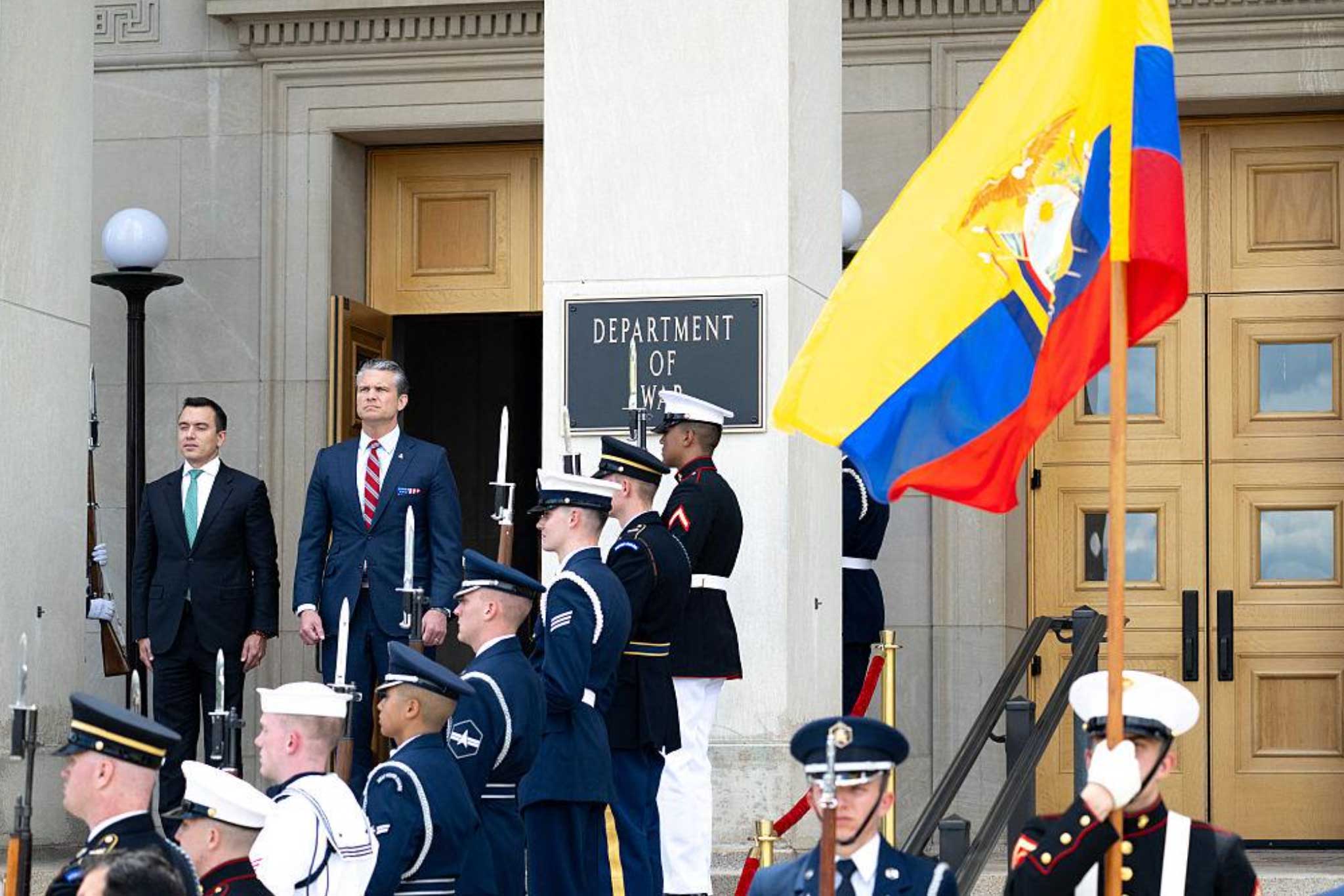
Noboa met with U.S. Defense Secretary Pete Hegseth at the Pentagon, where the two officials discussed military coordination, narcotics trafficking and the expanding influence of criminal organizations across Latin America. The Ecuadorian president was received with military honors at the Defense Department headquarters in Arlington, Virginia.
Foreign Minister Roberto Kury and Public Administration Secretary José Julio Neira accompanied Noboa during the meeting, which placed Ecuador’s security crisis within the Trump administration’s broader campaign against drug cartels and transnational criminal groups.
The discussions came as Ecuador continues to confront gangs involved in drug trafficking, extortion, illegal mining, prison violence and attacks on public officials. Noboa’s government has classified several criminal organizations as terrorist groups and has relied heavily on the military to reinforce police operations.
Washington praises Ecuador’s role
Hegseth described Noboa’s government as an important regional partner and praised Ecuador’s commitment to confronting networks that operate across international boundaries.
The defense secretary said those groups threaten not only Ecuador but also the United States and the security of the Western Hemisphere. He argued that cooperation must move beyond diplomatic statements and produce operational results against organizations involved in narcotics trafficking and political violence.
The Pentagon chief highlighted Ecuador’s participation in U.S.-supported regional initiatives, including the “Shield of the Americas” program and a coalition organized to strengthen cooperation against drug cartels.
The precise scope of future military assistance was not detailed publicly. However, the language used during the meeting suggested that intelligence sharing, coordinated operations, training and logistical support could remain central to the expanding relationship.
Hegseth said the shared objective was to dismantle criminal networks in Ecuador and throughout Central and South America rather than merely disrupting individual trafficking routes or arresting isolated leaders.
That approach reflects the increasingly regional character of organized crime. Groups operating in Ecuador frequently depend on overseas cocaine markets, foreign suppliers, cross-border transportation routes, international money-laundering systems and alliances with organizations based in neighboring countries.
Noboa calls for countries to act together
Noboa told U.S. officials that governments must cooperate as closely as the criminal groups they are trying to defeat. He said Ecuador and the United States were aligned in their pursuit of peace and economic progress but warned that criminal and extremist organizations constantly adjust their methods in response to government pressure.
The president pointed to Ecuador’s recent security coordination with Bolivia, Peru and Colombia as evidence that bilateral and regional partnerships are becoming more important.
“Evil always unites and always finds a way to collaborate in our countries,” Noboa said. “If we don’t do the same when we have our own problems, we are doomed to failure.”
His comments underscored one of the central difficulties facing Ecuadorian authorities. Police or military pressure in one province can push criminal operations into another part of the country, while stricter enforcement at one border crossing may simply cause traffickers to shift toward maritime routes, remote jungle areas or neighboring states.
Noboa has repeatedly sought greater international support since Ecuador’s security situation deteriorated sharply, particularly after criminal groups expanded their control over prisons and strategic coastal territories used for cocaine exports.
Trade and investment tied to security
The Ecuadorian president also linked security cooperation to trade and investment, arguing that Latin American governments cannot depend indefinitely on foreign assistance to finance military and police operations.
Noboa said expanded commerce and private investment could generate the economic resources needed to sustain long-term security campaigns. That position treats economic policy as a component of crime prevention, particularly in communities where unemployment and limited state services create opportunities for gangs to recruit young people.
The government has argued that restoring security is essential to attracting investment, while investment itself is needed to create jobs and reduce the influence of criminal organizations. The two objectives have become closely connected in Noboa’s international agenda.
The Washington visit therefore extended beyond discussions of weapons, training or military operations. It also promoted Ecuador as a strategic political and economic partner at a time when the United States is seeking governments willing to participate in a coordinated campaign against cartels.
Security talks continue at the White House
After leaving the Pentagon, Noboa met with Stephen Miller, the White House deputy chief of staff for policy and national security adviser.
The Ecuadorian government said the meeting focused on transnational organized crime, bilateral security cooperation and opportunities intended to improve economic conditions for Ecuadorians.
The talks with Miller reinforced the administration’s effort to build relationships across several branches of the U.S. government rather than limiting security negotiations to the Defense Department.
For Noboa, the meetings also provided an opportunity to demonstrate international support for his domestic security strategy. His government has made the confrontation with organized crime one of its defining policies, deploying troops in cities, ports and prisons while seeking foreign intelligence and technical assistance.
The challenge will be converting the public declarations in Washington into measurable improvements inside Ecuador. Criminal groups continue to evolve, develop new alliances and exploit weak institutions, while the government faces pressure to reduce violence without allowing emergency security measures to become permanent.
No major new agreement was announced immediately following the meetings. Even so, the reception at the Pentagon and the subsequent talks with senior White House officials indicated that Ecuador is being positioned as a significant U.S. partner in a regional security campaign that is expected to rely increasingly on intelligence, economic cooperation and coordinated action across national borders.
0 Comments