
New structure merges several portfolios as the administration says it is seeking a leaner Executive branch.
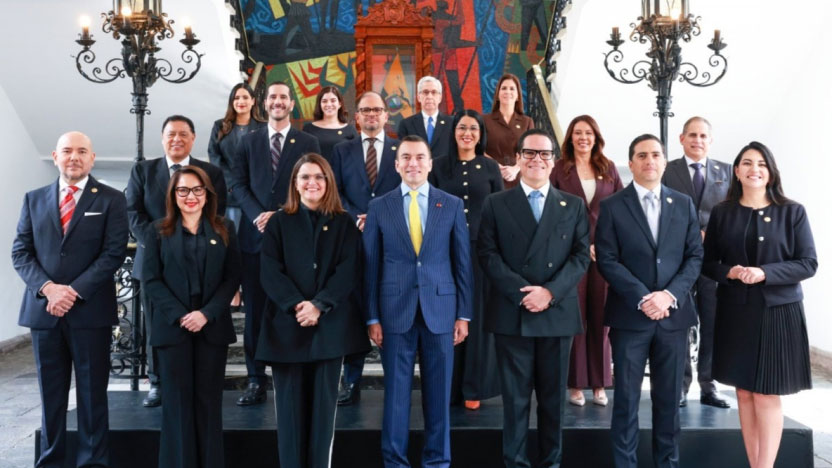
President Daniel Noboa has reorganized his cabinet again, reducing Ecuador’s ministries to 10 and naming the officials who will lead the smaller Executive branch.
The new structure, announced Monday, June 8, 2026, marks the second major reshaping of the government in less than a year. Noboa’s administration said the latest changes are intended to streamline decision-making, reduce duplication and lower the cost of running the state.
The cabinet lineup confirms several ministers who remain in key security and political posts, while also introducing new leadership in foreign affairs and creating broader ministries that combine responsibilities previously handled by separate agencies.
Foreign affairs gets a new minister
One of the most notable changes is the arrival of Roberto Kury as Minister of Foreign Affairs and Human Mobility. He replaces Gabriela Sommerfeld, who left the post after submitting her resignation for personal reasons, according to the government.
The Foreign Affairs Ministry is one of the portfolios that remains central to the administration’s agenda, particularly as Ecuador continues to manage relations with trade partners, international lenders, neighboring countries and foreign governments involved in security and migration issues.
The government also confirmed Nataly Morillo as Minister of Government, keeping her in a role tied closely to political coordination, relations with other branches of government and the administration’s ability to move its agenda through the National Assembly.
John Reimberg remains Minister of the Interior, while Gian Carlo Loffredo continues as Minister of Defense. Those two ministries are expected to remain among the most visible in the administration as Ecuador continues to confront organized crime, prison violence and security challenges across the country.
Merged ministries create broader portfolios
The restructuring reduces the number of ministries from 14 to 10 by merging several areas of government. The most visible example is the creation of the Ministry of Infrastructure and Technology, which will be led by Roberto Luque.
That new ministry combines responsibilities previously divided between the Ministry of Infrastructure and Transport and the Ministry of Telecommunications and Information Society. The change puts public works, transport infrastructure and technology policy under one minister.
The new cabinet also includes Sariha Moya as Minister of Economic and Productive Development, a portfolio that brings together responsibilities tied to the country’s economic management and production sectors.
Gilda Alcívar will lead the Ministry of Education, Sports and Culture, another broad portfolio created under the new structure. Cynthia Gellibert will head the Ministry of Labor and Human Development, while Jaime Bernabé will serve as Minister of Public Health.
Juan Carlos Blum was named Minister of Environment and Energy, placing two policy areas with major economic, social and regulatory implications under a single ministry.
The government has presented the mergers as part of a plan to make the Executive branch more efficient. Officials have said the goal is to optimize public resources and reduce the size of the state, although the administration has not yet detailed the full budgetary impact of the changes.
Secretariats also reshaped
Along with the ministerial appointments, Noboa named José Julio Neira as Secretary General of Public Administration, Planning and Cabinet of the Presidency, a position that is expected to play a central role in coordinating the newly reorganized Executive branch.
Enrique Herrería was appointed to lead the General Legal Secretariat, while Irene Vélez will head the Communication Secretariat.
Other appointments include Marissa Pendola as head of the Administrative and Real Estate Management Secretariat of the Public Sector, Doménica Bajaña as head of the Public Integrity Secretariat, Carolina Lozano in Risk Management and Michele Sensi Contugi as director of the National Intelligence Center.
Those appointments round out the new structure surrounding the presidency and are designed to support the work of the 10 ministries, according to the administration’s announcement.
Second restructuring in less than a year
Noboa’s latest cabinet changes follow a previous restructuring carried out in July, when the government reduced the number of ministries from 20 to 14 and cut the number of secretariats from nine to three.
With the new reduction to 10 ministries, the president has now carried out two rounds of institutional consolidation in less than a year. The administration says the changes are part of a broader effort to modernize government operations and make public administration more efficient.
The new cabinet will now be responsible for managing broader policy areas with fewer ministries, a structure that gives individual ministers larger portfolios and potentially greater influence inside the Executive branch.
For Noboa, the reorganization also gives his government a new administrative map as it enters another stage of its term, with security, economic growth, public services and state spending all competing for attention inside a smaller cabinet.
0 Comments