
A Manta judge is demanding answers about the U.S. operations as another 34 fishermen return to port and both governments defend a rapidly expanding anti-drug campaign.
Four boats in nine days
A fast-moving series of U.S. military operations against Ecuadorian fishing vessels in the eastern Pacific has turned into a legal and diplomatic controversy after Ecuadorian courts found no basis to keep 28 returned crew members in custody.
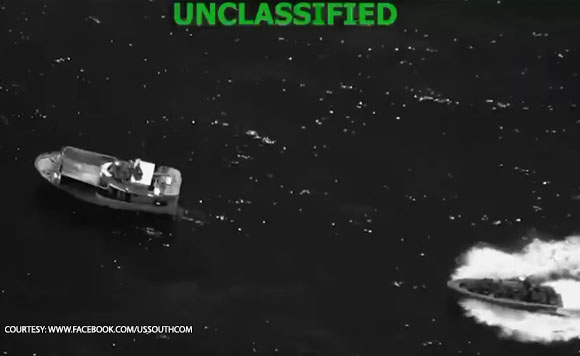
The operations began on August 28th with the interception of the Tres Hermanos and continued this week with the Conquista II on September 2nd, the OM2 on September 3rd and the María Candelaria on September 5th. U.S. forces boarded and searched the vessels and later sank them. U.S. Southern Command says the boats were being used as floating refueling stations for drug-trafficking operations linked to Los Choneros, one of Ecuador’s largest criminal organizations.
Ecuador’s government has publicly supported that account. Interior Minister John Reimberg said the vessels were part of a logistics system in which larger boats supplied fuel to smaller craft carrying drugs north toward Mexico and the United States. Southern Command described the September 2nd operation as a joint effort conducted in coordination with Ecuador and said intelligence had confirmed support for Los Choneros.
The fishermen and their families tell a very different story. They say the men were engaged in commercial fishing, deny links to drug trafficking and have questioned why the vessels were destroyed if they contained evidence of a crime.
The first court test produced no charges
The first major test of those competing accounts came after 28 crew members reached Manta on September 4th: nine from the Conquista II and 19 from the OM2. They arrived in Ecuadorian custody and were taken to a flagrancy hearing, the procedure used to determine whether there is sufficient basis to treat someone as having been caught committing or immediately after committing a crime.
They were released the following day.
According to Fernando Bastidas, an attorney with the Permanent Committee for the Defense of Human Rights in Guayaquil, prosecutors were unable to show the judge sufficient indications that the 28 men had committed a crime. Their release does not establish that no crime occurred, and it does not prevent prosecutors from investigating further. But it does mean the allegations that justified the maritime interceptions did not, at that hearing, translate into evidence sufficient to hold the men under Ecuador’s flagrancy rules.
A separate habeas corpus case is keeping the circumstances of the U.S. operation under judicial scrutiny. During that proceeding, a judge ordered Ecuador’s Foreign Ministry to seek information from the U.S. government about the procedures used during the interception of the Conquista II. The judge also requested information from Ecuador’s Navy and Defense Ministry and ordered authorities to identify where the vessel was sunk and the present location of its remains.
Bastidas argues that the period in which relatives did not know where some crew members were located should also be investigated. That allegation has not been adjudicated.
Eight missing fishermen are found — and another 26 are coming home
The Conquista II carried 17 people. Nine were transferred to Ecuadorian authorities immediately after the U.S. operation, while eight others had moved away from the vessel in four small boats before it was destroyed. For several days their location was uncertain.
On September 6th, Ecuador’s Navy announced that a Coast Guard unit had located the eight men and brought them to the Port Captain’s office in Manta.
At almost the same time, authorities were dealing with another interception. On September 5th, U.S. forces boarded the María Candelaria, a Manta vessel traveling with 26 crew members and nine support boats. Southern Command again said intelligence identified the operation as a floating refueling station supporting illicit drug trafficking. After the crew was removed, U.S. forces sank the main vessel and associated craft.
The 26 crew members were turned over to an Ecuadorian Coast Guard vessel for transport to Manta. Together with the eight recovered Conquista II fishermen, that meant 34 more Ecuadorians were being returned to port on Sunday.
Why this matters beyond Manta
The dispute is bigger than whether individual fishermen are ultimately charged.
Ecuador and the United States have sharply expanded security cooperation as the Noboa government confronts drug-trafficking organizations operating from Ecuador’s ports and Pacific coast. Maritime logistics are a genuine part of the cocaine trade, and fishing vessels can be used to refuel or support faster smuggling boats far from shore.
But the Manta cases expose a difficult gap between military intelligence and criminal evidence. Southern Command says its intelligence confirmed that the vessels supported Los Choneros. Ecuadorian judges, however, must apply Ecuadorian law to the people delivered into Ecuadorian custody. In the first 28 cases, prosecutors did not produce enough evidence at the flagrancy hearing to justify continued detention.
There is also a practical evidentiary question created by destroying the vessels after they are searched. If Ecuador later wants to prosecute crew members, defense lawyers can be expected to ask what physical evidence was found, how it was documented, who maintained custody of it and why the boats themselves were sunk.
For residents, especially in Manabí’s fishing communities, the next developments will be important. Prosecutors could open ordinary investigations even though the flagrancy cases failed. The habeas corpus proceeding could force Ecuadorian authorities to disclose more about how the joint operations work. And the arrival of the María Candelaria crew will provide another immediate test of whether the government can produce evidence supporting the accusations made at sea.
The government’s anti-drug partnership with Washington is likely to continue. What is now being tested is whether the evidence behind that partnership can withstand scrutiny once the fishermen reach an Ecuadorian courtroom.
0 Comments