
Government argues provisional deal can be improved in August as critics question its long-term balance.
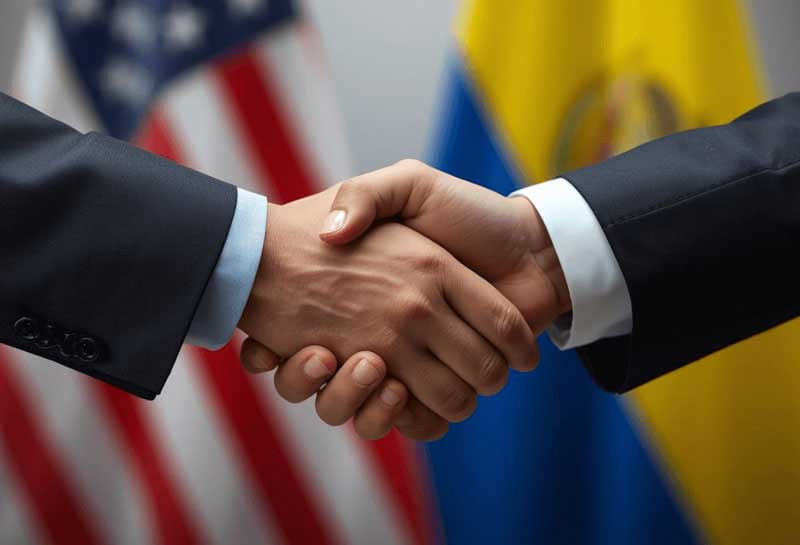
President Daniel Noboa said Ecuador’s recently signed reciprocal trade agreement with the United States is not a final document and will be revisited in August, pushing back against critics who have warned that the accord gives Washington too much while asking Ecuador to make lasting concessions.
Speaking days after the March 13th signing in Washington, Noboa described the pact as a broad initial framework rather than a closed negotiation. He said the agreement was designed to address immediate trade pressures while opening the door for further talks, and he urged opponents not to treat the document as a permanent surrender of Ecuadorian interests.
The government’s defense of the accord comes as economists, exporters and analysts continue to debate whether Ecuador gained enough in return for the commitments it made, especially in agriculture, investment, procurement and other strategic areas. Officials insist the agreement should be viewed as a temporary and practical response to a difficult international trade climate, not as a final blueprint for Ecuador’s economic alignment with the United States.
A deal the government says is still evolving
Noboa said the text signed this month deals with trade issues in general terms and remains subject to changes when both countries return to the table later this year. He framed compromise as unavoidable in any negotiation between Ecuador and a vastly larger economy, arguing that the country had to secure a foothold rather than wait on the sidelines for Washington to act unilaterally.
That argument has become central to the government’s message. Officials say Ecuador faced a limited window to protect its exporters from punitive measures and to place itself among a small group of Latin American countries that have moved quickly to formalize this kind of arrangement with the United States.
Production Minister Luis Alberto Jaramillo reinforced that position, saying the agreement is provisional in part because the current U.S. surcharge scheme has a set time horizon and because broader trade rules could still be modified. He said the important thing for Ecuador was to sign now and preserve a channel for future improvements through continued dialogue, including a planned meeting in Quito under the Trade and Investment Council.
For the Noboa administration, the agreement is being sold as a strategic opening move. Rather than presenting it as a finished triumph, officials are portraying it as a way to secure Ecuador’s place in a changing trade environment while larger negotiations continue in the background.
Tariffs and export hopes at the center
One of the government’s main selling points is tariff relief for Ecuadorian exports. Officials say more than half of the country’s non-oil exports to the U.S. market could be spared the surcharge that has affected Ecuadorian products since April 2025. Based on last year’s figures, that would apply to roughly $2.786 billion in annual exports.
Jaramillo went even further, arguing that once the agreement is fully in effect, 57% of Ecuador’s exports could enter at a zero tariff rate. He said that would strengthen Ecuador’s position in one of its most important foreign markets and could help drive a dramatic increase in sales over the next five years.
According to government projections, Ecuador’s non-oil exports to the United States could rise from $6.5 billion to $13 billion by 2030. Officials say such growth could create as many as 200,000 jobs, a figure they have repeatedly used to portray the agreement not merely as a trade document but as an employment and investment strategy.
The administration also argues that Ecuador enters these negotiations with strong export credentials. It points to the country’s standing as a major global supplier of shrimp, bananas and canned tuna, and says better access to the U.S. market could accelerate expansion in sectors where Ecuador already holds a competitive advantage.
Critics see asymmetry
Not everyone is convinced. Analysts who have examined the agreement say the structure appears uneven, with the United States receiving permanent or broad advantages while Ecuador’s benefits look narrower, more temporary, or dependent on later negotiations.
Among the concerns raised is Ecuador’s offer of preferential treatment for more than 90% of U.S. agricultural products. Critics say that kind of concession could expose domestic producers to stronger competition while leaving Ecuador with fewer durable protections of its own. Questions have also been raised about language related to services, labor, public procurement, investment and strategic sectors such as mining and energy.
For skeptics, the problem is not simply what the document says now, but what it could lead to later. A provisional agreement can still set expectations, establish leverage and shape future negotiations. That is why even general language has triggered intense scrutiny.
Noboa dismissed some of those criticisms by saying detractors were focusing too heavily on isolated details and missing the broader benefits for Ecuador. In his view, the agreement improves the country’s position at a moment when standing still would have left exporters more exposed.
Government rejects claims of a blank check
As debate intensified, officials moved to rebut some of the more politically damaging interpretations of the agreement. One of the strongest rebuttals concerns the fear that Ecuador would be required to adopt “mirror measures” whenever the United States blocked a country or a product.
Jaramillo said that is not what the text does. He argued that in cases involving shared security threats, Ecuador would still make its own decisions according to its own laws and assessments, rather than automatically following Washington’s lead. In that sense, he said, the agreement does not hand unilateral power to the United States.
The minister also rejected the idea that the pact opens Ecuador to imports of used clothing or used vehicles. He said the clause in question refers to remanufactured goods, not secondhand consumer products, and insisted that claims to the contrary are based on a careless reading of the document.
Another criticism has centered on public procurement, particularly after references to energy projects and the Sacha oil field raised fears that Ecuador was writing an open invitation for U.S. companies into sensitive sectors. Jaramillo said those fears are exaggerated. He described the procurement language as a transparency commitment, not a binding guarantee to award projects to North American firms.
He also said the mention of Sacha reflected the timing of the negotiations, when that issue was part of the broader policy conversation, not a hidden promise tied to one company or one country.
Labor and investment questions remain
The agreement’s references to labor issues have also drawn attention, especially in a country where working conditions and employment protections remain politically sensitive topics. Here again, the government has tried to lower the temperature.
Jaramillo said the labor language in the pact does not create legally binding obligations. Instead, he described it as a statement of intent aimed at improving conditions where possible, with no fixed deadlines or mandatory enforcement mechanisms attached.
That explanation may reassure some sectors, but it also underscores a larger feature of the agreement: many of its most controversial provisions appear to be written in flexible, open-ended terms. Supporters see that as room to negotiate and adapt. Critics see it as a source of uncertainty.
On investment, the government has emphasized provisions that could facilitate financing from U.S. institutions such as EXIM Bank and the International Development Finance Corporation for projects in sectors considered critical. Officials say that could help attract capital and expand opportunities for American firms interested in Ecuador, particularly in energy and other strategic industries.
That prospect is being promoted as an advantage, though it also feeds concern that the agreement could gradually reshape control over major projects in areas tied to national resources.
A bridge to something larger
The Noboa administration is also presenting the deal as more than a narrow fix for tariffs. Jaramillo called it a hybrid agreement and suggested it could become the first step toward a broader trade arrangement with the United States in the future.
That ambition remains outside the four corners of the current text, but it helps explain why the government has invested so much political capital in defending the agreement. For officials, this is not just about avoiding a surcharge for 150 days or gaining temporary commercial relief. It is about opening a path toward deeper economic ties with Washington while preserving Ecuador’s relevance in a shifting regional trade map.
To calm business concerns, the government has already begun meeting with export groups and says it will hold presentations around the country to explain the agreement point by point. That outreach suggests officials know the fight is no longer only about negotiating with the United States, but also about persuading Ecuadorians that a provisional pact can still be a national opportunity rather than a long-term liability.

0 Comments