
Astrid Arellano
March 17, 2026
- An investigation reveals that 47.42% of fish samples in Ecuadorian markets contained shark meat sold under false names.
- Four threatened shark species are being traded: pelagic thresher shark, silky shark, blue shark and, for the first time, the sale of smooth hammerhead shark, a species that has full legal protection, was documented.
- The mislabeled products were found in cities in the Sierra region such as Quito and Cuenca.
- The study underscores the urgency of implementing a traceability system, routine monitoring with genetic tools, and public education campaigns to protect endangered species and ensure food security.
In Ecuadorian markets, what many consumers buy as “corvina” could actually be shark meat. A recent study based on DNA analysis revealed that nearly half of the fish samples purchased in various markets across the country were sharks, including endangered species. The research identified four species being sold under other names in highland cities such as Ambato, Cuenca, Ibarra, and Quito.
“In Ecuador, it is illegal to fish for sharks for commercial purposes, only for incidental catch,” says molecular biologist María de Lourdes Torres, director of the Plant Biotechnology Laboratory at the San Francisco de Quito University (USFQ), where the research was conducted. “The fact that this is present in the samples we analyzed indicates a lack of control by the authorities over what is actually happening in the fishing industry. The regulations are not being enforced. This is a wake-up call.”

Researcher Gabriela Pozo extracting DNA from samples obtained from the markets. Photo: courtesy of USFQ
The research, published in the journal Frontiers in Marine Science, analyzed 97 fish samples using molecular identification and found that 47.42% contained shark DNA. Four shark species were identified among the samples: Alopias pelagicus, known as the pelagic thresher shark (Endangered); Carcharhinus falciformis, or silky shark, and Sphyrna zygaena, smooth hammerhead shark (both Vulnerable); and Prionace glauca, the blue shark (Near Threatened).
“What surprised me was finding fully protected species, like the hammerhead shark (Sphyrna zygaena ). This species, like all hammerhead sharks, was protected in 2020,” explains marine biologist Alex Hearn, a professor and researcher at USFQ. “Here we have a problem with illegal landings: the fraud of selling shark as croaker perpetuates the exploitation of endangered species.”
According to the research, this is the first time that the sale of Sphyrna zygaena has been documented in Ecuadorian markets.
In Ecuador, shark populations are affected by overfishing and illegal trade, even though the capture of several species—such as the smooth hammerhead and silky sharks—is prohibited. The country is home to more than 40 shark species, most of which are on the International Union for Conservation of Nature (IUCN) Red List.
However, experts warn that a legal loophole allows the sale of specimens caught as incidental catch, which has led to the annual landing of more than 250,000 individuals, mainly to obtain fins that are sold at high prices in Asian markets.
Mongabay Latam requested a statement from the Vice Ministry of Aquaculture and Fisheries of Ecuador regarding the findings of the investigation, however, no response was received by the time of publication.
An initial portrait of local markets
The study focused on six densely populated cities in Ecuador, located in the Sierra region —Ambato, Cuenca, Ibarra, and Quito—and the Coast —Guayaquil and Manta, the main ports. In each city, researchers visited three markets and purchased an average of five samples per market, asking for “corvina,” a local name that encompasses white fish such as the cachema (Cynoscion analis) and the brotula (Brotula clarkae), always opting for the most economical option. A total of 97 fresh samples were collected between June and September 2023.
“We would just go and ask for corvina; they would take out a piece, sell it to us, and we trusted that it was corvina,” says molecular biologist Juan José Guadalupe, a researcher at the Plant Biotechnology Laboratory. “The problem is that there’s no proper identification; I’m not going to say it’s done maliciously or with the intention to do harm, but consumers are being sold something that isn’t what they wanted to buy, because most consumers don’t know how to identify it.”
But this is not the consumer’s fault, he asserts. In the mountains, where fish consumption is less prevalent than on the coast, much of the fish arrives already cut into pieces, making it difficult to identify the species at a glance and allowing endangered sharks to reach the market undetected.

Blue shark ( Prionace glauca ). Photo courtesy of Daniel Norwood (www.danielnorwoodphotography.com)
Therefore, the study’s strategy aimed to provide an initial overview of fish products sold in Ecuadorian markets, rather than estimating precise figures or statistically comparing regions. Markets were chosen to represent geographic and socioeconomic diversity, without prioritizing size, sales volume, or type of vendor.
Fish products were generally sold without formal labeling, species-specific markings, or detailed receipts: fresh fish was offered under generic names like “corvina” and without packaging, reflecting typical consumer purchasing conditions in traditional markets. Sampling and purchasing procedures were designed to capture this reality.
“We don’t know if the vendor at the market stall is making this false identification or if it’s the supplier,” Guadalupe adds. “We don’t know where the problem lies, or at what point in the supply chain someone is saying, ‘This is corvina,’ when it’s actually shark. What we do know is that at some point, that gets changed.”
The problem is exacerbated by a complex and opaque supply chain, the study warns, as its dominance by intermediaries makes it difficult to monitor trade and enforce regulations. Although targeted shark fishing has been banned for 17 years, bycatch is frequently used to justify landings, while a shortage of inspectors at inland ports further weakens compliance.

Samples being loaded into a thermocycler for genetic amplification DNA testing. Photo: Courtesy of USFQ
Molecular tools have become essential for shark conservation and trade control, especially when identification is difficult based solely on appearance, researchers note. This study used a species-specific PCR technique that analyzes mitochondrial DNA markers (ITS2) to accurately identify shark species in market samples. This method is cost-effective, sensitive, and practical for monitoring.
While cities in the Andean region—such as Quito and Cuenca—had incorrectly labeled shark products, no shark meat was found in samples from coastal cities such as Guayaquil and Manta.
“The main concern for consumers is not being able to choose what they are consuming. One has the right to buy corvina and consume corvina,” says Gabriela Pozo, a specialist in biotechnology and genomics and a researcher at the Plant Biotechnology Laboratory.
“It’s also an ethical issue: if we know these sharks are endangered or vulnerable, we simply don’t want to eat them, and we shouldn’t have to without knowing,” the specialist adds. “In terms of health, eating shark isn’t prohibited, but, like other large species such as tuna or salmon, there is evidence that they can bioaccumulate mercury and arsenic, which also influences the decision to consume them,” she states.

DNA testing to detect silky shark in fish meat samples from local markets. Visible bands indicate a positive result. Silky shark was confirmed in samples MU2, MU3, MU4, 9OC5, and 3NC2. Photo courtesy of USFQ
Endangered species in the markets
Taken together, the study’s findings show that the sharks present in Ecuadorian markets belong to species already recognized as threatened or declining worldwide. Their sale under false names not only violates consumer rights and jeopardizes food safety, but also obscures the true extent of their exploitation, complicating conservation efforts.
These results underscore the urgent need to strengthen fish traceability, effectively implement existing protections, and align Ecuador’s fisheries management with international shark conservation commitments, experts say.

Pelagic thresher shark ( Alopias pelagicus ). Photo: courtesy of Jenvit Seriburi /Inaturalist
The pelagic thresher shark (Alopias pelagicus) and the silky shark (Carcharhinus falciformis) face intense global fishing pressure. The former is declining due to bycatch in longline and gillnet fisheries, while the latter, one of the most heavily exploited, is caught for both meat and fins. In Ecuador, although targeted fishing is prohibited, both sharks continue to reach markets under the bycatch exception, creating a legal loophole that undermines conservation efforts.
Meanwhile, the smooth hammerhead shark (Sphyrna zygaena) and the blue shark (Prionace glauca) are also showing declining populations. The smooth hammerhead has lost more than 50% of its population in three generations and, despite full legal protection, continues to appear in markets with counterfeit labels. The blue shark, although more abundant than other species, is caught in large numbers as bycatch in tuna and swordfish fishing, and its populations are declining globally.
A problem of global scope
Similar cases of deceptive shark meat labeling have been reported in several Latin American countries, including Argentina, Brazil, and Guatemala. They have also been reported in Chile and Peru, as Mongabay Latam recently reported. The problem is not limited to the region: similar situations have also been documented in the United States, Ghana, Singapore, and Taiwan, demonstrating that shark meat fraud is a global phenomenon that puts both vulnerable species and consumers at risk.
Sebastián Gómez, a biologist specializing in marine and coastal conservation and coordinator of the shark and ray program at the organization AquaMarina in Argentina, a researcher who did not participate in the study, agrees that the sale of sharks under other names is not an isolated phenomenon. The available scientific evidence indicates that it is a recurring practice in several countries, although complete regional estimates are not yet available due to a lack of systematic studies.
“It is worth noting that shark mislabeling in Latin America is not only a problem of commercial fraud, but also a central challenge for marine conservation because, ultimately, when the species disappears from the label, it also disappears from management.”

The silky shark ( Carcharhinus falciformis ) is one of the species whose meat is sold as croaker and other fish species, such as cod, in Mexico. Photo: courtesy of Oceana Mexico
The study proposes three key measures to address the problem of mislabeled shark meat sales in Ecuador. First, establish a robust traceability system that allows tracking the supply chain from capture to market, ensuring that the species sold are authentic.
Second, implement routine market monitoring using rapid DNA-based identification tools to detect species substitutions, ensure regulatory compliance, and facilitate the monitoring of threatened sharks. Third, inform and educate the public about the importance of consuming fish from sustainable fisheries, protecting both overexploited species and the marine ecosystems upon which humans depend.
Alex Hearn points out that, while solving the traceability problems in seafood products is difficult, there are efforts underway that are proving it is possible. “There are cases—here in Ecuador, in fact, in the Galápagos Islands—where fishermen are using a traceability system with onboard cameras, and that helps them sell their fish at a better price because it carries a responsible fishing seal,” the specialist explains.
“We also have industrial fisheries that are Marine Stewardship Council certified ; once your product is certified to be marketed, it has to go through intermediaries who also have a traceability certificate because you don’t want it mixed with uncertified product. Mechanisms exist; we would have to see how to integrate them into the reality of artisanal or more informal fishing in Ecuador,” he maintains.
The study makes it clear that the solution depends on both authorities and consumers. Asking about the origin of fish and choosing sustainable products can put pressure on markets and restaurants, encouraging more responsible trade.
“Many people have the ability to say, ‘I choose to buy free-range eggs or hormone-free meat.’ The same can happen with responsibly caught fish,” Hearn concludes. “If there is enough push from consumers, asking where the fish comes from, then markets and restaurants will also demand it of their suppliers, and so on.”
REFERENCE
Guadalupe, JJ, Pozo, G., Hearn, AR, Serrano-Abarca, C., Viera, P., Hidalgo, C., Mateo, MJ, Torres, ML (2026). Molecular identification of shark meat sold in Ecuadorian markets labeled under different names. Frontiers in Marine Science.
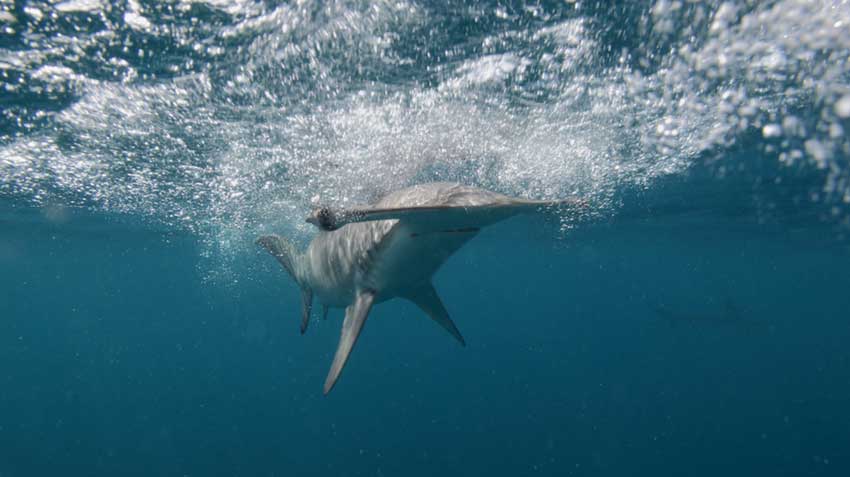
*Main image: smooth hammerhead shark. Photo: courtesy of Oceana
Originally published in its entirety on Mongabay, March 17, 2026.
0 Comments