
President links possible troop presence to Ecuadorian command while joint naval exercises signal expanding security cooperation.
President Daniel Noboa said Ecuador could receive U.S. military troops as early as this year if they operate in coordination with, and under the leadership of, Ecuador’s armed forces, a declaration that comes as the two countries expand visible military cooperation in Ecuadorian waters.
In comments to international media, Noboa insisted that any U.S. presence would not amount to a foreign occupation, but rather a joint effort aimed at confronting organized crime and drug trafficking. He said Ecuador is willing to work with outside partners so long as national security forces remain in charge.
A conditional opening
Noboa framed the possible arrival of U.S. troops as a limited and collaborative security measure, not a surrender of sovereignty. He said Ecuador would have no objection to foreign troops entering the country if they are prepared to work alongside Ecuadorian forces and respect their command structure.
The president argued that Ecuador has reached a moment where it must press its advantage against criminal groups. He said the country is experiencing a broader sense of calm than in previous months and that improvements in security indicators make this the time to continue dismantling trafficking networks and other threats.
His remarks are politically significant because they reopen a debate that appeared unsettled after Ecuadorians rejected, in the 2025 referendum and popular consultation, a proposal related to authorizing foreign military bases on national territory. Noboa nevertheless suggested that existing bilateral agreements could still permit a temporary foreign troop presence, as long as it remains under Ecuadorian military control.
He also pointed to what he described as broad public support for maintaining close relations with Washington, signaling that his government sees security cooperation with the United States as both strategically useful and politically defensible.
Exercises off the Ecuadorian coast
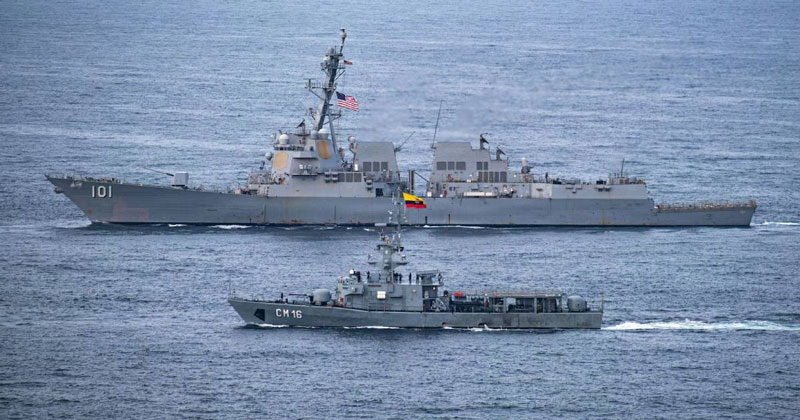
Noboa’s comments came just as Ecuadorian and U.S. forces wrapped up a new round of joint military exercises involving some of the most powerful naval assets deployed in the region.
The Ecuadorian Navy and the United States Southern Command concluded Operation Southern Seas 2026 on April 9th, following maneuvers conducted between April 7th and 8th in Ecuadorian waters. The operation brought together Ecuadorian naval and air units with the nuclear-powered aircraft carrier USS Nimitz and the guided-missile destroyer USS Gridley.
According to both militaries, the exercises were designed to strengthen security cooperation, improve operational coordination, and sharpen response capabilities tied to the fight against organized crime. The imagery and descriptions released afterward made clear that the operation was not merely symbolic. It included maritime interdiction simulations, live-fire drills, formation maneuvers, air defense exercises, and exchanges between specialists from both countries.
Ecuador deployed the missile corvettes BAE Manabí and BAE Loja, along with A-29 Super Tucano aircraft. The U.S. side contributed the Nimitz, the Gridley, F-18 Super Hornets, and MH-60 Sea Hawk helicopters assigned to Carrier Air Wing 17.
A senior Ecuadorian delegation also boarded the Nimitz, where officials observed flight deck operations, watched takeoffs and landings, and discussed interoperability and maritime security with U.S. commanders.
From cooperation to strategy
For Ecuador, the exercises offered more than a show of force. They also served as a public demonstration of how far security ties with Washington have advanced as the government seeks outside support against increasingly sophisticated criminal organizations.
The Ecuadorian Navy described the operation as evidence of its training, readiness, and commitment to international maritime security. U.S. commanders, meanwhile, said the drills helped refine critical operational skills while reinforcing an already established partnership with Ecuador.
That message aligns closely with Noboa’s own insistence that all joint operations with the United States remain led by Ecuadorian security institutions. His government appears eager to present deeper cooperation as an extension of national strategy rather than a transfer of control.
The timing also underscores the administration’s effort to build a broader anti-crime architecture that combines domestic military pressure with international backing. Noboa has repeatedly presented organized crime as a transnational threat requiring cross-border coordination, intelligence sharing, and external support.
Regional influences and the next phase
Asked about his broader security approach, Noboa said Ecuador’s model is not the same as the one associated with El Salvador’s President Nayib Bukele. Instead, he pointed to similarities with the hardline strategy pursued in Colombia under former president Álvaro Uribe.
Noboa said members of Uribe’s former team have advised his government, suggesting that Ecuador is drawing not only on U.S. logistical and military cooperation, but also on regional counterinsurgency and anti-crime experience.
That combination may shape the government’s next moves as it tries to convert tactical gains into a longer-term security plan. For now, the message from Quito is that Ecuador wants foreign help, but on its own terms: temporary, coordinated, and visibly subordinated to Ecuadorian command, even as U.S. warships and aircraft become an increasingly familiar presence just off its coast.
“…on its own terms.” Whether you align with or against the USA, it is never on your own terms. And exactly where has the USA ever solved a security problem or brought the flow of drugs to heel?
So much for the referendum upholding the constitutional ban to keep foreign forces out.
President Noboa consulted with President Trump several months ago. Unfortunately, he drank the Trump Kool-Aid. Now, Ecuador has issues with trade tariffs and angry neighbors, and we are riddled with US troops on the coast. It makes me very sad. The USA did not succeed in the war against drugs, but we imported the US military to fight this battle here. Solution: Legalize drugs created in Colombia and tax the import and sales. Use that money to pay China and resolve that debt. Later use it to improve many departments and services. I was in Colorado, and after that state legalized and taxed marijuana, I spoke to my police chief. We were surprised that all crime was down with huge drops of up to 85%, except arson. He attributed that to the meth labs. What’s the old expression: If you cannot beat them, join them? Colorado had so much money that infrastructure was improved, and education was of a higher standard.