
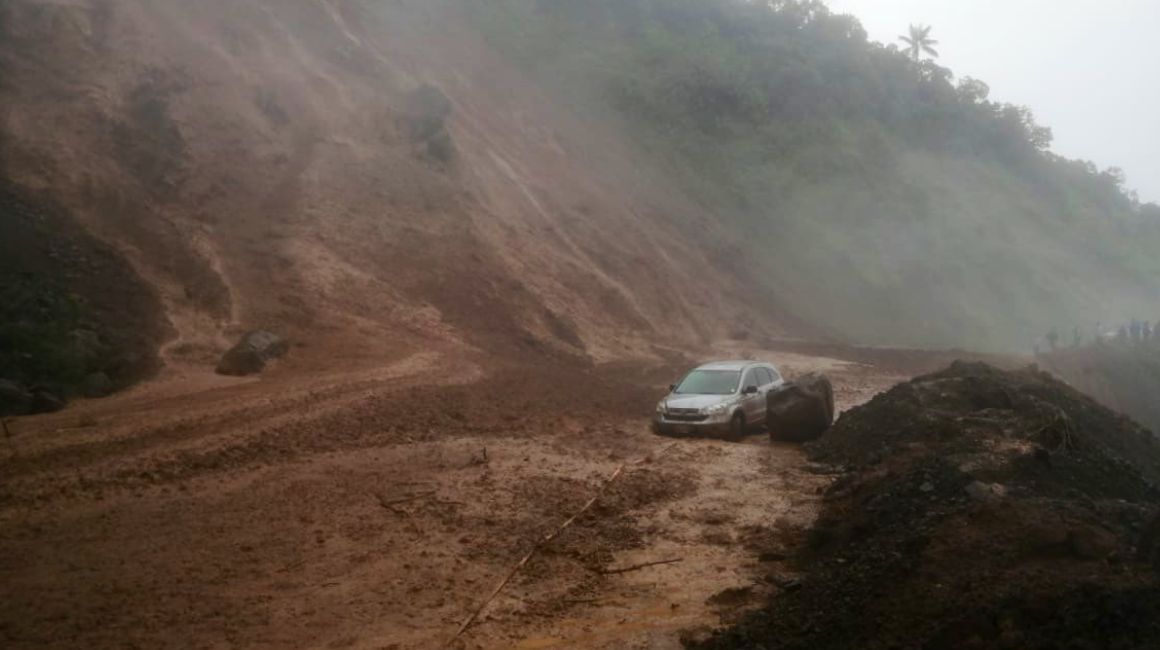
The government reports 29.34% contractual progress on the mountain highway, where a fresh collapse at kilometer 90 interrupted traffic Thursday.
The Cuenca–Molleturo–El Empalme highway closed again at kilometer 90 on November 5th when rock and earth fell from a mountainside onto the pavement, only hours after the government was emphasizing progress on its $20 million-plus rehabilitation of the route.
The Ministry of Infrastructure and Transport sent two excavators, a backhoe, a front-end loader and four dump trucks to clear the obstruction. The section was reopened before midday, initially with some material still on the road. During the closure, drivers were directed toward the Biblián–Zhud–Cochancay corridor.
The slide occurred on a route that is already under a major construction contract. President Daniel Noboa and Infrastructure Minister Roberto Luque inspected work between kilometers 6 and 10 during a visit to Azuay this week. On November 5th, the ministry put contractual progress at 29.34%.
A contract running into 2027
The rehabilitation began March 27th, 2026, and is scheduled to finish September 17th, 2027. The ministry describes the intervention as covering 112 kilometers, while an earlier presidential statement rounded the corridor to 113 kilometers. The project is financed with a World Bank loan and is being carried out by RIPCONCIV Construcciones Civiles, with HYC Integra responsible for supervision.
The work goes beyond resurfacing pavement. Plans include maintenance of ten bridges, rehabilitation of drainage, treatment of critical slope sections, road markings and safety improvements. The government has said that technical and contractual amendments are being considered to incorporate updated solutions for difficult sections.
Earlier project descriptions identified five particularly difficult points along the corridor. In August, the ministry put the rehabilitation at 12% progress. The November report’s 29.34% figure therefore describes a substantial advance over the previous three months, although it is a contractual measure rather than an independent count of finished kilometers.
Trouble spots identified by kilometer
The ministry’s November 6th road bulletin listed a sinkhole at kilometer 53+700 along the Molleturo–Sayausí section. Other entries identified sinkholes at kilometers 91+600 and 92+600 and a landslide at kilometer 101. The affected locations were shown with restrictions or instructions to proceed cautiously.
Separate traffic notices identified partial restrictions elsewhere along the corridor after Thursday’s clearance operation. Emergency notices named kilometers 71, 80, 90, 92, 94, 96, 98 and 101 as sections requiring special attention.
The kilometer 90 section had also required clearance work earlier in the holiday period. The November 5th collapse again sent crews into the area with heavy equipment while vehicles waited or diverted.
More than 6,000 vehicles use the Cuenca–Molleturo corridor on an average day, according to the ministry. The route is one of the principal connections between Azuay and Guayas, carrying trucks, buses and private vehicles between Cuenca and the coastal region.
The government’s announced completion date remains September 2027. Until then, the ministry must keep traffic moving while contractors work on pavement, drainage, bridges and the unstable sections that continue to produce emergency closures.
For the latest road status, the operational report is the ministry’s current bulletin, rather than the progress percentage quoted during the presidential visit. The November 5th reopening restored passage through kilometer 90; it did not eliminate the other restrictions listed along the highway.
0 Comments