
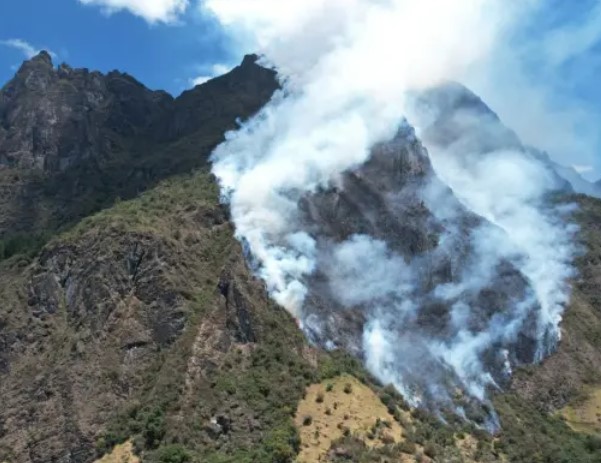
Cuenca firefighters warn that agricultural burns, wind and extremely dry vegetation are keeping the province at high risk.
More than 600 hectares burned in Cuenca
Forest fires have burned more than 1,700 hectares of vegetation across Azuay this year, including more than 600 hectares in Cuenca, as firefighters warn that dry vegetation and strong winds continue to create dangerous conditions despite scattered rain.
The latest estimate from the Cuenca Fire Department is higher than the 1,552 hectares reported by national risk-management authorities through September 21st. At that point, Cuenca already led the province with 496.16 hectares affected.
Other heavily affected cantons included Nabón with 236.05 hectares, Girón with 156.53, Santa Isabel with 155.45, Paute with 130.76 and Gualaceo with 118.93.
The continuing fires have pushed the provincial total above 1,700 hectares, according to Cuenca Fire Chief Sixto Heras.
Dry grass and wind can turn a small fire into a major one
Heras says the principal danger is the condition of the vegetation.
Fine fuels such as dry grass, thin branches and undergrowth have lost enough moisture that they can ignite easily and allow fire to spread rapidly. Wind then pushes flames across larger areas and can carry burning material beyond the original fire line.
That means even a small agricultural burn or other ignition source can become difficult to control.
Rain has fallen in parts of Cuenca, including showers in the southern and northern portions of the city, but firefighters say the precipitation has not been sufficient to reverse the overall dryness.
On September 28th, a fire in Cumbe threatened several homes. Firefighters from the Tarqui station responded, demonstrating how quickly a vegetation fire can become a threat to property when conditions are dry.
Agricultural burning becomes a growing concern
One of the biggest risks comes from agricultural burning as rural residents prepare land for the November planting season.
Controlled burns are traditionally used to clear fields and dispose of vegetation, but firefighters warn that the practice becomes particularly dangerous when it coincides with dry fuel and wind.
In Ludo, in Sígsig canton, one person died after becoming trapped by flames while carrying out a burn, according to the Cuenca Fire Department.
Another significant fire was reported near Paute.
Authorities are asking residents to avoid burning vegetation under dangerous conditions and to report any fire immediately so firefighters can respond before it expands.
Fireworks and sky lanterns add another hazard
Rural festivals create another seasonal risk.
Firefighters are particularly concerned about fireworks and paper sky lanterns used during parish celebrations. Once a lantern is released, there is no way to control where it lands, and an open flame can come down in dry grass, forest or páramo.
Discarded cigarette butts are another potential ignition source.
Heras has asked parish governments and other local authorities to exercise greater control over activities that can start fires while vegetation remains unusually dry.
The department has also suggested evaluating temporary restrictions in protected areas, including Cajas National Park, if conditions warrant additional precautions.
Cajas and its surrounding ecosystems are vulnerable
The concern around Cajas extends beyond the park boundary.
Forests, páramo and other vegetation in surrounding buffer areas play an important role in the ecosystems that store and regulate water for Cuenca and neighboring communities.
Earlier assessments documented extensive losses in areas near Cajas and in protected vegetation zones. Fire does not simply remove visible plants; severe burns can damage soil, wildlife habitat and the ability of high-altitude ecosystems to retain water.
That makes wildfire prevention particularly important during a period when Azuay is simultaneously confronting low river flows and pressure on the hydroelectric system.
Firefighters consider an aerial unit
The growing number and geographic spread of emergencies have also renewed discussion about whether Azuay needs dedicated aerial-response capability.
The Cuenca Fire Department is studying the possibility of having access to a helicopter, but Heras says purchasing and operating one is beyond the department’s financial capacity.
Rather than using an aircraft only for forest fires, the proposal envisions an aerial unit capable of supporting four areas: search and rescue, firefighting, hazardous-material incidents and prehospital medical emergencies.
One possibility would be a joint arrangement among public institutions, potentially with participation from the private sector, to finance and operate the aircraft.
No purchase has been approved, and the proposal remains under discussion.
Floods on the Coast, fires in the Andes
The Azuay fires underscore one of the most counterintuitive features of Ecuador’s current weather emergency.
While heavy rain and flooding have affected thousands of people in coastal provinces, parts of the southern Andes remain dry enough to sustain serious forest fires and falling hydroelectric reservoirs.
El Niño does not produce identical conditions across the country, and rainfall in one region does not automatically relieve drought or fire danger in another.
Weather forecasts through October 5th call for moderate to heavy rain in several parts of Ecuador, including western areas of Azuay. Any sustained rainfall could reduce local fire danger, but firefighters caution that scattered showers alone are not enough to restore moisture to severely dried vegetation.
For now, the province is dealing with both sides of Ecuador’s climate problem: the national emergency is increasingly defined by too much water in some places and far too little in others.
0 Comments