
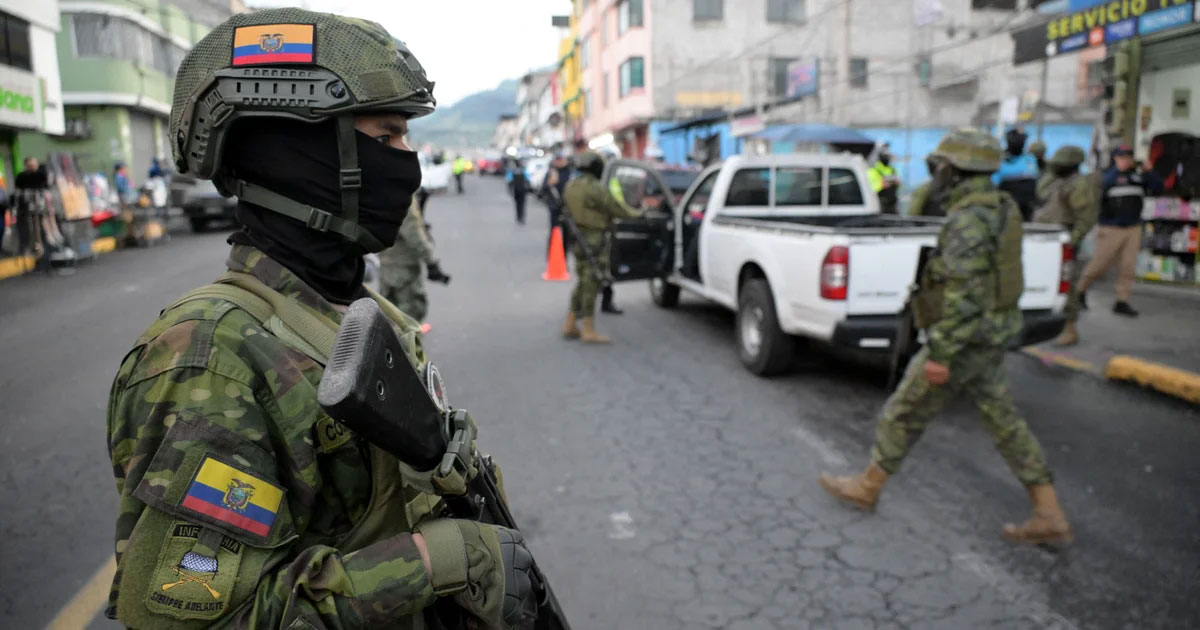
The extension adds no curfew but keeps extraordinary police and military powers in force across the province.
Azuay will remain under a state of exception for another 30 days as the national government says organized criminal groups continue to operate in Cuenca and other parts of the province.
President Daniel Noboa extended the emergency measures on August 14th through Executive Decree 472. The extension covers Azuay along with Guayas, Manabí, Santa Elena, Los Ríos, El Oro, Pichincha, Esmeraldas, Santo Domingo de los Tsáchilas and Sucumbíos, as well as the cantons of La Maná, Las Naves and La Troncal.
For people living in Cuenca, one point is particularly important: the extension does not impose a curfew.
Residents can continue to move around the city without a government-imposed nighttime restriction, and businesses are not required by the decree to close at a particular hour.
Instead, the state of exception preserves extraordinary powers for the National Police and Armed Forces that the government says are necessary to confront organized crime.
Why Azuay remains included
Azuay’s continued inclusion may seem surprising because the province has not experienced homicide rates comparable with some of the hardest-hit areas of Guayas, Los Ríos, Manabí or El Oro.
The government’s argument focuses not only on the current level of violence but on the presence and expansion of criminal organizations.
Intelligence reports cited in support of the decree identify Los Lobos as the principal organized armed group operating in Azuay. The reports say its strongest activity is concentrated in the Cuenca North and Cuenca South police districts and in Camilo Ponce Enríquez.
Ponce Enríquez is considered particularly strategic because of its mining economy and its road connections with El Oro and Guayas. Authorities say those characteristics facilitate movement by criminal actors and support illicit economies.
In Cuenca and Ponce Enríquez, intelligence reports associate Los Lobos with drug distribution as well as crimes including extortion, kidnapping and robbery.
Authorities have also identified what they describe as occasional activity by members of Sao Box from neighboring El Oro. According to the intelligence assessment, those members may be attempting to expand their influence and dispute criminal territory in Cuenca.
Those are government intelligence claims rather than criminal convictions against every person associated with the groups, and they should be understood as the security rationale behind the emergency declaration.
Extraordinary powers remain in effect
The state of exception continues temporary restrictions on certain constitutional protections, including aspects of the inviolability of the home and correspondence, under the conditions laid out in the decree and existing law.
Security forces can conduct operations and searches when legal conditions are met and there are indications involving organized armed groups, weapons or evidence of criminal activity. The Armed Forces can continue working in support of the National Police.
The decree also permits temporary requisition of legally owned goods or services when required for emergency security operations, subject to constitutional and legal requirements.
Those powers are not unlimited. The government remains bound by the Constitution, applicable legislation and Constitutional Court rulings governing states of exception.
For most Cuenca residents, the practical effect is therefore likely to be increased or continued police and military operations rather than a dramatic change in daily routines.
The extension also underscores a distinction that can be lost when Azuay appears on the same government list as provinces experiencing much higher levels of violence.
The government is not saying that Cuenca has become another Durán or that Azuay suddenly has the same security conditions as coastal hot spots.
Its stated concern is that organized criminal groups that already operate nationally are developing networks, markets or territorial interests in Azuay, including in Cuenca.
Whether the extraordinary measures actually prevent those organizations from strengthening their position is a different question and one that can only be judged over time.
For now, the state of exception remains in force for another 30 days, with no curfew but with expanded security powers continuing in the province.
0 Comments