
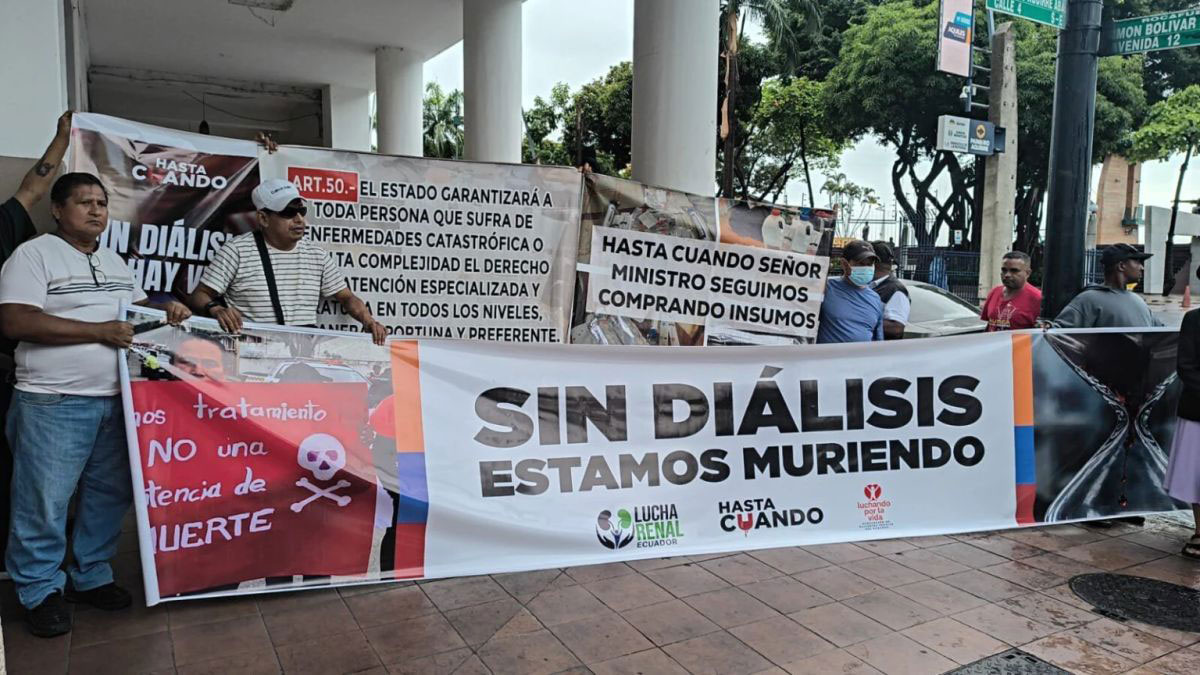
One local center says it is owed more than $4 million while patients fear unpaid bills could disrupt lifesaving care.
Patients return to the Governor’s office
Kidney patients and their families returned to the Azuay Governor’s office on September 29th to demand that the government pay private dialysis centers that provide treatment to patients referred by Ecuador’s public health system.
The demonstration was driven by a fear that has become familiar to dialysis patients around the country: the Ministry of Public Health and the Ecuadorian Social Security Institute, or IESS, continue sending patients to private providers while payments for those services accumulate for months.
Patients in Cuenca say they are not asking for a new benefit. They want the government to pay for treatments that have already been provided so the centers can continue operating.
Dialysis is not a procedure patients can simply postpone while a financial dispute is resolved. People whose kidneys can no longer adequately remove waste and excess fluid generally require treatment several times a week, making continuity of service critical.
One Cuenca provider says it is owed more than $4 million
The scale of the problem is visible in the accounts of the Unidad de Servicios Renales del Austro, known as Unireas, a Cuenca dialysis provider serving patients referred through the public health network.
Unireas says the Ministry of Public Health and IESS together owe it approximately $4.17 million.
According to figures the company provided in September, about $2.05 million corresponds to the Health Ministry for 20 months of services provided between January 2025 and August 2026.
The company says another approximately $2.08 million is associated with IESS and Seguro Social Campesino obligations, including unpaid treatment periods and disputed or previously justified billing adjustments.
Unireas has warned that the prolonged lack of payment has created a liquidity crisis that threatens the sustainability of a service on which patients with chronic kidney failure depend.
Government says payments are coming
Azuay Governor Xavier Bermúdez says an agreement has been reached with dialysis providers and that payments are expected during the first days of October.
The Governor’s office said it has held meetings with patients and representatives of dialysis companies and insisted that no kidney patient has stopped receiving treatment because of the payment dispute.
Bermúdez met with representatives of the patients after the September 29th demonstration and said the government remains committed to keeping them informed and guaranteeing continuity of care.
At the time of the protest, however, Unireas had reached only a partial payment agreement with IESS and had not reached an equivalent agreement with the Ministry of Public Health, according to local reporting.
The company said it had continued treating patients because of its own commitment to them, not because the outstanding state obligations had been resolved.
Patients reject claims that protest is political
The dispute became more contentious when the Governor’s office described the protest as an action influenced by political interests and accused people outside the issue of trying to create a media spectacle.
Patient organizations strongly rejected that characterization.
Flavio Aguas, a representative of kidney patients in Cuenca, said the demonstrations are driven by concern over the continuity of treatment rather than electoral or party politics.
Diego Jimbo, who represents patients with catastrophic illnesses, also asked that future meetings with officials not be held privately. Patients want the press present so commitments and proposed payment arrangements are public.
The disagreement has shifted part of the debate from the size of the debt to whether patients’ public demonstrations are legitimate pressure on the government.
The problem is national, not only Cuenca’s
Cuenca’s dialysis dispute is part of a much larger national financing problem.
Industry representatives say the Ministry of Public Health owes dialysis centers across Ecuador more than $140 million. IESS also carries substantial obligations to external health providers.
The reliance on private dialysis centers exists because Ecuador’s public hospitals do not have enough capacity to provide all required renal treatments directly. The state therefore refers patients to outside providers and is responsible for paying for their care.
When those payments fall months behind, providers still face immediate expenses for specialized supplies, medications, equipment, utilities and medical staff.
That mismatch has produced repeated protests and warnings from dialysis centers in Ecuador over several years.
Promises now face an immediate test
The latest government commitment is unusually easy to measure because officials attached a short timetable to it.
The Azuay Governor’s office said disbursements would occur during the first days of October. That means patients and providers will soon be able to determine whether the promised payments actually arrive and how much of the accumulated debt they cover.
A partial payment could provide temporary liquidity without resolving obligations that in some cases extend back well over a year.
For patients, the accounting dispute matters only because of what it could eventually do to their treatment. Providers can absorb delayed payments for a period by using reserves, credit or unpaid obligations of their own, but that cannot continue indefinitely.
So far, authorities say no Cuenca patient has lost dialysis because of the dispute. The patients protesting outside the Governor’s office are trying to make sure the system does not reach the point where someone does.
0 Comments