
Ana Cristina Alvarado
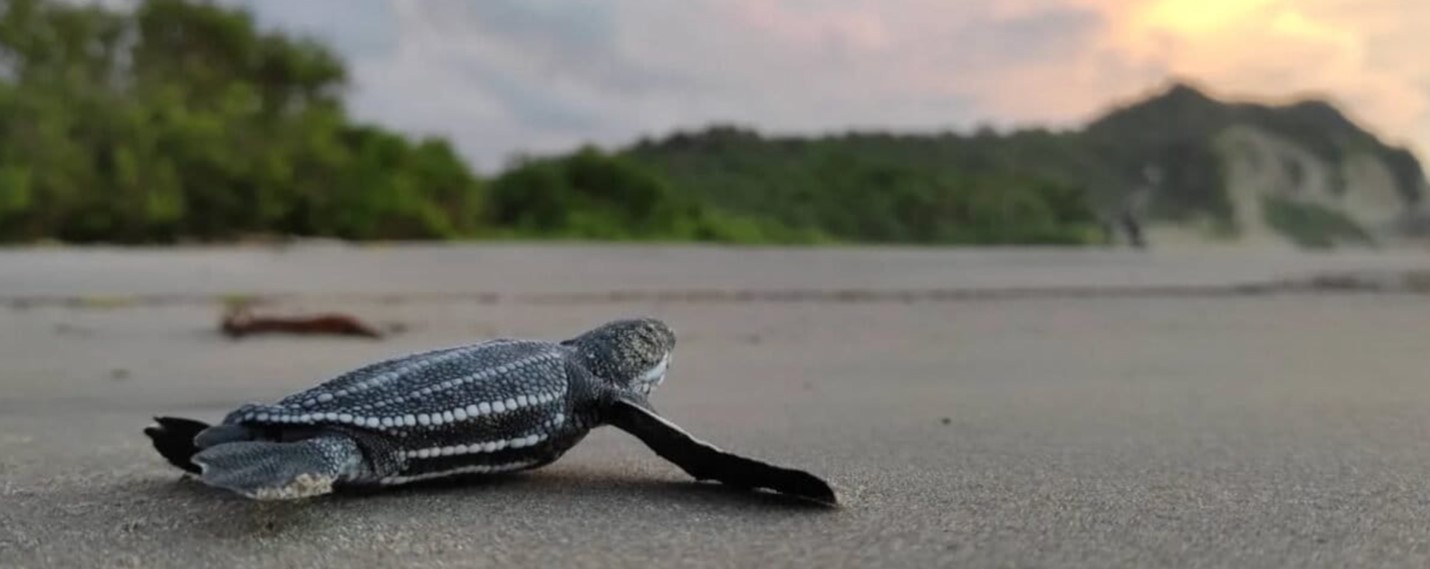 A newborn leatherback turtle heads towards the sea. Photo: Courtesy of Fundación Contamos Contigo
- In early 2025, an Ecuadorian court banned sand mining and vehicular traffic on Bikini Beach in Manabí to protect the nesting sites of the leatherback turtle.
- One year after the precautionary measures, these illegal activities continue and the case is under preliminary investigation by the Prosecutor’s Office.
- Populations of the Tropical Eastern Pacific leatherback have declined by 97%, so it is listed as Critically Endangered.
- Civil society organizations and park rangers have protected nearly 500 eggs during the first three weeks of January.
In Ecuador, the courts recognized the rights of the leatherback sea turtle (Dermochelys coriacea) and established measures to protect Bikini Beach, a well-known nesting site. However, a year after the Criminal Court of Sucre, in the province of Manabí, granted protective measures for the species, civil society continues to document illegal sand extraction and vehicle traffic in the area.
“The case has been referred to the Prosecutor’s Office to investigate illegal sand mining. It is currently in the preliminary investigation phase,” says Kimberly Viracocha, a lawyer with the Ecuadorian Coordinating Body of Organizations for the Defense of Nature and the Environment (CEDENMA). At this stage, the progress of the investigation is confidential.
This species is the largest sea turtle in the world, reaching nearly two meters in length and weighing up to 500 kilograms. It has inhabited oceans around the world since the time of the dinosaurs, according to the U.S. National Marine Fisheries Service.
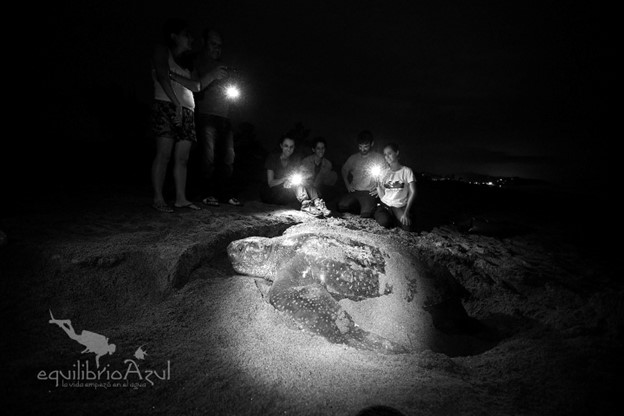 Archived image of a leatherback turtle nesting in Ecuador. Photo courtesy of Equilibrio Azul
Despite its wide distribution, it is listed as Vulnerable on the International Union for Conservation of Nature (IUCN) Red List of Threatened Species. Even worse, the population in the Eastern Tropical Pacific has declined by 97%, leading to its classification as Critically Endangered. However, when the mothers approach the beaches to nest, they face all kinds of threats.
“In general, sea turtles are at a disadvantage in Ecuador,” says Cristina Cely, director of the One Health Ecuador Foundation and a marine crime researcher. The construction of seawalls, vehicle traffic, and streetlights threaten nesting, a vital process for the survival of their populations, she explains. Furthermore, sand mining puts turtles, their nests, and the entire beach ecosystem at risk.
Therefore, in February 2025, Cely and the CEDENMA team filed a petition for the immediate protection of the leatherback sea turtle’s rights. A court determined that there is an imminent and serious threat of violation of nature’s rights. Ecuador recognizes the rights to existence and perpetuation of species, as well as the full respect for their life cycles.
 Documentation of illegal sand extraction on sea turtle nesting beaches. Photo: courtesy of Fundación Contamos Contigo
Judge Ginger Mendoza granted the request for precautionary measures and ordered the Municipality of Sucre Canton to prevent sand extraction and the transit of vehicles and machinery in the nesting area of turtles and other species at Punta Bikini. She also ordered monitoring to identify nests and the development of management plans for their protection.
Mongabay Latam obtained a report from the Ombudsman’s Office, dated June 2025, which states that there has been no compliance. Recent videos collected by Cely and analyzed by this outlet show that the prohibited activities continue.
Nearly 500 eggs relocated
The leatherback turtles, unaware of this dispute on land, began to frequent Ecuadorian waters in early January. This is how Juan Fernando Pesántez, a marine biologist and co-founder of the organization Contamos Contigo Ecuador, described it. The organization is dedicated to the protection and research of sea turtles in the cantons of Sucre and Portoviejo, both in Manabí province.
 Relocation of leatherback turtle eggs in early January. Photo: courtesy of Fundación Contamos Contigo
In early January 2026, a leatherback sea turtle made national news after becoming trapped in a rocky access point for swimmers at Crucita Beach, about 12 kilometers from Punta Bikini. Pesántez says the large number of lights and tourists may have caused the turtle to become disoriented. With the help of the Crucita Fire Department, the turtle was freed, but it returned to the sea without nesting.
The Contamos Contigo team remained monitoring and protecting the site until, two days later, the bird finally nested. Pesántez relocated the clutch so the eggs would be safe from tourists, dogs, and other threats. This is a process that demands great precision.
Leatherback sea turtles, also known as baulas, build nests about a meter deep in the sand. There they lay dozens of eggs. These are not calcareous, like birds’ eggs, but gelatinous. As time passes, the shell hardens, with a texture similar to a sheet of paper, explains the marine biologist. After five hours, the eggs become rigid and can no longer be moved. “That’s why it has to be done immediately,” he emphasizes.
 The community visits the nursery of the Contamos Contigo Foundation. Photo: courtesy of the Contamos Contigo Foundation
Once the turtle leaves, the Contamos Contigo team uncovers the nest and places each egg, without turning it over and in the same position in which it was found, into a Styrofoam box filled with sand. In San Jacinto, a couple of kilometers from Crucita, the foundation has a hatchery. There, the nest is replicated using sifted sand. Finally, a thermometer and a camera to detect hatching are placed in the nest, and it is covered.
The temperature is taken every day. Ideally, it should be kept at 28 degrees Celsius. Excessive heat produces mostly females, while cold results in more males. To regulate the temperature, on hot days they provide shade and water the nests. On cold days, they put up a kind of tent to concentrate the heat.
By mid-January, 438 eggs had been relocated by specialized organizations and park rangers, according to a statement from the Ministry of Environment and Energy (MAE). Of these, Contamos Contigo (We Count on You) rescued approximately 200 eggs found on various beaches between Crucita and Bahía de Caráquez, where it holds an environmental operating permit. Following the announcement, the foundation safeguarded an additional 50 eggs, bringing the total to nearly 500 rescued eggs in Manabí.
Punta Bikini awaits protection
 In 2021, 60 leatherback sea turtles hatched at Punta Bikini. Photo: courtesy of Fundación Contamos Contigo
To date, no leatherback turtles have been recorded arriving at Punta Bikini, but the Contamos Contigo team continues to monitor the site, as the nesting season extends until March. Pesántez and his team recorded nests on two previous occasions. In March 2021, 60 turtles hatched on that beach.
The representative of the Municipality of Sucre attempted to dismiss the request for precautionary measures, arguing that the Municipality is not responsible for illegal acts committed by third parties, the area is not a protected zone, and there is no “imminent and serious” harm. The lawyer also claimed that, according to data from the Ministry of the Environment (MAE), no leatherback turtles have been recorded in the area since that year. However, Randall Arauz, a Costa Rican scientist and expert on the subject, refuted these arguments.
Arauz is a policy advisor for Marine Watch International and has over 30 years of experience in the conservation of sea turtles and other highly migratory species. He participated as a witness and technical expert during the hearing. He explained—according to the transcript obtained by Mongabay Latam —that turtles typically return to their natal beach in cycles of three to five years, a phenomenon known as philanthropy. This information was used by Judge Mendoza to justify the protection of Bikini Beach.
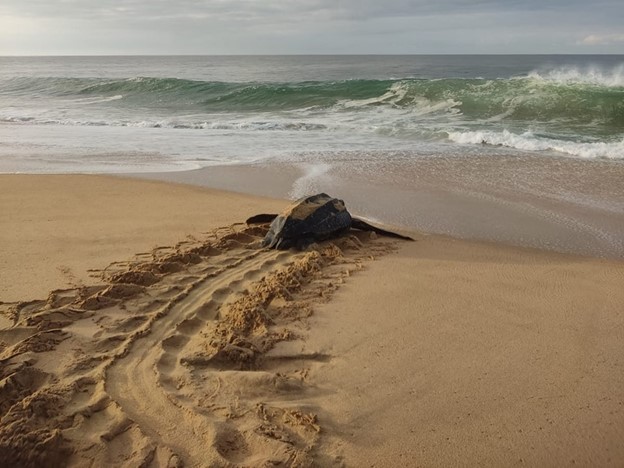 Leatherback sea turtle in Jalisco, Mexico. Photo: courtesy of Campamento Tortuguero Mayto
“It’s a characteristic of sea turtles,” Arauz told Mongabay Latam. This is because, she explained, adults return to nest where they were born because that site worked in the past. This means that the beach has the necessary characteristics for a successful hatching, for example, in terms of temperature and type of sand.
The representative from the Ministry of Environment and Energy, for his part, argued that neither the imminence nor the severity of current harm to the leatherback turtle has been proven. According to him, no specific offender has been identified as endangering the species, and therefore he considered the plaintiffs’ accusations to lack “plausibility.”
In the statement issued this year regarding the relocation of more than 400 eggs, the Ministry of the Environment (MAE) also fails to recognize illegal sand mining as a threat to sea turtle nesting. It does, however, list predation by feral dogs, vehicular traffic, tourism activities, light pollution, and extreme weather events.
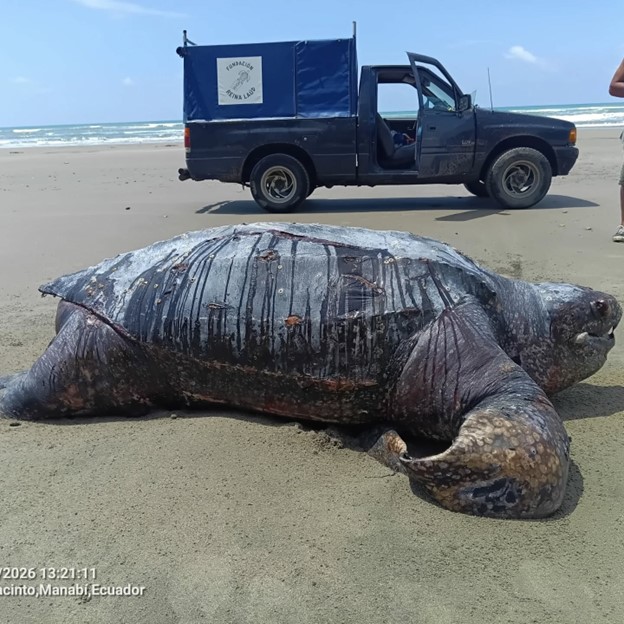 The body of a leatherback sea turtle was found in an area where nesting had previously been documented. The cause of death is unknown. Photo: courtesy of Fundación Contamos Contigo
Viracocha points out that although the Municipality of Sucre has not complied with Judge Mendoza’s order, they will continue to seek legal alternatives to protect and raise awareness of this endangered species. “We are analyzing how to file an injunction that covers the entire province of Manabí and other coastal areas,” he says.
Mongabay Latam asked the Ministry of the Environment (MAE) and the Municipality of Sucre about the progress in complying with the measures and the actions they are taking to protect the species. However, neither institution responded.
Take care of each nest as if it were gold
“I was very pleased with the resolution that came out in Ecuador,” Arauz said. “We must protect every nest as if it were gold and make sure that all the eggs hatch so that the species has a chance,” he added.
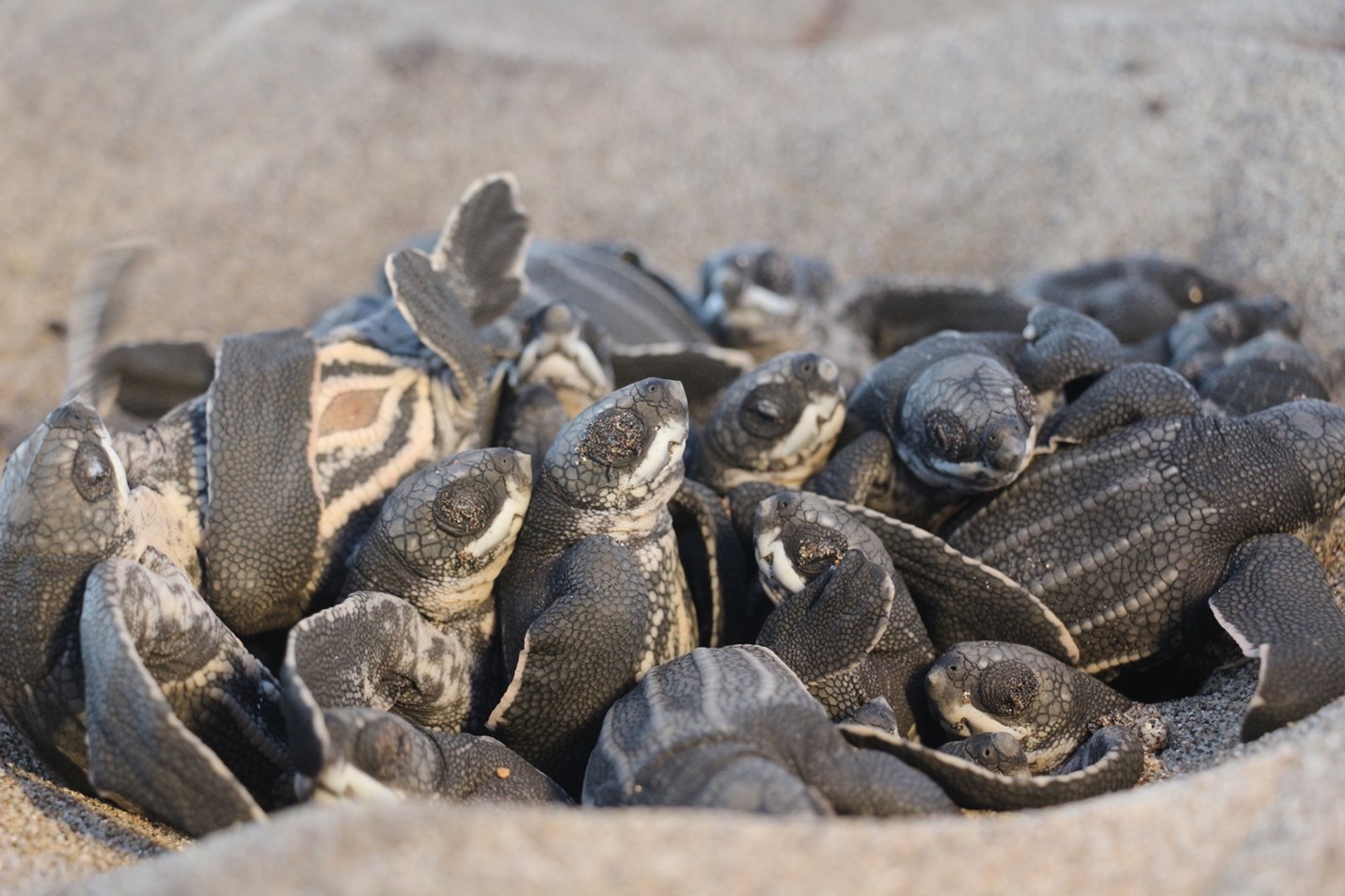 Leatherback turtle hatchlings emerging on a Mexican beach. Photo: Carlos Salas / Red Laúd OPO
To protect them and prevent the disappearance of the leatherback turtle population in the Eastern Tropical Pacific, a complementary strategy is needed, says the Costa Rican scientist. On land, there must be strict protection of the beaches, and at sea, agreements must be reached with the fishing industry to reduce bycatch. “It was the first species to show a significant population decline due to longlining [the fishing gear used to catch large pelagic and commercial species]. In 1990, it was said that if nothing was done, sharks would follow the same path,” Arauz asserts.
The disappearance of leatherback seabream could cause an imbalance in the ocean, affecting the fishing industry, which is often reluctant to adopt new fishing methods based on scientific evidence, according to the expert. In the animal world, everything is interconnected. These giants feed on thousands of jellyfish, controlling their population. In this way, they prevent them from multiplying and decimating the zooplankton, which consists of the larvae of commercially important species.
 Leatherback sea turtle in Jalisco, Mexico. Photo: courtesy of Campamento Tortuguero Mayto
Although more than 30 years have passed since the first warnings, Arauz says we must remain optimistic and continue working until overfishing is stopped. This doesn’t mean banning fishing, but rather establishing regulations and scheduling measures and implementing selective fishing gear.
On land, organizations like Contamos Contigo maintain the hope of protecting this and other species that come to nest on Ecuadorian beaches. “It’s the most impressive thing there is, we call it ‘the leatherback queen’,” says Pesántez.
The team is monitoring the eggs’ well-being, and in 55 days, the baby turtles could hatch and begin their journey back to the sea. Meanwhile, with binoculars in hand, specialists continue to monitor the beaches, waiting for mothers to return to the place where they were born.
0 Comments