
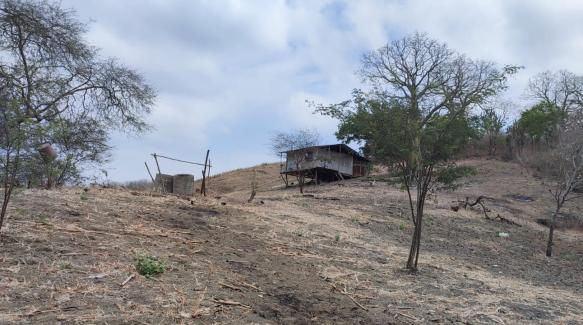
As Ecuador grapples with rolling blackouts triggered by an ongoing energy crisis, a hidden reality has come into sharper focus: for thousands of families in rural Manabí, the issue isn’t the inconvenience of losing electricity—it’s that they’ve never had it.
While the rest of the country debates how to manage temporary outages, these communities have lived for generations without access to even the most basic electrical infrastructure.
Manabí, Ecuador’s second-most populous province with a population of 1.5 million, includes hundreds of remote communities spread across rugged terrain.
While national statistics report a 93.6% electrification rate in the province, these numbers mask an uncomfortable truth. In areas like Pedernales, Jipijapa, and Bolívar, countless families live without electricity, relying instead on oil lamps, candles, and the faint glow of open flames. The situation underscores a glaring disparity between urban centers and rural regions, where electrification remains an elusive dream.
A Generational Crisis of Neglect
In the canton of Pedernales alone, over 80 of its 284 rural communities have never been connected to the electrical grid. Despite official claims of a 94.7% electrification rate in Jipijapa, families in remote areas like Matapalo, El Retiro, and La Rinconada live in near-total isolation, both figuratively and literally.
Entire generations in these areas have lived without electricity. Parents describe how their children must complete homework before sunset, often by the dim and flickering light of a candle.
For Patricia Zambrano, a resident of Rinconada de Lizondro in Pichincha canton, the lack of electricity means her family is cut off from modern life. “We light candles at night and pray the wind doesn’t blow them out,” she said. “We don’t have refrigeration, so we can’t store food. And when my kids are sick, we can’t even call for help.”
In Bolívar canton, the mother of a disabled son shared a heartbreaking account of her family’s struggles. “I can’t refrigerate his medicines or provide the proper care he needs,” she said. “Electricity would change everything for us, but we’ve been waiting for decades.”
The Daily Reality of Life Without Power
The absence of electricity has far-reaching consequences that touch every aspect of life in these communities. Without refrigeration, families are forced to make daily trips to the nearest market—often miles away—to purchase perishable goods. Radios, powered by scarce and expensive batteries, serve as the only connection to the outside world. Internet and telecommunications are non-existent, leaving these communities digitally invisible.
Children are among the hardest hit. Without reliable lighting, their education is compromised. Many drop out of school early, unable to compete with peers in urban areas who enjoy access to modern resources. Teachers who work in these communities describe the challenges of educating students who cannot complete assignments at home or even read after dark.
The lack of electricity also makes medical care more precarious. In emergencies, patients must be transported on foot, horseback, or canoe to reach the nearest health centers, which can be hours away.
For many families, these barriers are life-threatening.
Transportation is another major hurdle. Many of these rural communities are accessible only during the dry season, as heavy rains render roads impassable. Some areas have no roads at all, relying on narrow trails that are barely navigable even under the best conditions.
Electrification Efforts: A Drop in the Ocean
Despite the glaring need, progress on electrification projects in Manabí has been painfully slow. Between 2022 and 2024, the National Electricity Corporation (CNEL EP) allocated approximately $4 million for rural electrification efforts in the province. While some communities have benefited—such as Cabello Adentro in Bolívar canton, where 59 families were recently connected to the grid—these successes are the exception, not the rule.
CNEL EP officials estimate that at least $20 million is required to connect all underserved communities in Manabí. However, more than 800 electrification projects remain pending, and many have been stalled for years due to budget constraints, logistical challenges, and seasonal accessibility issues. Even in areas where progress has been made, the high cost of extending electrical grids into remote regions has limited the pace and scope of development.
“Electrification isn’t just about installing poles and wires,” one CNEL EP representative explained. “It’s about overcoming decades of neglect and systemic underinvestment in rural infrastructure.”
A Stark Contrast to the Blackout Crisis
As urban areas across Ecuador protest rolling blackouts, the plight of Manabí’s rural communities serves as a stark counterpoint. For these families, the conversation isn’t about temporary power cuts; it’s about a complete absence of electricity. The energy crisis dominating national headlines has done little to change their reality or bring attention to their struggles.
The lack of electricity underscores a deeper issue: rural communities are often treated as an afterthought in national development plans. While urban centers receive the bulk of public investment, rural areas like those in Manabí are left to fend for themselves. This disparity raises questions about equity and justice in a country that prides itself on progress and modernization.
The Broader Implications for Ecuador
The situation in Manabí is not unique. Across Ecuador, rural electrification remains a persistent challenge, with thousands of families living in conditions more reminiscent of the 19th century than the 21st. As the government works to stabilize the national power grid, it faces a broader challenge: how to ensure that all Ecuadorians, regardless of where they live, have access to basic infrastructure.
Electricity is more than a convenience; it is a lifeline. It enables education, improves healthcare, and fosters economic growth. For the communities of rural Manabí, the promise of electrification is not just about light—it’s about hope for a better future.
Until that promise is fulfilled, the stark contrast between the power struggles of urban Ecuador and the enduring darkness of Manabí’s forgotten communities will remain a glaring testament to inequality in the nation.

0 Comments