
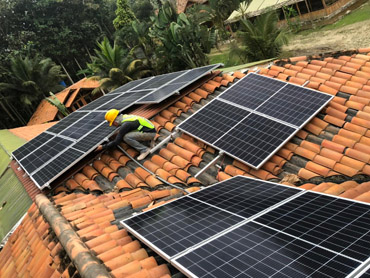
A photovoltaic solar energy system can keep your home running during outages and lower your energy bills. But what type of system does it require, and how much will the installation cost?
Solar energy systems are most effective in areas with high sun exposure. Ecuador, with its diverse geography, offers varying solar potential based on location. The World Bank mapped solar radiation across the country, drawing on data from 1999 to 2018, to highlight where solar systems perform best.
- Highland cities like Quito, Ibarra, Riobamba, and Ambato have excellent solar potential, with radiation levels up to 5.8 kWh/m² per day. Thanks to their altitude, these cities receive more sunlight hours, making them ideal for solar installations.
- In Quito, the average radiation is 5.2 kWh/m², translating to nearly six hours of productive sunlight on clear days.
- In Guayaquil, solar exposure ranges between 4.65 and 4.8 kWh/m², providing around four and a half productive hours from 11:00 a.m. to 4:30 p.m.
- Cuenca’s solar potential is similar to Guayaquil, with approximately 4.8 kWh/m² daily.
Solar performance also varies across the year, and external factors like dust on panels can reduce efficiency. The Andean provinces of Loja, Chimborazo, Pichincha, and Imbabura have higher potential, as do coastal regions like Playas Villamil, La Libertad, Manta, and Pedernales.
What Type of Solar System Do You Need?
According to Ronnie Bonilla, a professor at the Catholic University of Santiago de Guayaquil, two main types of solar systems are available:
1.-Grid-Connected Photovoltaic System
- Solar panels absorb sunlight and convert it into direct current (DC) during the day. This is then transformed into alternating current (AC) to power household appliances.
- It reduces your dependence on the public grid during the day but won’t provide energy at night or during evening outages.
2.-Hybrid Photovoltaic System
- This more advanced system includes solar panels, an inverter, and batteries that store energy.
- The stored energy can be used at night or during power outages. Batteries can charge from either the solar panels or the grid, ensuring continuous power when needed.
Both systems require a bi-directional meter, which records the energy both produced and consumed. If your home has only a standard meter, you’ll need to request a replacement from your electricity provider, which involves inspections and project approval.
Installation Costs and Energy Savings
For a typical middle-class household (four people) with appliances like a refrigerator, TV, and air conditioning, energy consumption ranges between 2.9 and 3.2 kW daily. To meet this demand:
- 7 solar panels of 470 watts each are required.
- A 5 kW inverter is recommended to allow future expansion, such as adding another air conditioner.
- The total cost of this system would be approximately $3,500, which works out to about $1.05 to $1.10 per watt.
With these solar panels, homeowners can expect energy savings and a return on investment within 6 to 8 years, depending on their energy usage habits.
Example of Solar Energy Production
- In Quito: A 10 kW system can produce up to 50 kWh on a sunny day, and about 25 kWh on a cloudy day.
- In Guayaquil: The same system generates 35 kWh on a sunny day and 17.5 kWh on a cloudy day. Over a month, this averages around 800 kWh, which is enough for a home consuming 400–500 kWh per month.
For larger homes consuming 2,500 kWh monthly, the system will only cover part of the demand, but the savings will still be substantial.
Batteries and Backup Systems for Power Outages
During outages, a hybrid system with batteries offers autonomy. Bonilla explains that with:
- One battery system costing around $1,000, you’ll get 3.5 hours of power for essential appliances like lights, the refrigerator, and a TV.
- Adding four batteries extends that to 4.5 hours, covering lights, TV, sockets, and air conditioning.
Longer autonomy requires additional batteries. Over time, solar panels can also be added to further reduce energy bills.
Components of a Photovoltaic System
A solar system consists of several key components, as outlined in Ecuador’s Solar Atlas:
- Solar panels: Capture sunlight and convert it into DC power.
- Battery bank: Stores energy for use at night or during cloudy days.
- Charge regulator: Prevents overcharging or deep discharging of batteries.
- Inverter: Converts DC power into AC power, compatible with household appliances.
These systems allow homeowners to reduce reliance on the public grid, generate their own power, and even sell surplus energy back to the grid, providing savings and energy security.

Informative article but costs in Ecuador are much higher than mentioned here
@Grace
You are correct. Lithium Iron Phosphate batteries are hard to find and very expensive especially in Ecuador. For an effective system using a quality hybrid inverter figure $16K for a household needing 1200kvh per month.
Ecuador government should remove taxes and import fees for batteries, panels and inverters to assist in reducing pressure on hydro. What say you President Noboa