
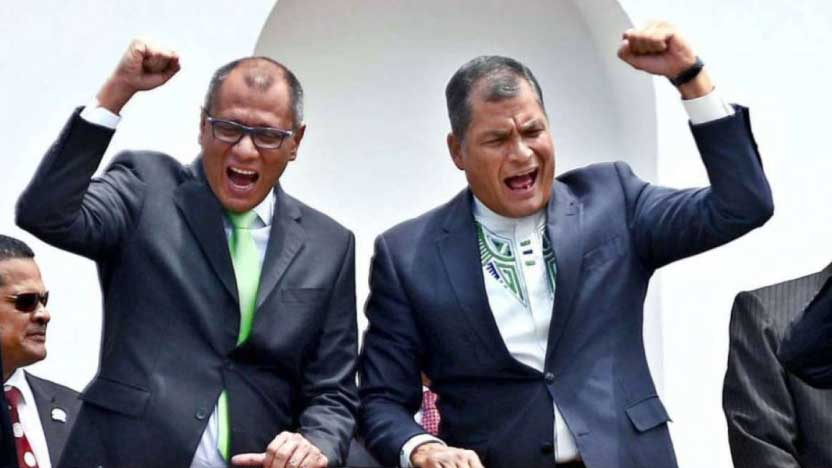
The families of the former leaders are also affected by the measure taken by the U.S. State Department.
In a significant development, the U.S. State Department has announced a ban on former Ecuadorian President Rafael Correa and former Vice President Jorge Glas from entering the United States due to their involvement in substantial corruption during their respective tenures.
This decision, made public on October 9, 2024, also extends to the immediate family members of both leaders, marking a new chapter in the ongoing scrutiny of Ecuadorian political figures.
Details of the Ban
The sanctions stem from allegations that Correa and Glas engaged in corrupt activities, including accepting bribes through political contributions in exchange for lucrative government contracts. According to the State Department, both leaders accepted “significant bribes” while in office, which facilitated corrupt practices that undermined public trust and diverted state resources.
The ban is not only a direct rebuke of Correa and Glas but also signals the U.S. government’s growing impatience with corruption in Latin America. This action reflects a broader U.S. commitment to combating corruption globally and supports Ecuadorians advocating for greater transparency and accountability in their government.
In addition to Correa and Glas, the entry ban includes several family members: Anne Malherbe Gosselin, Sofia Correa, Anne Dominique Correa, Rafael Miguel Correa, Cinthia Díaz Aveiga, and Jorge Glas Díaz.
This comprehensive approach highlights the U.S. government’s intention to hold accountable not only the politicians but also their associates and family members, which is a departure from typical diplomatic practices.
Reactions from Correa and Glas
In response to the sanctions, Correa took to social media, describing the U.S. government’s actions as a personal attack that unjustly involves his family.
He criticized the notion that family members should bear the consequences of his alleged actions, arguing that criminal responsibility should be individual, not collective.
Correa’s statements underscored his belief that the U.S. is overstepping its boundaries and interfering in Ecuador’s internal matters. He lamented, “They even dare to name my family members one by one, putting their safety at risk.” His comments reflect a common sentiment among his supporters, who view the sanctions as part of a larger political campaign against them.
Jorge Glas, who remains incarcerated for his involvement in corruption scandals, echoed Correa’s sentiments. Glas highlighted that the ban not only affects him but also punishes innocent family members, which he argues is unjust.
Together, they are likely to leverage these developments to galvanize their political base, framing their struggles as a fight against external oppression and internal corruption.
Background on the Allegations
Correa served as president from 2007 to 2017, a period during which he implemented significant social programs and infrastructural developments. However, his administration has been marred by accusations of corruption, particularly surrounding large-scale projects and contracts awarded to foreign companies. He was convicted in absentia on corruption charges in 2020 and sentenced to eight years in prison. Since then, he has lived in exile in Belgium, from where he continues to wield influence over the political landscape in Ecuador.
Glas served as vice president from 2013 until his dismissal in 2017. He was embroiled in the notorious Odebrecht bribery scandal, which implicated numerous officials across Latin America.
Glas was convicted of unlawful association related to the scandal and is currently serving a six-year sentence. The severity of the charges against both leaders has raised questions about the integrity of their administrations and the long-term implications for Ecuadorian politics.
Impact on Correa’s Political Future
The U.S. sanctions represent a significant blow to Correa’s attempts to position himself as a victim of political machinations. Until this point, he had garnered international support, often citing a lack of actionable judgments against him outside Ecuador.
The U.S. Department’s decision complicates Correa’s efforts to rally support for his political movement, particularly with elections approaching in Ecuador in February 2025.
In the wake of the sanctions, Correa’s party, the Citizen Revolution, issued a statement condemning the timing and rationale of the U.S. decision. They characterized it as a politically motivated distraction, intended to divert attention from pressing domestic issues such as increasing crime rates, economic instability, and power outages that have plagued the country under President Daniel Noboa’s administration.
Moreover, the sanctions could have broader implications for Ecuador’s international relations, especially with the United States. Analysts suggest that this could lead to a reevaluation of U.S. aid and engagement with Ecuador, potentially affecting development programs and cooperation on security issues.
It may also serve as a warning to other Latin American leaders about the consequences of corruption.
The Broader Context of Corruption in Ecuador
Corruption has been a persistent issue in Ecuador, with successive administrations facing allegations of unethical conduct. The government of Correa was marked by numerous scandals, and his administration often clashed with the media and civil society, which he accused of attempting to undermine his government.
The recent U.S. sanctions may also resonate with Ecuadorians disillusioned by years of corruption scandals. The Biden administration’s decision to take action against high-profile figures like Correa and Glas may restore some faith in the international community’s commitment to supporting governance reforms in the region.

0 Comments