
Arrest of Venezuela’s leader triggers regional rhetoric, accusations of foreign meddling and an escalating war of words at home.
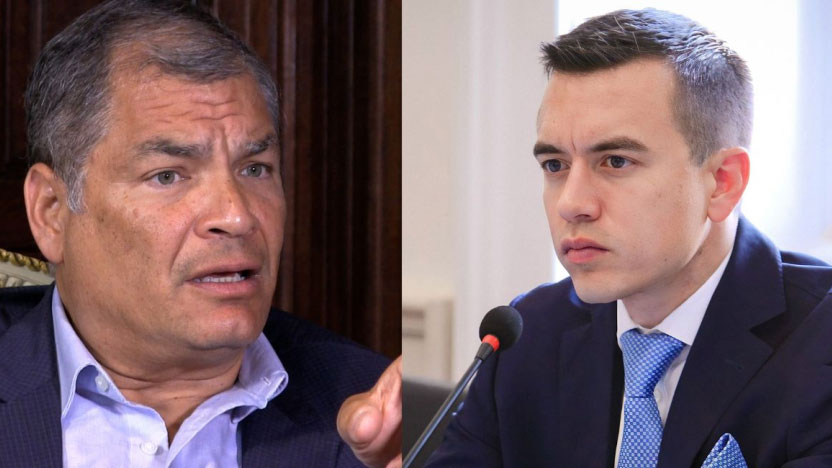
The capture of Venezuelan President Nicolás Maduro by U.S. forces and his transfer to New York has sent shockwaves far beyond Caracas, reopening deep political divisions in Ecuador and turning an already volatile regional moment into a bitter domestic confrontation between the government of President Daniel Noboa and the movement loyal to former president Rafael Correa.
Within hours of the operation, the Citizen Revolution movement closed ranks around Maduro, portraying the arrest as an illegal military intervention and calling on leftist parties, social movements and governments across Latin America to condemn what it described as a violation of sovereignty and international law. The tone was urgent and defiant, invoking a long history of U.S. intervention in the region and framing the episode as a threat to regional stability.
Citizen Revolution leaders argued that no political or ideological dispute could justify the use of force against a sovereign state, warning that such actions endangered civilians and risked dragging Latin America into a new era of militarized conflict. The group’s statements rejected what they labeled interventionism, neocolonialism and a revival of Cold War-era doctrines, drawing parallels to Operation Condor and accusing Washington of acting in pursuit of Venezuela’s vast energy and mineral resources.
Correismo rallies behind Maduro
Luisa González, the movement’s two-time presidential candidate, urged Latin American political actors to take a clear public stand against what she called an invasion of a sister nation. The Citizen Revolution reiterated its longstanding support for Maduro, whom it defended even after Venezuela’s disputed 2024 elections, insisting that peace, self-determination and respect for sovereignty were essential conditions for coexistence between nations.
The movement also criticized the U.S. military buildup in the Caribbean in the months preceding the operation, arguing that Washington’s focus was misplaced given that the bulk of drug trafficking routes move through the Pacific. In pointed remarks, Correista leaders highlighted Ecuador’s role in those routes and accused the Noboa government of acting as a strategic ally of the United States while ignoring deeper structural problems fueling organized crime at home.
Financing allegations resurface
As Correismo denounced the arrest, Ecuador’s government seized the moment to revive long-simmering allegations linking the former Venezuelan regime to political financing networks in Ecuador. José Julio Neira, head of the country’s Financial and Economic Analysis Unit, suggested that the collapse of Maduro’s government could expose an alleged flow of funds from Venezuela to actors connected to the Correa movement.
According to Neira, investigators had identified transfers and contracts involving Venezuela’s state oil company and its Ecuadorian subsidiary that may have benefited individuals associated with Luisa González and relatives of former vice president Jorge Glas. The claims, which Correismo has repeatedly denied in the past, added a legal and financial dimension to what was already a heated political dispute.
Noboa applauds, then escalates
President Daniel Noboa took a sharply different stance, publicly celebrating Maduro’s capture and framing it as a victory against what he termed “narco-Chavista” criminal structures. In a message posted on social media, he argued that figures tied to drug trafficking and authoritarianism across the continent would eventually face justice, and he encouraged Venezuela’s opposition to move quickly toward assuming power.
That message triggered an immediate and furious response from Rafael Correa, who accused Noboa of servility toward Washington and questioned his national loyalties. Correa, who has publicly advised the Maduro government on economic matters and resides abroad, lashed out at the Ecuadorian president in personal terms, portraying him as a vassal of U.S. interests.
Noboa did not let the attack pass. His reply marked one of the most aggressive exchanges yet between Ecuador’s sitting president and his predecessor, blending political accusations with deeply personal recriminations. He accused Correa of presiding over an era in which drug trafficking flourished, of fleeing justice while living comfortably overseas, and of leaving behind problems that the current administration continues to confront at great personal and political cost.
A war of words with heavy accusations
In a lengthy public response, Noboa accused Correa’s government of persecuting his family’s businesses, murdering journalists, intimidating members of the armed forces, ceding territory and allowing criminal networks and the Maduro regime to finance political projects in Ecuador. He also alleged that close associates had been sacrificed to shield Correa from accountability and that families had been destroyed under his rule.
The president went further, promising that evidence would soon be presented to demonstrate alleged collusion between Correa’s circle and elements of the banking sector, and warning that the former leader would ultimately meet the same fate as other Latin American strongmen brought down by international justice. The reference to Manuel Noriega and Nicolás Maduro was deliberate and unmistakable.
Regional shock, domestic consequences
Beyond the rhetoric, the episode underscores how events in Venezuela continue to reverberate inside Ecuador, reshaping alliances and sharpening old resentments. For Noboa, the arrest of Maduro reinforces his narrative of confronting transnational crime and distancing Ecuador from the socialist bloc that dominated parts of the region for more than a decade. For Correismo, it revives a familiar discourse of resistance to foreign intervention and loyalty to ideological allies.
As investigations into alleged financing links advance and political tempers continue to flare, the fallout from Maduro’s capture appears likely to deepen Ecuador’s polarization. What began as a dramatic international operation has quickly become another flashpoint in the country’s unresolved struggle over its recent past, its political future and its place in a rapidly shifting Latin American landscape.

0 Comments