
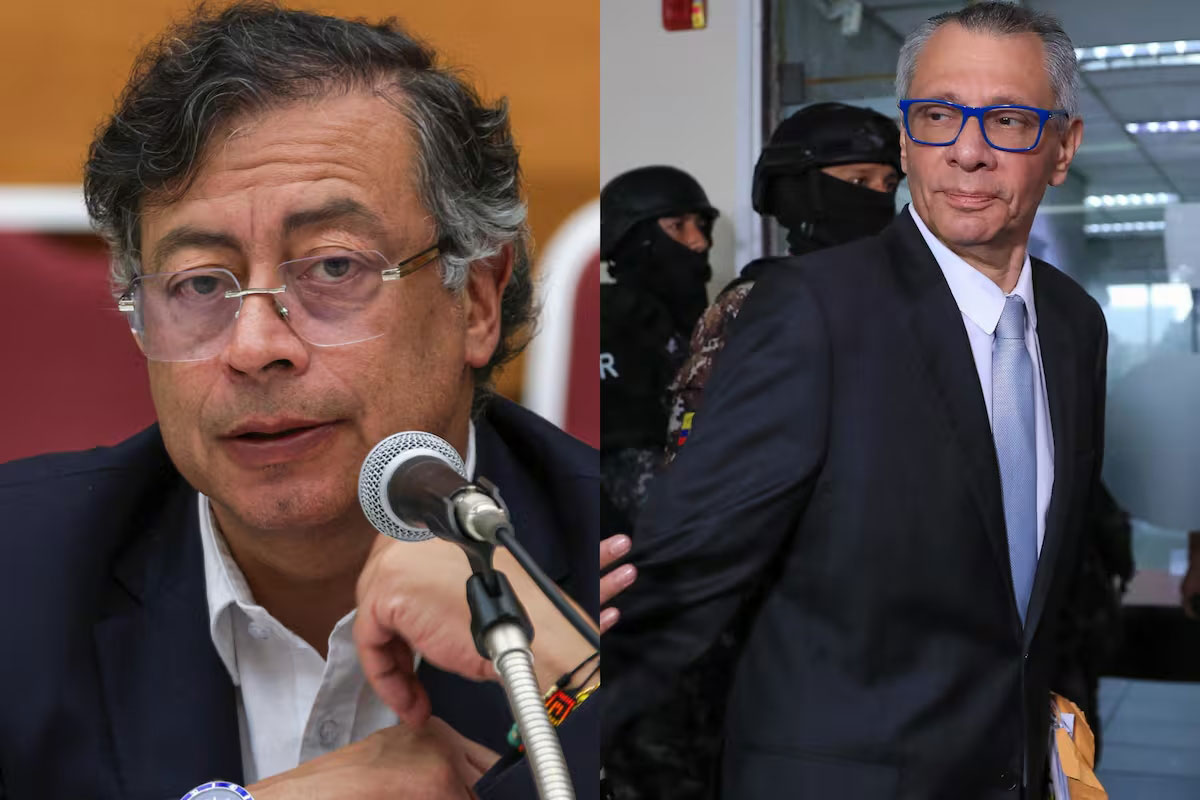
The Colombian president’s announcement deepens diplomatic tensions as Quito maintains Jorge Glas is still Ecuadorian and must serve his sentences.
Petro’s announcement and Ecuador’s response
Colombian President Gustavo Petro announced this week that his government has granted Colombian citizenship to former Ecuadorian Vice President Jorge Glas, a political ally of Rafael Correa who is serving multiple prison sentences for corruption. Petro made the revelation through a post on X, attaching an oath of office signed in Quito on September 16th, in which Glas swore allegiance to the Colombian Constitution. The message was later deleted, but not before igniting a political storm.
Following Petro’s statement, Ecuador’s Foreign Ministry issued a sharp response, clarifying that it had not received any official notification from Bogotá and affirming that “Mr. Jorge Glas remains an Ecuadorian citizen, without prejudice to the granting of nationality by another country.” The ministry stressed that Glas’s convictions “remain in effect, and the pending cases will continue to be processed in accordance with Ecuadorian law.”
Glas’s legal record in Ecuador
Glas has been at the center of Ecuador’s largest corruption scandals over the last decade. He was first implicated in 2017 during the global Odebrecht bribery investigation, which revealed that he and his associates had accepted millions in kickbacks. That year, then-President Lenín Moreno distanced himself from Glas, who surrendered to authorities and was eventually sentenced to six years in prison for criminal association.
His troubles compounded in 2019 when prosecutors uncovered evidence of a parallel structure within the Correa administration that funneled bribes from major companies into Alianza PAIS campaign coffers. Known initially as the Arroz Verde case, it became the Bribes 2012–2016 case, which led to an eight-year sentence for Glas, Correa, and other high-ranking officials. In subsequent years, he was also implicated in the Singue oil field case, though that conviction was later overturned.
A cycle of releases and returns to prison
Despite multiple convictions, Glas repeatedly sought release through habeas corpus rulings, precautionary measures, and controversial judicial decisions. In 2022, judges in Santa Elena and Manabí briefly granted him freedom, only for higher courts to reverse the decisions and sanction the judges involved. His last significant release came in late 2022, when a tribunal annulled the Singue case, prompting his defense to renew requests for early release.
But before those efforts bore fruit, Glas became the focus of another corruption trial over the misuse of reconstruction funds in Manabí after the 2016 earthquake. In April 2024, Ecuadorian police stormed the Mexican Embassy in Quito to arrest Glas, who had sought asylum there. The move triggered a diplomatic crisis with Mexico. He has since been confined in La Roca, Ecuador’s maximum-security prison, and in June 2025 received a new 13-year sentence in the Manabí Reconstruction case.
Petro’s call for Glas’s transfer
Petro, who has long described Glas as a political prisoner, used the Colombian naturalization to pressure Ecuador to hand him over. “Citizen Jorge Glas obtains his Colombian nationality, I expect the Ecuadorian government to hand it over to the Colombian government,” Petro said, reviving a demand he had already made at Daniel Noboa’s presidential inauguration in Quito last year.
However, Quito has stood firm, underscoring that Glas’s status as an Ecuadorian citizen is unchanged and his criminal responsibility remains. The Foreign Ministry noted that citizenship granted by another country does not erase obligations before Ecuadorian courts.
Regional reactions
Petro’s move was quickly welcomed by the Puebla Group, a coalition of left-wing leaders in Latin America, which called on President Noboa to grant Glas safe passage to either Colombia or Mexico. In contrast, Francisco Barbosa, Colombia’s former attorney general, labeled Petro’s gesture “another international embarrassment,” accusing him of politicizing a convicted criminal’s case.
For Glas, who has spent more than six years in prison and accumulated three convictions, Colombian citizenship represents his latest attempt to use international avenues to escape Ecuadorian justice. But for now, Quito’s stance suggests that despite Petro’s intervention, Glas’s future remains tied to La Roca prison and the unresolved legal battles that have defined his political downfall.
0 Comments