
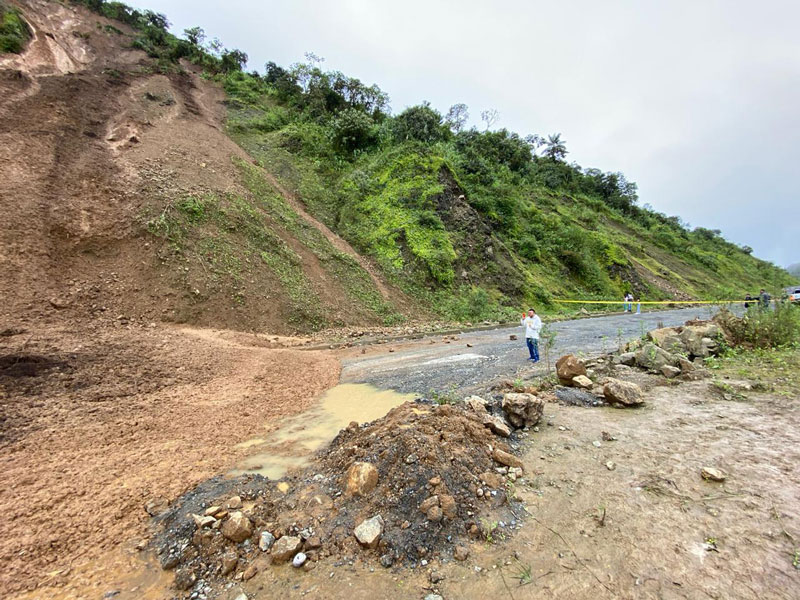
The Cuenca-Molleturo highway’s ongoing instability and delays in promised repairs threaten regional commerce and development.
The Cuenca-Molleturo-El Empalme highway, a critical artery linking Guayaquil and Cuenca, has long been plagued by instability and frequent closures. As the rainy season intensifies, concerns mount about the road’s vulnerability and the unfulfilled promises of long-term solutions.
A History of Setbacks
The dry conditions of 2024 temporarily shifted focus away from the road’s issues, but the onset of heavy rains in early 2025 has reignited concerns. During the New Year holidays, a sinkhole at kilometer 54 caused temporary restrictions, while landslides and rockfalls in several areas—including Marianza and kilometer 49—disrupted travel and commerce. These incidents highlight the persistent fragility of this essential highway, which supports not only local connectivity but also the economic lifeline between Azuay and Guayas provinces.
In previous years, the road endured closures that disrupted tourism and trade, particularly in 2022 and 2023. The return of heavy rains has amplified concerns among Azuay’s economic stakeholders. Henry Astudillo, president of the Cuenca Construction Chamber, emphasized the road’s importance, noting its role in facilitating commerce, port access, and tourism. The region’s economic vitality depends on a reliable link to Guayaquil, making the highway’s condition a pressing issue.
Promises of Rehabilitation Face Delays
Amid growing frustration, the Ecuadorian government announced ambitious plans in mid-2024 to address the road’s problems. Transport Minister Roberto Luque outlined the Azuay Road Plan, committing $150 million to the province’s infrastructure, including $20–25 million for the rehabilitation of the Cuenca-Molleturo highway. The project, initially expected to conclude by early 2025, has faced delays, despite assurances that funding—secured through a World Bank loan—remains intact.
Hugo Vásconez, undersecretary of the Ministry of Transport and Public Works (MTOP), acknowledged the project’s extended timeline, attributing delays to the necessary diagnostic and study phases. Vásconez indicated that maintenance and rehabilitation contracts should be finalized by February or March 2025. In the interim, the MTOP has deployed machinery to address immediate issues and pledged routine maintenance to ensure minimal disruption.
The project aims to stabilize 20 critical points along the 119-kilometer route, address road deformations, and enhance safety. Despite these plans, skepticism persists, with local unions like the Chambers of Construction and Industry pressuring the government to meet its commitments.
Long-Term Solutions: A New Road?
The Cuenca-Molleturo highway has been fraught with challenges since its construction over three decades ago. Its susceptibility to erosion has required costly interventions, including a $68.7 million overhaul in 2012 and an $8 million slope stabilization project in 2022–2023. High maintenance costs further complicate efforts to keep the road operational.
Given the ongoing issues, local leaders and economic unions have called for a more permanent solution. One proposal involves granting the road’s management to a private concessionaire, though this plan has yet to materialize. Meanwhile, a more ambitious initiative is gaining traction: the construction of a new Cuenca-Guayaquil highway.
In November 2024, the government signed a contract for pre-feasibility studies on the proposed route, expected to conclude in late 2025. These studies aim to estimate investment needs and lay the groundwork for resource mobilization. For many in Azuay, this new road represents a long-overdue alternative that could finally resolve the connectivity challenges plaguing the region.

0 Comments