
World leaders condemn violence as Ecuador reels from strike-related unrest and rising tensions ahead of holiday.
Attack on the president’s convoy
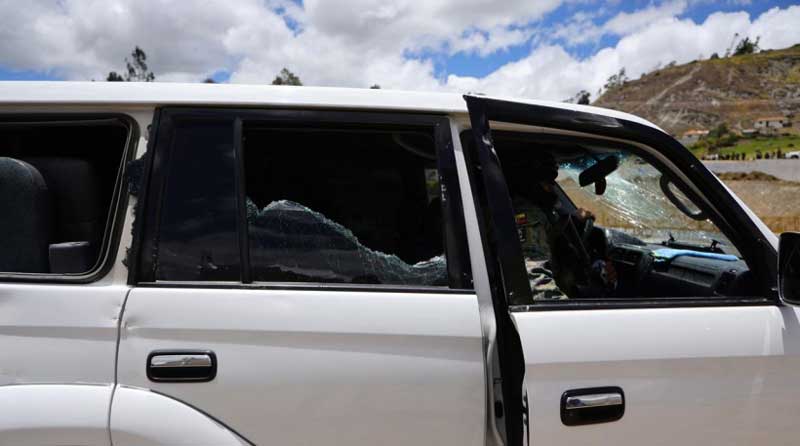
President Daniel Noboa denounced as “terrorists, violent people, and vandals” those who attacked his motorcade in Cañar on October 7th, during a national strike organized by the Confederation of Indigenous Nationalities of Ecuador (Conaie). The incident, which authorities described as an assassination attempt, sparked widespread condemnation abroad and deepened the country’s growing political crisis.
The ambush occurred while Noboa was traveling through the province amid nationwide demonstrations against the government’s decision to eliminate the diesel subsidy. The confrontation left several vehicles damaged and five people detained. Defense Minister Gian Carlo Loffredo later said the assault was “a clear act of terrorism,” arguing that the aggressors used lethal force. The Ministry of Environment and Energy formally filed a criminal complaint for attempted murder against those involved.
Detentions declared illegal
The arrests quickly became a point of contention. A judge in Cañar ordered the release of all five detainees, ruling that their constitutional rights had been violated when police failed to read them their rights in a timely manner. According to defense lawyers, the detainees were transferred between police facilities in Cuenca and El Tambo without proper notification to their families or counsel. One of them, represented by attorney José Campoverde, remained in Cuenca for several hours awaiting a hearing before being freed.
Government blames infiltrators, Conaie rejects accusations
Cañar’s governor, Patricio Sarmiento, claimed the attack was carried out by “infiltrators” who joined a peaceful march that had started in El Tambo earlier in the day. He said six vehicles were struck by stones and other projectiles during the chaos.
Conaie, which called the national strike, rejected accusations of involvement, insisting that those arrested were not protesters. “We reject the unfounded allegations of attempted assassination,” the organization stated, questioning why the president’s convoy entered a mobilized zone without adequate security assessment.
Noboa defiant in Cuenca appearance
Despite the attack, Noboa continued with his planned schedule in Cuenca, where he attended a ceremony at the Dávalos Barracks to deliver agricultural machinery to farmers. From there, he reaffirmed his hardline stance.
“The terrorists, the violent ones, and the vandals will go to jail,” he declared, adding that his government had been “open to dialogue since day one.” He also dismissed social media rumors about new fuel price hikes or the removal of gas subsidies, calling them “lies meant to create fear.”
Security forces tightened protection in Azuay Province, where the president’s motorcade was met with heavy police and military presence. Roads surrounding the Azuay Governor’s Office and central Cuenca were closed for much of the day.
International condemnation and travel alerts
The attack drew swift condemnation from across the globe. The United States, Argentina, and the European Union all issued statements rejecting violence and urging Ecuadorians to resolve disputes through dialogue. “We stand with Ecuador while authorities investigate and ensure accountability,” the U.S. Embassy stated.
Italy, Morocco, and several Latin American nations—including Panama, Peru, and Costa Rica—echoed those sentiments. Moroccan Foreign Minister Nasser Bourita called his Ecuadorian counterpart to express “the strongest condemnation” of the attack, while Italy’s embassy in Quito urged “calm and respect for democratic institutions.”
South Korea raised its travel advisory to Ecuador to level three, warning citizens to avoid non-essential travel, especially to provinces where protests were intensifying. The alert cited growing unrest over fuel prices and advised evacuation from several coastal and Andean regions.
Clashes continue across the country
Unrest persisted in multiple provinces on Wednesday, including Quito, where roads near the Government Palace were shut down amid heavy rain and new marches along Avenida 10 de Agosto. Police clashed with demonstrators in the San Miguel del Común sector, deploying tear gas to disperse crowds blocking the Pan-American Highway. The Kitu Kara community reported two people injured during the confrontation.
Interior Minister John Reimberg labeled the Cañar attack an act of terrorism and said special security forces had been deployed nationwide to prevent further road blockades.
“We will not allow acts that threaten public order,” he said, adding that police and military units were reinforcing roads ahead of the October 9th Independence holiday.
A nation on edge
The attack on President Noboa’s convoy has intensified the political climate surrounding the ongoing strike, testing the government’s ability to maintain order while pursuing its economic reforms. As Noboa pressed forward with his public agenda in Cuenca and Guayaquil, the message from Carondelet remained clear: the administration intends to show strength in the face of what it now calls terrorism.
Meanwhile, opposition leaders and international observers continue to call for dialogue—hoping to pull Ecuador back from the brink as the protests risk turning a political dispute into a national crisis.

Ex-pats love Ecuador and support President Naboa but most of all democracy for Ecuador.