
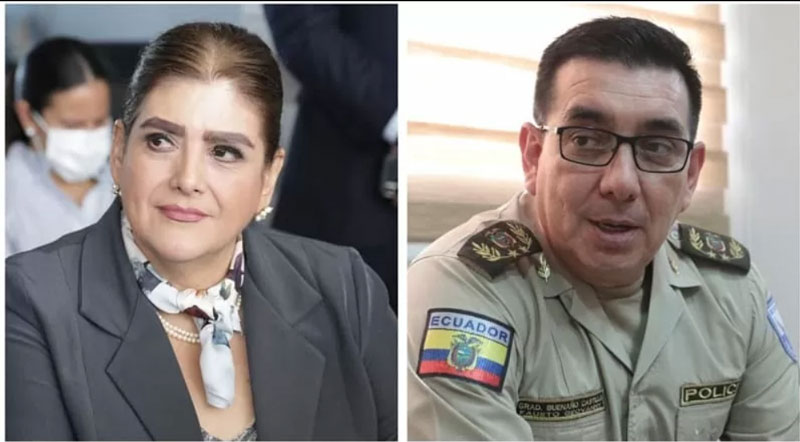
Noboa reshuffles security leadership amid rising violence and election pressure, appointing controversial figures to key positions.
Facing an escalating security crisis and a looming electoral showdown, President Daniel Noboa has reshuffled key positions in his administration, particularly in the security sector. The move comes after his failure to secure an outright victory in the first round of Ecuador’s presidential election and amid growing concerns over his ability to contain rampant criminal violence.
Security Overhaul in a Critical Moment
The latest changes include the replacement of Mónica Palencia, a close ally of Noboa who initially held the dual role of Minister of the Interior and Government. Palencia has now been replaced by Fausto Buenaño, a former general of the National Police who retired from active service only on February 15, 2025. Additionally, Julio Zaldumbide, who had been in charge of Ecuador’s prison system (SNAI) since the start of Noboa’s administration, has been replaced by Víctor Hugo Andrade, a former prison director and military officer.
These shifts come at a time when security is dominating the national agenda. In January 2025 alone, Ecuador registered 781 violent deaths, marking the deadliest start to a year in the country’s history. The wave of criminal activity has continued despite Noboa’s aggressive security measures, including declaring an internal armed conflict and mobilizing the military in early 2024.
With a decisive runoff election against Luisa González of the Correísta movement set for April 13, 2025, the president’s response to violence could prove pivotal in swaying voters. Noboa, who has been in office for 14 months, is under pressure to demonstrate that his administration can turn the tide against organized crime.
A Troubled Security Record
Noboa’s tenure has been marked by fluctuating crime rates. His first full month in power, December 2023, saw 755 violent deaths. The situation worsened in early January 2024, prompting his declaration of a nationwide internal armed conflict. The immediate aftermath of this decision saw a dramatic 63% reduction in murders, with only 93 killings reported in the following days. The downward trend continued into February 2024, which became the least violent month since April 2022.
However, this progress proved short-lived. By March 2024, violent deaths were on the rise again, culminating in the staggering figures of January 2025. That month became the second most violent of Noboa’s government and ranked among the deadliest in Ecuador since records began in 2011.
Buenaño’s Appointment Draws Scrutiny
The decision to appoint Fausto Buenaño as Minister of the Interior has not been without controversy. Until recently, Buenaño served as deputy commander of the National Police and vice minister of Citizen Security under Palencia. His abrupt transition from active-duty general to civilian minister has sparked debate over his independence and effectiveness in leading the security forces.
Adding to the scrutiny, two incidents from his police career have resurfaced in public discourse. The first involves an October 2021 episode in which Adolfo Macías Villamar, alias ‘Fito,’ leader of the Los Choneros gang, allegedly arranged for his girlfriend to stay in Guayaquil’s Regional Prison for several days. A leaked police report from that time suggested Buenaño, then the police chief in Guayas, ordered her release in exchange for two rifles. Buenaño has categorically denied the allegations, calling them “absolutely false” and requesting an investigation by the Public Prosecutor’s Office, which ultimately resulted in no disciplinary action.
The second controversy stems from December 2021, when then-U.S. Ambassador Michael Fitzpatrick warned of suspected “narco-generals” within Ecuador’s police force. A subsequent audit by the Comptroller’s Office flagged Buenaño for discrepancies in his financial disclosures. While he claimed the inconsistencies stemmed from his ex-wife’s finances during their divorce, the case was referred to the Prosecutor’s Office, though no criminal charges were pursued.
A New Leader at the Helm of SNAI
Less is known about Víctor Hugo Andrade, the newly appointed head of Ecuador’s prison system. He holds a degree in Military Sciences and has experience in security policy and governance. His past roles include serving as Human Resources director at Ecuador’s Customs Corporation in 2005 and, more recently, as director of Cotopaxi Prison—a facility notorious for violent outbreaks—between 2021 and 2022 under President Guillermo Lasso’s administration.
Andrade’s appointment signals a potential shift in the government’s approach to prison management, a sector that has been at the center of Ecuador’s security crisis. Overcrowding, corruption, and gang control within prisons have fueled violence inside and outside correctional facilities. Whether Andrade can curb these issues remains to be seen.
Defense Minister Loffredo Remains Despite Challenges
While Noboa has replaced key security officials, he has retained Gian Carlo Loffredo as Minister of Defense, despite concerns about the military’s role in tackling violence. Under Loffredo’s leadership, the armed forces have struggled to contain Ecuador’s spiraling crime rates. Additionally, the military has been implicated in human rights controversies, most notably the disappearance and subsequent murder of four minors in Guayaquil—an incident that drew public outrage.
A Race Against Time
Noboa’s security reshuffle reflects the urgency of the situation. With an election runoff fast approaching and violent crime reaching historic levels, his administration is racing to reassert control. The coming weeks will test whether these leadership changes can translate into tangible results—or whether the security crisis will continue to cast a shadow over his re-election hopes.

0 Comments