
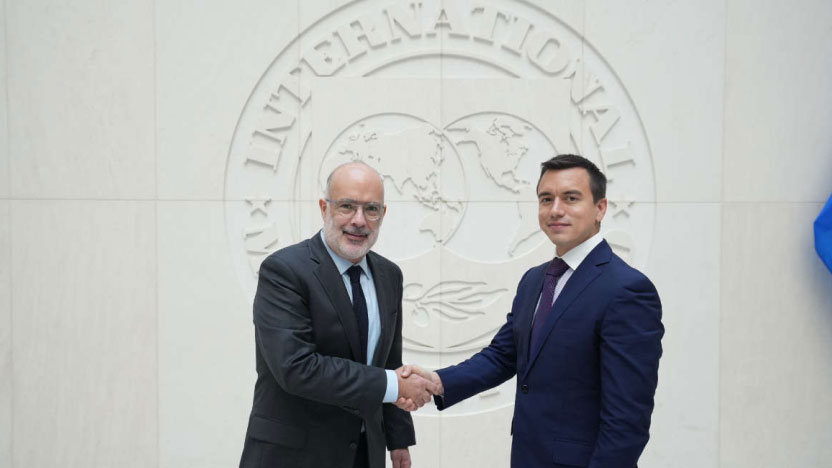
Rising disbursements push the country higher among IMF debtors while repayment pressures build toward 2026.
Ecuador’s relationship with the International Monetary Fund has entered a new phase, marked by larger disbursements, higher repayment obligations and a growing presence among the Fund’s biggest borrowers worldwide. With a fresh tranche expected before the end of 2025, the country has moved up the ranking of IMF debtors and now sits behind only Argentina and Ukraine.
The shift reflects both the structure of Ecuador’s current lending program and the government’s decision to expand it. What began as a $4 billion agreement during the administration of President Daniel Noboa has grown into a $5 billion commitment, with more money arriving sooner and repayment obligations accelerating just as the country prepares for heavier external debt service in the years ahead.
A new disbursement to close 2025
Ecuador is preparing to receive an additional $620 million from the IMF in December 2025, following the technical approval of revised targets by the Fund’s staff. The final step—authorization by the IMF’s Executive Board—is pending, but the disbursement is expected to close out the year.
Once it arrives, Ecuador will have received $2.7 billion under the current program, spread across four disbursements tied to periodic reviews. The loan agreement was signed in May 2024, and each release of funds has followed the government’s compliance with fiscal, financial and structural benchmarks negotiated with the Fund.
While the government highlights the role of IMF financing in stabilizing public accounts and supporting macroeconomic reforms, the cumulative effect has been a rapid increase in outstanding debt to the institution.
Ecuador rises among the IMF’s largest debtors
Even before the December disbursement, Ecuador has already climbed to third place among countries with the largest outstanding obligations to the IMF. As of November 2025, the country owed $9.415 billion to the Fund.
Earlier in the year, Ecuador ranked fourth, behind Argentina ($57 billion), Ukraine ($15 billion) and Egypt ($9 billion). That position changed after two additional IMF disbursements totaling $1.2 billion were made following April, pushing Ecuador past Egypt in the global ranking.
By comparison, Argentina remains the IMF’s largest debtor by a wide margin, while Ukraine’s borrowing has surged amid the ongoing war and reconstruction needs. Ecuador’s rise into the top three places it in a small group of countries with prolonged and significant reliance on IMF financing.
Why the loan grew larger
A key factor behind the jump in Ecuador’s IMF debt was the government’s request to increase the size of the lending program. Although the agreement announced in May 2024 initially totaled $4 billion, negotiations continued over the following months as fiscal pressures persisted.
In July 2025, the IMF approved an expansion of the program by an additional $1 billion. The overall duration of the agreement did not change and still runs through 2028, but the higher ceiling increased the amount Ecuador can receive at each review.
The expansion gave the government more short-term breathing room but also raised the country’s long-term exposure to the Fund, including higher principal repayments and continued exposure to surcharges applied to large and extended IMF loans.
A return to the Fund after years of distance
Ecuador’s current debt to the IMF is part of a longer arc that began in 2019, when the country returned to the organization after more than a decade of political and financial separation.
During the government of Rafael Correa, Ecuador severed its relationship with the IMF, paying off its remaining balance in 2007 and publicly rejecting further engagement. In the years that followed, the country increasingly turned to China for financing, particularly through oil-backed loans. By 2016, Ecuador’s debt to China had peaked at $9.612 billion.
That strategy began to unravel as oil prices fell, public spending remained high and Chinese lending slowed. By 2019, under President Lenín Moreno, Ecuador once again sought support from multilateral lenders, including the IMF. Since then, successive agreements under Moreno, Guillermo Lasso and now Noboa have steadily rebuilt Ecuador’s debt to the Fund.
Today, the IMF stands alongside the Inter-American Development Bank (Ecuador owes $3 billion to the IDB) as one of Ecuador’s largest international creditors.
What the debt means per person
The scale of Ecuador’s IMF obligations becomes more tangible when broken down by population. With approximately 16.9 million people, the country’s current debt to the Fund translates to about $557 per person if it were divided evenly among citizens.
While such calculations are symbolic rather than practical, they underscore the weight of the commitment and the long-term implications for public finances, particularly as repayment schedules tighten.
Heavier payments begin in 2026
The real strain from IMF borrowing will become more visible starting in 2026, when Ecuador’s external debt service obligations increase sharply. That year, the country is scheduled to pay $1.091 billion to the IMF, followed by $1.286 billion in 2027.
These figures do not include interest and surcharges—additional fees imposed by the Fund when a country maintains high levels of outstanding debt for an extended period. The IMF argues that surcharges are designed to discourage prolonged reliance on its resources, but critics say they can significantly increase the cost of borrowing for already strained economies.
Under the current program signed in May 2024, Ecuador’s effective interest rate with surcharges stands at about 7%.
A pivot toward private markets?
Facing rising multilateral payments, the government has signaled its intention to reduce reliance on institutions like the IMF beginning in 2026. Finance Minister Sariha Moya has said the administration plans to return to international capital markets by issuing bonds to private investors.
The strategy depends heavily on improvements in Ecuador’s risk profile. According to Moya, bond issuance would only be viable if the country’s risk index falls to between 300 and 400 points, levels that would allow borrowing at more manageable interest rates. As of December 9th, Ecuador’s risk stood at 575 points, well above that target.
The government has suggested that a successful return to markets could occur between mid-2026 and the third quarter of that year, assuming fiscal consolidation, economic growth and political stability support lower risk perceptions.
Balancing stability and dependence
For now, IMF financing remains a central pillar of Ecuador’s economic strategy, providing liquidity and policy backing at a time of fiscal vulnerability. But the country’s ascent into the ranks of the Fund’s largest debtors highlights the trade-offs involved: short-term stability in exchange for long-term obligations that will shape public finances well into the next decade.
As repayments accelerate and the government weighs a return to private markets, Ecuador’s challenge will be to manage that transition without deepening its dependence—or its debt burden—even further.

I hope that Ecuador cancels its proposed nuclear plans, and that the IMF do not offer funding that project, or rather do not push to that.