
Rising global oil prices are complicating Ecuador’s effort to cut fuel subsidy costs in 2026.
Ecuador’s long-running effort to reduce the fiscal burden of fuel subsidies has reached a new turning point, with Extra and Ecopaís gasoline now set to be sold at international prices and without state support from March 12th to April 11th, 2026. But even as that move helps trim one part of the subsidy bill, a jump in global oil prices tied to the U.S. attacks on Iran is driving up government spending in other areas, especially electricity generation fuels and domestic gas.
The shift highlights the contradictory pressures facing Ecuador’s energy policy. On one side, the government has made measurable progress in lowering subsidy costs through a price-band system and the phased withdrawal of support for some fuels. On the other, international turmoil and Ecuador’s own refining limitations are threatening to push public spending back up.
Gasoline subsidy reaches its end
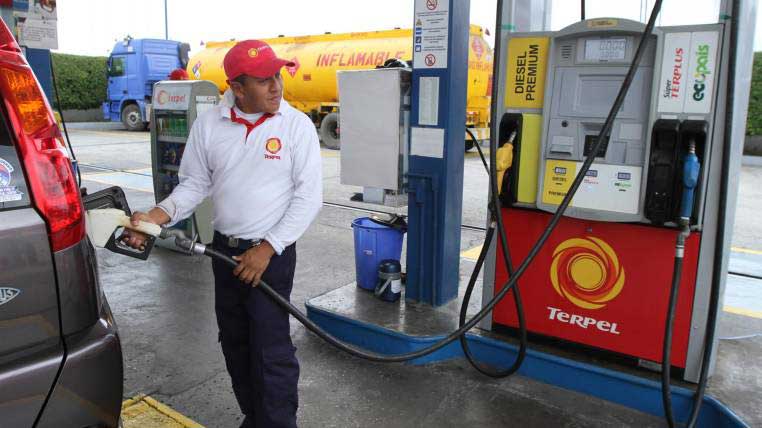
Beginning March 12th, Extra and Ecopaís gasoline entered a new stage in Ecuador’s pricing policy, with those fuels no longer receiving a state subsidy. The change is part of the band system already applied to Extra, Ecopaís, and automotive diesel, under which prices may rise by as much as 5% per month or fall by up to 10%, depending on international market movements.
The mechanism was designed to gradually reduce the State’s role in cushioning fuel prices while avoiding abrupt jumps for consumers. Under the new period running through April 11th, gasoline will be sold without subsidy and at international market value. Automotive diesel, however, will still carry limited state support of four cents per gallon.
The government’s broader subsidy-cutting strategy already showed results in 2025. According to recent Central Bank figures, Ecuador spent $752 million on imported fuel subsidies last year, down sharply from $1.658 billion in 2024 and far below the $3.328 billion recorded in 2022.
Much of that reduction came from diesel.
Diesel changes brought the biggest savings
The most significant savings in 2025 came after the government eliminated the diesel subsidy by decree on September 13th, 2025. That measure pushed the price from $1.80 to $2.80 per gallon and was later followed by the implementation of the same monthly price-band system in December.
As a result, state spending on diesel subsidies dropped from $957 million to $560 million in 2025. Gasoline, meanwhile, produced an even more favorable result for public finances. After the government removed the subsidy for Extra and Ecopaís gasoline in June 2024, the gasoline import account closed with a positive fiscal balance of $267 million.
Those figures gave the government a strong argument that subsidy reform was beginning to pay off. The 2026 budget proposal reflected that optimism, projecting that total fuel subsidy spending would fall from $2.504 billion in 2025 to $1.160 billion in 2026, a decline of 54%.
That projection now looks less certain.
Electricity sector subsidies are climbing again
The recent rise in international oil prices is already increasing the cost of fuels that still depend heavily on state support. Between March 12th and April 11th, 2026, the subsidy for diesel 2 used in electricity generation climbed to $1.30 per gallon, up 23.75% from the previous period.
Other electricity-sector fuels also posted notable increases. Premium diesel for power generation will now carry a subsidy of $1.56 per gallon, an increase of 14.18%. Fuel Oil 4, also used in the electricity sector, registered a 20.35% increase in subsidy levels.
These increases matter because they affect a part of the fuel market that remains deeply dependent on government support even as automotive fuels move closer to market pricing. In practical terms, Ecuador may be saving money at the pump for some products while simultaneously paying more to keep power generation running.
Domestic gas remains heavily subsidized
Another major pressure point is household cooking gas, one of the most politically sensitive subsidies in Ecuador. A 15-kilogram cylinder continues to sell at a fixed price of $1.65, far below international levels, with the State covering the difference.
In March 2026, that subsidy rose from $8.10 to $8.50 per cylinder. The increase may appear modest on a per-unit basis, but across a nationwide market it represents a substantial ongoing fiscal commitment.
Domestic gas has long been treated differently from other fuels because of its direct impact on household budgets. That makes it one of the hardest subsidies for any administration to reform, even when public finances are under strain.
Global conflict and local bottlenecks
The new pressure on Ecuador’s subsidy bill is being driven by forces both abroad and at home. Internationally, oil prices moved higher after the U.S. attacks on Iran, with WTI, the benchmark crude relevant to Ecuador, rising by about 8%.
Under Ecuador’s price-band system, however, domestic fuel prices can only increase by a maximum of 5% in a month. That means when international prices rise faster than the allowed domestic adjustment, the State must absorb the gap. In the current context, that remaining difference effectively becomes a renewed subsidy burden.
The problem is compounded by Ecuador’s dependence on imported fuels. Although the country is an oil producer, its refining system cannot meet domestic demand. The refineries at Esmeraldas, Shushufindi, and La Libertad together process about 175,000 barrels per day, while national demand reaches 291,000 barrels. To fill the gap, Ecuador imports roughly 201,000 barrels per day for the domestic market.
The situation has become more difficult because the Esmeraldas Refinery, the country’s largest, has not been operating at full capacity due to technical problems and unscheduled maintenance. That has forced greater reliance on imports at a time when international prices are rising.
In that setting, Ecuador’s recent subsidy savings remain real, but they are colliding with geopolitical instability and structural weaknesses in the country’s energy system. The result is a fiscal picture in which reform has reduced some old burdens, even as new ones begin to build.
0 Comments