
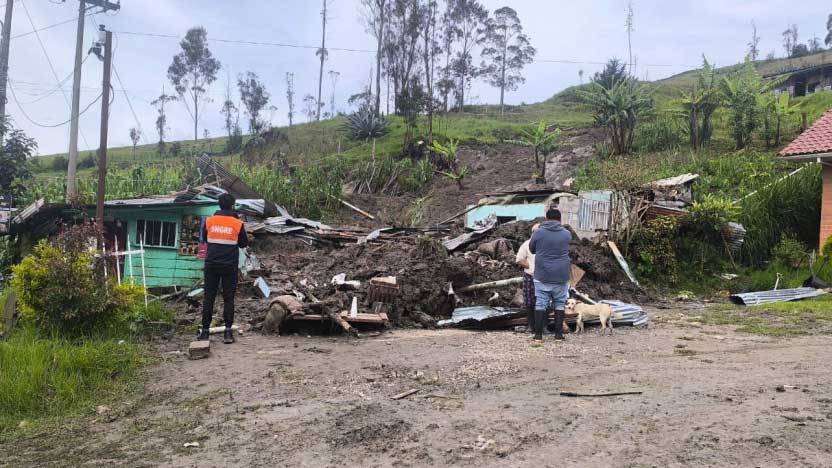
Government moves from a regional alert to a national emergency as flooding, landslides, and river overflows intensify.
Ecuador’s government has expanded its response to the winter crisis by declaring a 60-day national emergency as relentless rains continue to batter the country, leaving deaths, damaged infrastructure, flooded cities, and growing pressure on local authorities already struggling to keep pace.
The measure, issued by the National Risk Management Secretariat at midnight on March 12th, 2026, broadens to the entire country a set of emergency actions that had previously been applied only to a limited group of provinces. Officials said the decision was taken after a review of the damage caused by the rainy season and is intended to accelerate the state’s ability to respond to the mounting effects on people, roads, public services, and livelihoods.
The new declaration comes after weeks of worsening weather conditions that have touched every province in the country. From January 1st through March 12th, authorities recorded 1,662 rain-related emergencies, affecting all 24 provinces, 190 cantons, and 590 parishes.
A season of nationwide damage
The scale of the rainy season has turned what began as a regional crisis into a national one. Floods and landslides have emerged as the most common threats, together accounting for the great majority of reported emergencies. The toll has included 11 deaths, 24 injuries, and thousands of people affected across Ecuador.
The damage has extended well beyond homes and families. Authorities have reported destroyed housing, major impacts on schools and health centers, collapsed bridges, and roughly 35 kilometers of damaged roads. The figures reflect how the winter season is not only displacing residents but also straining critical infrastructure and public services in multiple regions at once.
Government officials said the effects have now been recorded in 100% of the provinces and in more than 85% of the country’s cantons, underscoring the breadth of the emergency and the difficulty of containing it through localized measures alone.
What the emergency declaration changes
The national emergency activates faster-response mechanisms that allow authorities to move public resources more quickly and cut through the delays of ordinary procurement procedures. In practical terms, that means the state can directly contract goods and services tied to immediate disaster response without going through longer bidding processes.
That flexibility can be used for actions such as bringing in heavy machinery to clear mud and debris, repairing damaged roads, installing temporary drainage systems, purchasing food and water for affected families, and setting up shelters for displaced residents.
The decree also requires institutions at different levels of government to coordinate their actions more closely in the affected territories. Provincial and cantonal emergency committees have been instructed to prioritize early warning systems, organize evacuations in areas at risk, deploy first-response teams, assess immediate needs, and ensure humanitarian assistance and temporary shelter where necessary.
Municipal and provincial governments are also being pressed to strengthen their own response capacity in order to protect lives, infrastructure, and essential services. At the same time, national monitoring of rainfall and related threats is to continue on a permanent basis, with authorities leaving open the possibility of further adjustments if conditions deteriorate.
The measure also opens the door to international support. The government has asked the Foreign Ministry to manage and channel international cooperation mechanisms if the emergency requires outside assistance.
From eight provinces to the entire country
Before this week’s decision, the government had already declared a regional emergency on February 26th, 2026, covering eight provinces that were among the hardest hit by the rains: Guayas, Santa Elena, Esmeraldas, Manabí, Los Ríos, Loja, El Oro, and Chimborazo.
That earlier measure was based on technical assessments warning that rainfall was increasingly affecting both the population and basic infrastructure. But as the number of incidents spread across the rest of the country, officials opted to replace the regional declaration with a national one, effectively extending the same emergency framework to all of Ecuador.
The decision reflects the government’s conclusion that the crisis can no longer be treated as a cluster of isolated local emergencies. Instead, it now demands a nationwide response involving central government agencies, local authorities, emergency committees, and technical monitoring institutions.
Rivers still rising
Even as the national emergency was declared, warning signs remained visible across several provinces. As of March 13th, authorities reported 28 rivers overflowing their banks in Guayas, Los Ríos, and Azuay. Another 28 rivers in Azuay, El Oro, and Chimborazo were showing rising flow levels, raising the risk of more flooding in the days ahead.
That danger has been compounded by forecasts from the National Institute of Meteorology and Hydrology, which warned that heavy rains could continue through March. Continued downpours increase the likelihood of additional landslides, swollen rivers, and road interruptions, especially in areas already saturated by weeks of rain.
The persistence of the weather threat is one reason authorities say the emergency declaration is as much about prevention as response. Officials want local governments and emergency committees to act before more communities are cut off or additional infrastructure fails.
Babahoyo shows the urgency
One of the clearest examples of the crisis unfolded in Babahoyo, the capital of Los Ríos province, where heavy rains on the morning of March 13th triggered serious flooding in several sectors of the city.
According to preliminary reports, floodwaters entered the facilities of EMSABA, where the electrical panels used to activate the canton’s drainage pumps are located. Because of the flooding, the pumps could not be turned on for safety reasons, leaving accumulated water trapped in several parts of the city.
Flooding was reported in streets near Avenida Universitaria, one of Babahoyo’s main thoroughfares, as well as outside key public institutions including the IESS hospital, the Lucha Obrera health subcenter, ECU 911, and the fire station.
Initial assessments indicated that 100 families and 100 homes were affected, along with two public assets and 500 meters of roadway.
Mayor Gustavo Barquet described the situation as catastrophic and said authorities would have to wait for the rains to ease and the water level to drop before the city could safely restart the drainage system. Once conditions allow, municipal crews plan to send medical brigades into affected areas, distribute food rations, and carry out fumigation work aimed at preventing disease outbreaks after the floodwaters recede.

0 Comments