
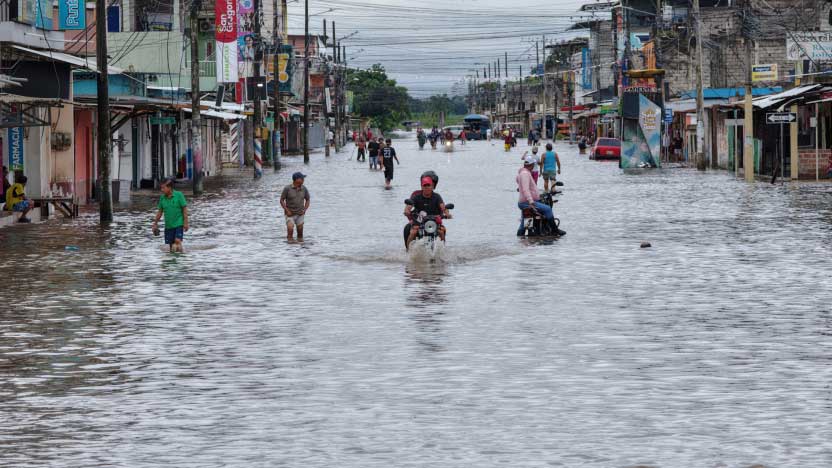
Severe flooding and landslides disrupt daily life nationwide as authorities warn rains will persist into early March.
Heavy winter rains have pushed Ecuador into a nationwide emergency response, with more than 19,000 people affected, widespread infrastructure damage, and eight provinces placed under a 90-day state of emergency as authorities scramble to contain flooding, landslides, and overflowing rivers.
According to data compiled by the National Risk Management Secretariat, intense rainfall between January 1st and February 26th has triggered 1,079 adverse weather events across all 24 provinces, underscoring the breadth of a winter season that has already claimed three lives and injured at least 13 others. Homes, bridges, schools, and health facilities have been damaged or destroyed, while entire communities have faced evacuations as rivers continue to rise.
Red alerts and mounting damage
Six provinces remain under red alert due to the severity of the impacts, while another 15 are on orange alert. The most affected areas include Guayas, Esmeraldas, El Oro, Los Ríos, Chimborazo, Manabí, Loja, Santa Elena, and Zamora Chinchipe, with the coastal region bearing the brunt of the rainfall.
Authorities report 369 floods and 422 landslides so far this year, along with dozens of sinkholes, mudslides, erosion events, and windstorms. At least 4,965 homes have been affected nationwide, 55 of them destroyed outright. Eleven bridges have suffered damage and another 10 have collapsed, cutting off road access in several cantons and complicating emergency response efforts.
The human toll has been particularly visible in low-lying coastal communities, where stagnant floodwaters lingered for days. In the canton of Milagro, in Guayas province, flooding was so severe that a public hospital was forced to suspend outpatient services. In neighboring Los Ríos, sections of the E25 highway between Jujan and Babahoyo were submerged, effectively turning a major transport artery into a shallow lagoon.
Schools and health centers hit hard
The rains have also taken a heavy toll on public services. A total of 263 educational units have been affected nationwide, with 224 suffering functional impairment that has interrupted classes or limited basic services, even where buildings were not completely destroyed. Thirteen health centers have been damaged, compounding the strain on communities already dealing with displacement and sanitation challenges.
In the highlands, particularly in Loja and Chimborazo, the impact has come in the form of landslides and sinkholes that have opened beneath roads and near homes, forcing families to evacuate and increasing the risk of further collapses if the rains continue.
State of emergency and government response
On February 27th, the National Emergency Committee declared a 90-day state of emergency in eight provinces: Guayas, Manabí, Esmeraldas, Los Ríos, El Oro, Santa Elena, Loja, and Chimborazo. The measure activates all levels of government in the affected territories and authorizes them to redirect resources toward emergency response, recovery, and mitigation efforts.
The declaration outlines 14 specific actions, including coordination among national, provincial, and municipal authorities, reinforcement of local response capacity, and accelerated implementation of flood-prevention measures. Municipalities and prefectures have been instructed to strengthen their ability to respond within their areas of responsibility, particularly through infrastructure maintenance and risk-reduction projects.
One of the most urgent measures is the activation of river dredging plans, long requested by the Risk Management Secretariat, to reduce the risk of rivers overflowing during peak rainfall. National authorities have also called on all public sector entities involved in the emergency to allocate sufficient resources to support affected populations.
Humanitarian aid and temporary shelters
As flooding and landslides continue, the government has expanded humanitarian assistance. Two temporary shelters have been opened in Santa Rosa and Milagro, currently housing 314 people displaced by rising waters and damaged homes. Emergency teams have delivered thousands of aid kits to affected communities, including food, hygiene, and first-response supplies.
So far this year, 4,193 first humanitarian response kits, 1,716 personal hygiene kits, and 1,173 food kits have been distributed, mainly in Guayas, Esmeraldas, and El Oro. Additional supplies have included cleaning kits, beds, blankets, sleeping kits, and dishware. In total, aid has reached more than 13,000 people, though authorities acknowledge the assistance is temporary as long as heavy rains persist.
According to official specifications, first-response food kits are designed to sustain a family of four for up to three days, while supplementary kits can last up to 15 days. Despite this, nearly 78% of the kits distributed so far have been the shorter-term first-response packages, reflecting the rapid pace at which new emergencies continue to emerge.
Agriculture and rivers under pressure
The impact of the rains has extended beyond urban areas. Fifteen rivers in Guayas and Los Ríos have overflowed, causing the loss of at least 135 hectares of crops and damaging another 664 hectares, raising concerns about food security and economic losses for small farmers.
Meteorological authorities warn that the situation is not yet over. Forecasts indicate that rains will continue until at least March 2nd, particularly along the coast, while the highlands can expect localized but intense precipitation. Officials are urging residents in vulnerable areas to remain alert to the risk of flooding, landslides, electrical storms, and strong gusts of wind as Ecuador’s winter season continues to test the country’s emergency response capacity.

0 Comments