
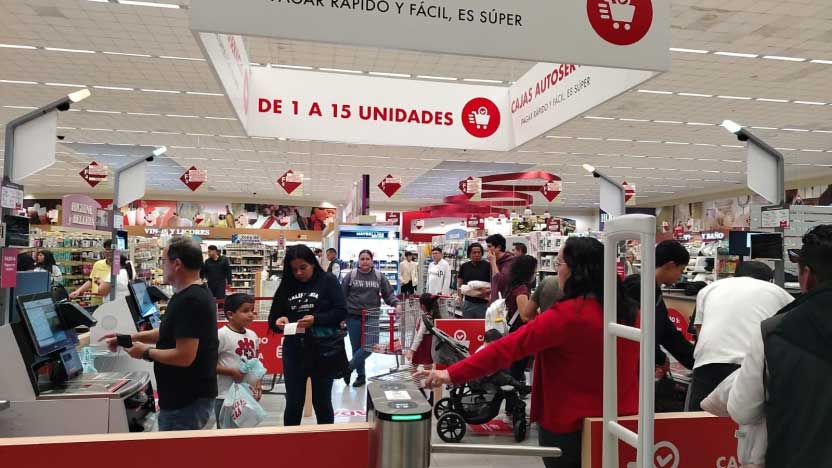
While other countries retreat from cashier-less shopping, Corporación Favorita moves forward with a new tech-forward approach in Ecuador.
Despite mixed global results and consumer skepticism abroad, Ecuador’s largest supermarket conglomerate, Corporación Favorita, is forging ahead with self-checkout systems in its Megamaxi stores, betting on technology to reduce lines and boost customer satisfaction.
The company recently unveiled its new “Scot Zone” areas at select high-traffic Megamaxi locations, enabling shoppers to scan and pay for up to 15 items without the assistance of a cashier. The move comes after weeks of pilot testing and reflects what the company describes as a commitment to modernize the shopping experience.
“By offering customers the option to check out independently, we’re not only improving efficiency but also aiming to reduce the number of abandoned purchases caused by long lines,” the company said in a statement. Corporación Favorita also noted that Scot Zones help reduce the use of resources like paper, and promote a more streamlined, low-contact experience—features particularly appealing to younger shoppers accustomed to using technology.
Although the company has not disclosed the exact financial investment behind the new system, it emphasized that both the hardware and software were custom developed. The terminals are equipped with modern payment options, including smartwatch and smartphone compatibility, in line with the habits of digitally fluent consumers.
Rolling Out Slowly, But Intentionally
The initial implementation includes only a portion of checkout stations—roughly 20%—at select locations. These were chosen based on customer volume, with the company stating that it will closely monitor usage before expanding to more stores in its network. Corporación Favorita operates over 550 commercial outlets across Ecuador and abroad, with major supermarket brands like Supermaxi, Megamaxi, Akí, and Titán under its belt. As of 2023, it employed more than 12,000 people and posted revenues of $2.48 billion.
This push toward self-checkout mirrors earlier initiatives by other Ecuadorian chains. Tiendas Industriales Asociadas, better known as Tía, introduced its first self-checkout system back in 2018 at its Ciudad Celeste store in Guayaquil. Today, Tía has rolled out 98 of these counters across 39 locations. According to Telmo Salazar, the company’s IT Infrastructure Manager, self-checkout now accounts for about 8% of total receipts at stores where the system is available.
“Self-checkout helps ease congestion at traditional registers and has improved the overall speed of the purchasing process,” Salazar said.
A Global Trend in Reverse
While Ecuador’s major retailers seem bullish on cashier-less technology, the story abroad is more complicated. In France, major supermarket chains like Auchan and Leclerc have begun to question the long-term viability of self-checkout. According to a report by Infobae, the promise of faster service and reduced payroll expenses has largely fallen short due to high levels of theft and the continued need for staff intervention when customers encounter technical difficulties.
Similar concerns are surfacing in Spain. El Cronista recently reported growing dissatisfaction among customers at Eroski, a chain that adopted self-checkout with the hope of modernizing its stores. Instead, shoppers have complained about the lack of human interaction, particularly those making large purchases or unfamiliar with the machines. In some cases, sales have reportedly declined as a result.
Despite these international red flags, Corporación Favorita remains optimistic. Executives say the system is not designed to replace human cashiers altogether but to give customers more choice in how they shop and pay. It’s a calculated step toward modernization, not a wholesale leap.
A Different Equation for Ecuador
Unlike in Europe, where labor costs are significantly higher and customer expectations around service differ, Ecuadorian retailers may be facing a different cost-benefit equation. With rising urban populations, increased tech adoption, and more competition in the grocery sector, companies like Corporación Favorita and Tía appear willing to embrace innovations that offer flexibility, even if they come with some growing pains.
In the end, the success or failure of Ecuador’s self-checkout experiment may depend less on how it compares to Europe or North America—and more on whether local consumers are ready to make the transition. For now, the scanner is in their hands.

0 Comments