
Government pledges aggressive actions in nine provinces, but analysts warn of limited resources and political rhetoric.
Military strategy enters new stage
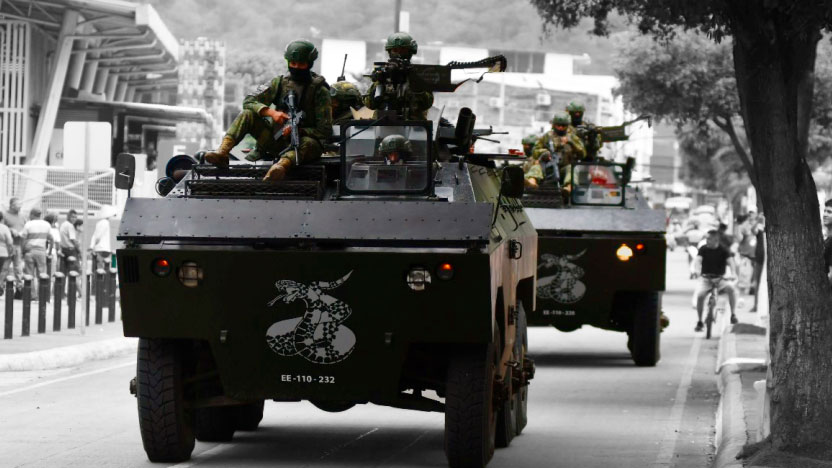
Ecuador’s Armed Forces have outlined a new strategy that places the elimination of organized crime leaders at the top of their priorities. The shift, announced on September 10th by the Ministry of Defense, comes just days after President Daniel Noboa appointed a new military high command. Officials describe this as the “new phase of the war” against criminal groups that have expanded their control across the country.
The Joint Command, led by General Henry Delgado Salvador, pledged “jail or hell” for gang leaders, promising immediate action. The new plan rests on three pillars: expanding territorial control and launching direct offensives, strengthening intelligence and special operations, and neutralizing high-value targets. Nine provinces—Guayas, Los Ríos, Manabí, El Oro, Carchi, Sucumbíos, Orellana, Zamora, and Morona Santiago—have been designated as priorities for intensified operations.
Targets and priorities
Military actions will focus on dismantling the leadership structures of groups such as Los Lobos, Los Choneros, Comandos de la Frontera, Frente Oliver Sinisterra, Comuneros del Sur, and Los Tiguerones. Additional objectives include shutting down illegal mining operations, destroying smuggling networks, and tightening control over weapons and explosives. The Armed Forces also pledged zero tolerance for corruption within their own ranks, framing the strategy as both an external offensive and an internal purge.
High-security prisons, which have become strongholds for gangs, will remain under strict military oversight. According to Delgado, the immediate goal is to disrupt criminal economies tied to narcotrafficking, illegal fuel trade, and contraband.
U.S. support and drone funding
International cooperation features prominently in this new phase. During a visit to Quito on September 4th, U.S. Secretary of State Marco Rubio announced $6 million in funding for drones for the Ecuadorian Navy, in addition to $13.5 million for broader security initiatives. The drones will be used in drug interdiction operations both in national waters and in coordination with U.S. forces abroad.
The Defense Ministry has hinted that air strikes against “illegal camps” could be part of future operations, drawing comparisons to Colombia’s campaigns against guerrilla and cartel targets in previous decades.
Questions over capacity and resources
Despite the strong rhetoric, experts caution that Ecuador’s ability to implement such an ambitious military campaign remains uncertain. In the first seven months of 2025, the Ministry of Defense executed just 10.66% of its investment budget—around $29 million of the planned $272.5 million. Analysts argue that without significant new funding, the government may struggle to sustain expanded operations.
Renato Rivera of the Global Initiative Against Organized Crime noted that the “new phase” largely resembles past strategies. “The doctrine hasn’t changed,” he said. “This seems like a political message to boost confidence in new leadership rather than a true shift in the operational model.” Rivera emphasized that any meaningful change would require integration into the 2026 budget cycle.
Human rights concerns
Human rights advocates warn that the aggressive rhetoric risks deepening abuses by security forces. Valeska Chiriboga of the Permanent Committee for the Defense of Human Rights criticized the plan as “a heavy-handed discourse” that could increase cases of forced disappearances and extrajudicial executions attributed to state agents. She argued that without parallel investment in social and preventive policies, militarization alone cannot resolve the country’s security crisis.
“The measures announced are not new,” Chiriboga added. “The real question is why they weren’t applied before—and what prevents them from being effective now.”

0 Comments