
Agreement removes tariff pressure from key exports while sharpening Noboa’s confrontation with Rafael Correa.
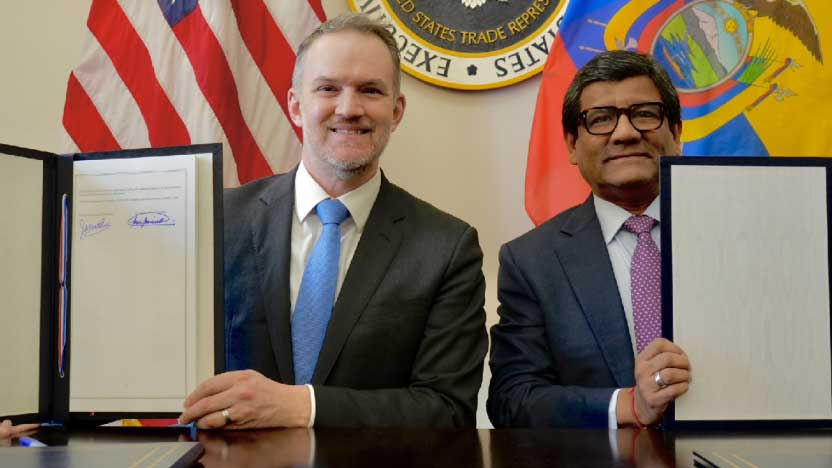
Ecuador and the United States signed a Reciprocal Trade Agreement in Washington on Friday, March 13th, in a move the Noboa government says will ease pressure on major export sectors and deepen trade ties with the country’s most important foreign market. The agreement, signed at the headquarters of the Office of the United States Trade Representative, is expected to exempt 53% of Ecuador’s non-oil exports to the U.S. from the tariff surcharge that has weighed on shipments since April 2025.
According to Ecuador’s Ministry of Production and Foreign Trade, the products covered by the agreement represented $2.786 billion in annual exports based on 2025 figures. The government described the signing as an important step toward more predictable trade conditions with the United States, while U.S. officials said the accord would also open Ecuador’s market more broadly to American agricultural and industrial goods.
Tariff relief for major sectors
The agreement was signed by Production Minister Luis Alberto Jaramillo and U.S. Trade Representative Ambassador Jamieson Greer. In comments released after the event, Greer said the pact would expand market access for U.S. farmers and manufacturers while strengthening bilateral trade and investment.
For Ecuador, the immediate significance lies in the range of export sectors that will gain relief from the surcharge. Government officials said the agreement covers flowers, fish products and related preparations, strategic minerals including gold and copper, processed agro-industrial goods, industrial manufactures, and products from the forestry and timber sector.
Some agricultural exports had already caught a break months earlier. In November 2025, the United States removed the surcharge for a group of products regardless of origin, benefiting Ecuadorian bananas, plantains, cacao, coffee, pitahaya, pineapple, and mango. Under the new agreement, those products remain in a more favorable position and are joined by additional sectors that had continued facing the extra tariff burden.
The Ministry of Production said the broader goal is to strengthen Ecuador’s place in its main export destination while giving producers greater certainty after nearly a year of shifting trade rules.
When the agreement takes effect
Although the agreement has now been signed, it will not be implemented immediately. Ecuadorian authorities said it will enter into force only after both countries complete their internal ratification procedures. The ministry said that process is expected to be finished around August, assuming both governments move through their respective approval steps on schedule.
That timeline matters because exporters are still dealing with a separate temporary tariff measure now in force in the United States. Since February 24th, 2026, a new 10% surcharge has applied to 47% of Ecuador’s exports to the U.S. That measure is set to last 150 days, or about five months, meaning it runs into July unless extended.
Officials in Quito said the U.S. government is expected to use that period to determine how the new trade conditions will be put into practice once the agreement becomes active.
Shrimp still left outside the relief
Even with the new pact, not all Ecuadorian exports are escaping the latest surcharge. Among the products still affected is shrimp, the country’s leading export to the United States and one of the most important pillars of Ecuador’s external trade.
That remaining exposure highlights both the importance and the limits of the agreement. It delivers relief to a large share of non-oil exports, but it does not fully resolve trade tensions for every sector. For exporters left outside the exemption list, the temporary 10% tariff remains a pressing concern.
The recent trade turbulence has unfolded against a shifting legal backdrop in the United States. The newer surcharge followed a decision by the U.S. Supreme Court declaring earlier so-called reciprocal tariffs illegal. President Donald Trump then ordered the current temporary tariff under Section 122 of the Trade Act of 1974, which allows the president to impose short-term import restrictions of up to 15%.
A vital market for Ecuador
The United States remains Ecuador’s most important export destination, and the figures from 2025 show why the agreement drew such close attention from government and business leaders. Ecuador exported $6.83 billion to the U.S. last year, a 2% decline from the previous year, largely because of lower oil exports.
At the same time, non-oil exports surged. Those shipments reached $6.57 billion in 2025, up 30% compared to 2024, underscoring the growing importance of manufactured goods, processed products, agriculture, mining, and other non-petroleum sectors in Ecuador’s trade relationship with Washington.
On the import side, the agreement is also expected to reduce costs for Ecuadorian businesses. Officials said agricultural machinery, industrial equipment, and construction machinery from the United States could enter Ecuador with zero tariffs once the accord takes effect or within short transition periods. Tariffs on industrial parts, components, and inputs are also set to fall, a change the government says should lower production costs for local companies.
Business groups welcome the accord
Representatives of Ecuador’s private sector quickly lined up behind the agreement. Juan Carlos Navarro, president of the Ecuadorian Business Committee, attended the signing ceremony and described the sector’s presence as a sign of support for Ecuador’s effort to deepen its integration into international trade.
The Quito Chamber of Commerce also welcomed the pact, saying it would create clearer and more predictable conditions for commerce and help expand opportunities for Ecuadorian companies. For exporters and importers alike, predictability may prove as valuable as the tariff cuts themselves after months of uncertainty over which products would be penalized and for how long.
Negotiations leading to the agreement lasted nine months and went through eight rounds before concluding in mid-February 2026. That drawn-out process reflected both the political sensitivity of the trade relationship and the practical urgency of securing relief for Ecuadorian exporters facing additional costs in the U.S. market.
Trade deal triggers political firestorm
What might otherwise have stood as a straightforward economic announcement quickly turned into a political fight. Shortly after the signing, President Daniel Noboa used social media to frame the agreement as proof that his government had chosen action over passivity.
He said Ecuador had faced two options: stay still or go out and seek better conditions, and that his administration had chosen the latter. He argued that the agreement would strengthen productive sectors that already sustain thousands of jobs and open the door for more Ecuadorian goods to enter the U.S. market.
Former President Rafael Correa answered the following day from Belgium, accusing Noboa of handing the country over to U.S. interests. The response set off a new round in the long-running public battle between the current president and the former leader who remains one of the most polarizing figures in Ecuadorian politics.
Noboa shot back with a message of his own, saying Ecuador had been opened to trade, investment, and employment, not surrendered. He then escalated the exchange into a personal attack, accusing Correa of having handed the country to drug traffickers and declaring that the former president’s time was running out.
The clash turned a trade announcement into another front in Ecuador’s political war, linking a technical tariff agreement to the larger battle over the country’s economic direction, its international alliances, and the legacy of the Correa era.

0 Comments